
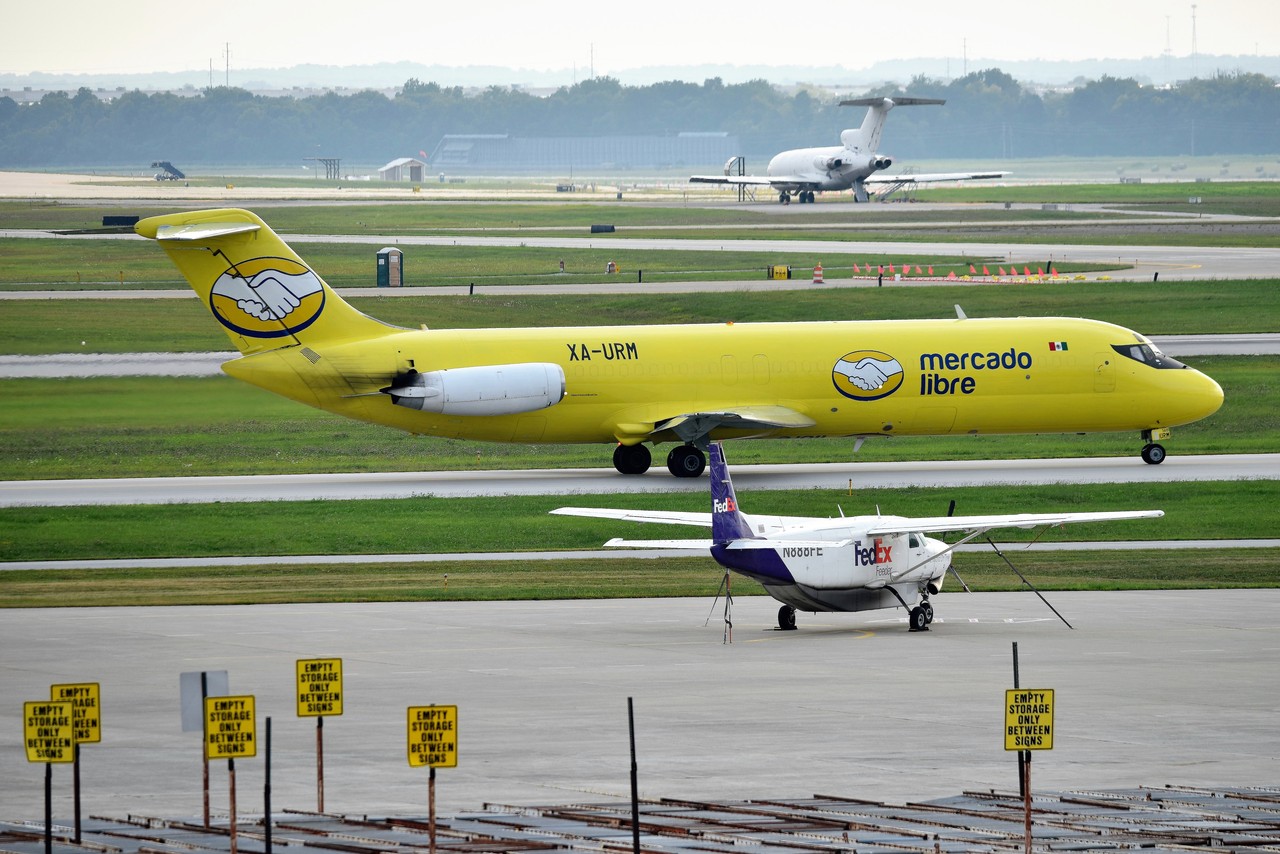
Service History
The DC-9-30 transformed American regional aviation by enabling jet service to 98% of U.S. airports, including smaller cities that had never experienced turbine-powered passenger service. Delta Air Lines launched the DC-9 family into service on December 8, 1965, with its inaugural aircraft nicknamed Delta Prince operating seven flights on its first day from Hartsfield-Jackson Atlanta International Airport to Kansas City via Memphis. The DC-9-30 variant specifically targeted the critical short- to medium-haul market segment, where 60% of U.S. passenger traffic occurred in 1965, replacing aging propeller aircraft like the DC-6, DC-7, and Convair 440.
Northwest Airlines emerged as another major operator, utilizing the DC-9-30 as a reliable workhorse for nearly two decades. The type's ability to operate from shorter runways while delivering jet speeds and passenger comfort made it invaluable for connecting smaller markets to major hub airports, fundamentally changing the economics of regional air travel.
The Manufacturer
Douglas Aircraft Company, founded in Santa Monica, California, on July 27, 1921, by Donald Wills Douglas Sr., originally developed the DC-9 family. Design studies for the aircraft, initially designated Douglas Model 2086, began in 1962, with project approval coming on April 8, 1963. The company manufactured the aircraft at its Long Beach, California facility, a 1.4 million square foot plant adjacent to Daugherty Field that had been designed for 24-hour operation during World War II blackouts.
Financial difficulties and delivery delays forced Douglas into a merger with McDonnell Aircraft Corporation in 1967, creating McDonnell Douglas. The merger was announced in January 1967, confirmed by both company boards in March, and approved by Douglas shareholders in April. McDonnell Douglas continued DC-9 production until 1982 before the company itself was acquired by Boeing in 1997, ending the independent existence of the Douglas name.
Engine & Technical Innovation
The DC-9-30 was powered by two Pratt & Whitney JT8D-11 turbofan engines, each producing 15,000 pounds of thrust. These low-bypass turbofans represented cutting-edge technology for regional aircraft in the mid-1960s, offering superior fuel efficiency and reliability compared to contemporary turbojet engines. The JT8D series became one of the most successful aircraft engines ever produced, with over 14,000 units manufactured across all variants.
The aircraft's innovative design featured rear-mounted engines that significantly reduced cabin noise levels compared to wing-mounted configurations, enhancing passenger comfort on short flights. The T-tail design prevented engine exhaust from interfering with control surfaces while optimizing short-field performance capabilities essential for regional airport operations.
Performance Characteristics
The DC-9-30's stretched fuselage measured 119.29 feet in length, accommodating 115 passengers in economy configuration within a cabin 22.79 meters long, 3.12 meters wide, and 2.05 meters high. The aircraft achieved a maximum cruise speed of 485 knots (898 km/h) at altitudes up to 35,000 feet, with a rate of climb of 2,000 feet per minute. Its maximum takeoff weight of 108,000 pounds enabled operations from runways as short as 6,890 feet, while landing distance requirements of just 4,921 feet opened access to numerous regional airports.
The fuel capacity of 3,679 gallons provided a range of 1,500 nautical miles, perfectly suited for the short- to medium-haul routes the aircraft was designed to serve. This performance envelope allowed airlines to replace multiple daily propeller flights with fewer, faster jet services while maintaining schedule frequency.
Production Success
Between 1967 and 1982, McDonnell Douglas produced 662 DC-9-30 aircraft, contributing significantly to the 976 total DC-9s manufactured across all variants. The DC-9-30's production run represented the most successful stretch variant of the original DC-9 design, validating the market demand for higher-capacity regional jets.
The first DC-9 prototype (Series 10, registration N9DC) completed its maiden flight on February 25, 1965, from Long Beach Airport to Edwards Air Force Base, piloted by Chief Engineering Test Pilot George R. Jansem, Program Test Pilot Paul H. Patten, and Flight Test Engineer Duncan Walker. FAA certification followed on November 23, 1965, clearing the way for commercial service.
Legacy and Modern Status
The DC-9-30's design influence extended far beyond its production years, spawning derivatives including the DC-9-80 (later redesignated MD-80, first flight October 1979), MD-90, and eventually the Boeing 717. These evolutionary developments demonstrated the fundamental soundness of the original DC-9 concept and its adaptability to changing market requirements.
As of recent data, approximately 30 DC-9s of all variants remain in active service worldwide, primarily in cargo operations with airlines like Aeronaves TSM and Everts Air Cargo, while African Express Airways continues passenger service. The DC-9-30's pioneering role in establishing efficient short-haul jet travel directly influenced modern narrowbody aircraft design and enabled the hub-and-spoke airline network structures that dominate contemporary aviation.