
Service History
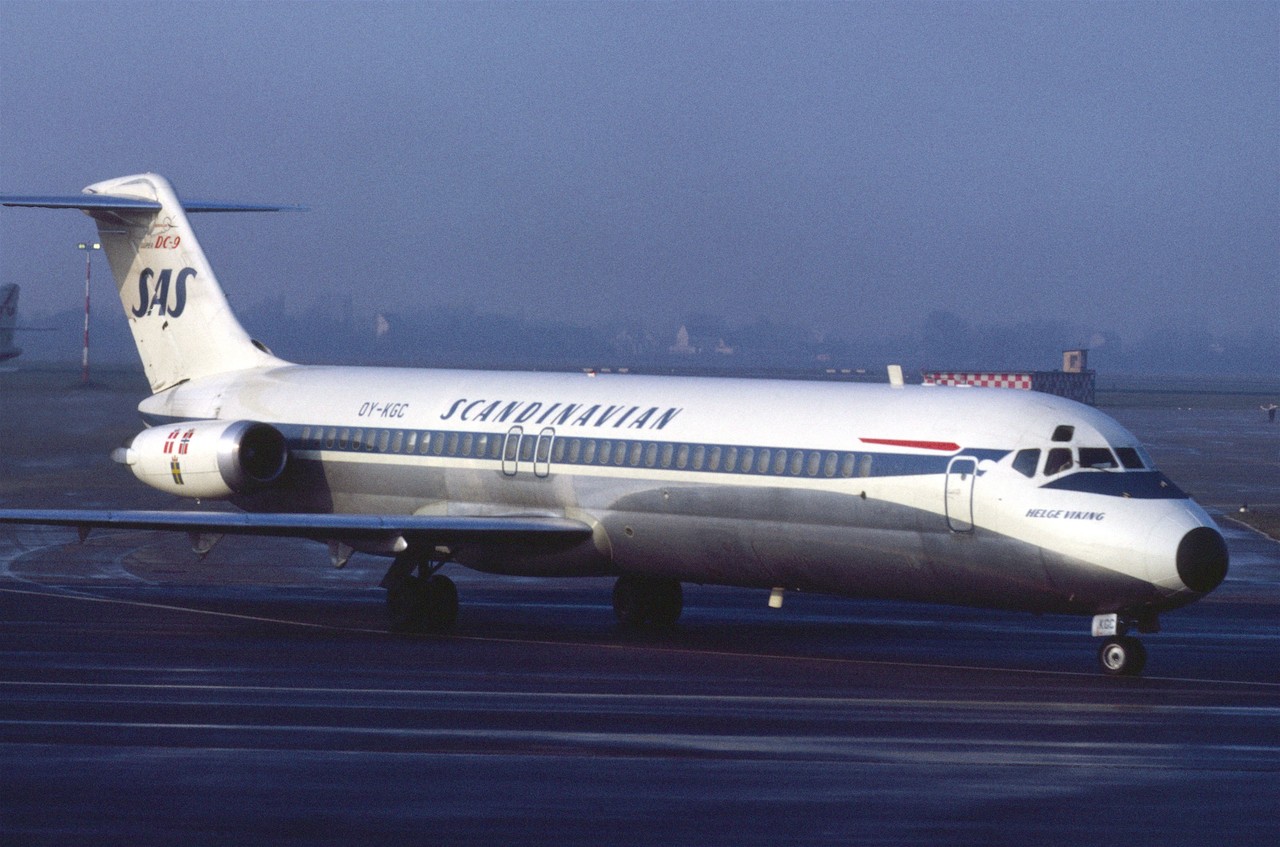
The DC-9-40 entered commercial service in March 1968 with Scandinavian Airlines System (SAS), which had specifically requested the stretched variant to replace their Sud Aviation Caravelles with higher-capacity aircraft. SAS ordered 49 DC-9-40s, making them the launch customer and primary operator of this variant. The aircraft filled a crucial market niche, offering greater passenger capacity than the standard DC-9-30 while maintaining the operational flexibility that made the DC-9 family popular with airlines serving smaller airports.
Northwest Airlines became another significant operator, utilizing the DC-9-40 as a workhorse in their domestic fleet well into the 1990s. Aircraft like N750NW, delivered in August 1991, demonstrated the variant's longevity in commercial service. The DC-9-40's ability to operate from shorter runways while carrying 125 passengers made it ideal for connecting secondary cities to major hubs.
The Manufacturer
Douglas Aircraft Company, founded by Donald Douglas in Santa Monica, California, in 1921, originally developed and manufactured the DC-9 series at their massive 1.4 million square foot facility in Long Beach. This air-conditioned, windowless factory had been designed during World War II for blackout operations and was located adjacent to Daugherty Field. However, Douglas faced severe financial difficulties during the 1960s, losing approximately $1.25 million per DC-9 due to aggressive pricing strategies, production delays, supply chain problems, and the company's focus on Vietnam War military contracts.
The financial crisis led to Douglas merging with McDonnell Aircraft Corporation in 1967, with the merger announced in January, confirmed in March, and approved by shareholders in April of that year. The newly formed McDonnell Douglas continued DC-9 production until 1982, ultimately building 976 aircraft in the entire DC-9 family. McDonnell Douglas itself was later acquired by Boeing in 1997, and Boeing continues operations today.
Engine & Technical Innovation
The DC-9-40 was powered by two Pratt & Whitney JT8D-17 turbofan engines, each producing between 14,000 and 16,000 pounds of thrust. These reliable, low-bypass turbofans were specifically chosen for their excellent short-field performance characteristics, enabling the aircraft to serve airports that larger jets could not access. The engines mounted on the rear fuselage in a distinctive configuration that became the DC-9 family's signature design feature.
The aircraft's design originated from 1962 studies of the Douglas Model 2086, inspired by the rear-engine configuration of the Sud Aviation Caravelle. The T-tail design placed the horizontal stabilizer high above the wing wake, improving control effectiveness during low-speed operations. The DC-9-40 specifically featured a fuselage stretched by 6 feet 4 inches compared to the DC-9-30, allowing for two additional seat rows while maintaining the same wing and engine configuration.
Performance & Pilot Perspective
The DC-9-40 typically operated with a three-person crew consisting of two pilots and a flight engineer. The aircraft demonstrated impressive performance capabilities, with a maximum cruise speed of 485 knots (898 km/h) and a service ceiling of 35,000 feet. Its climb rate of 3,000 feet per minute allowed for rapid departure from congested airports, while the relatively short takeoff distance of 6,562 feet and landing distance of 4,922 feet provided access to airports with limited runway lengths.
With a maximum takeoff weight of 114,000 pounds and maximum landing weight of 101,998 pounds, the DC-9-40 could carry up to 31,665 pounds of payload while maintaining its 1,200 nautical mile range. The aircraft's approach speed of 131 knots made it manageable for pilots transitioning from smaller aircraft, contributing to its popularity among regional carriers.
Production & Legacy
Exactly 71 DC-9-40 aircraft were manufactured between 1967 and the early 1970s, representing a small but significant portion of the 976-unit DC-9 family production run. The limited production reflected the aircraft's specialized market position, as most airlines preferred either the smaller DC-9-30 or larger variants like the DC-9-50.
The DC-9-40's design principles directly influenced the development of the MD-80 series, with the first DC-9-80 (later redesignated MD-80) flying in October 1979. This evolution demonstrated the adaptability of the original DC-9 concept, which had been designed from the outset for easy scaling to different passenger capacities.
While many DC-9 variants continued flying into the 2000s and beyond, the specific number of DC-9-40s remaining in active service is limited. Some aircraft transitioned to cargo operations or private ownership, but most have been retired as airlines modernized their fleets with more fuel-efficient aircraft. The variant's legacy lies in its role as a stepping stone in the evolution of short- to medium-haul jet aircraft, proving that stretched fuselages could effectively increase capacity without compromising operational flexibility.