
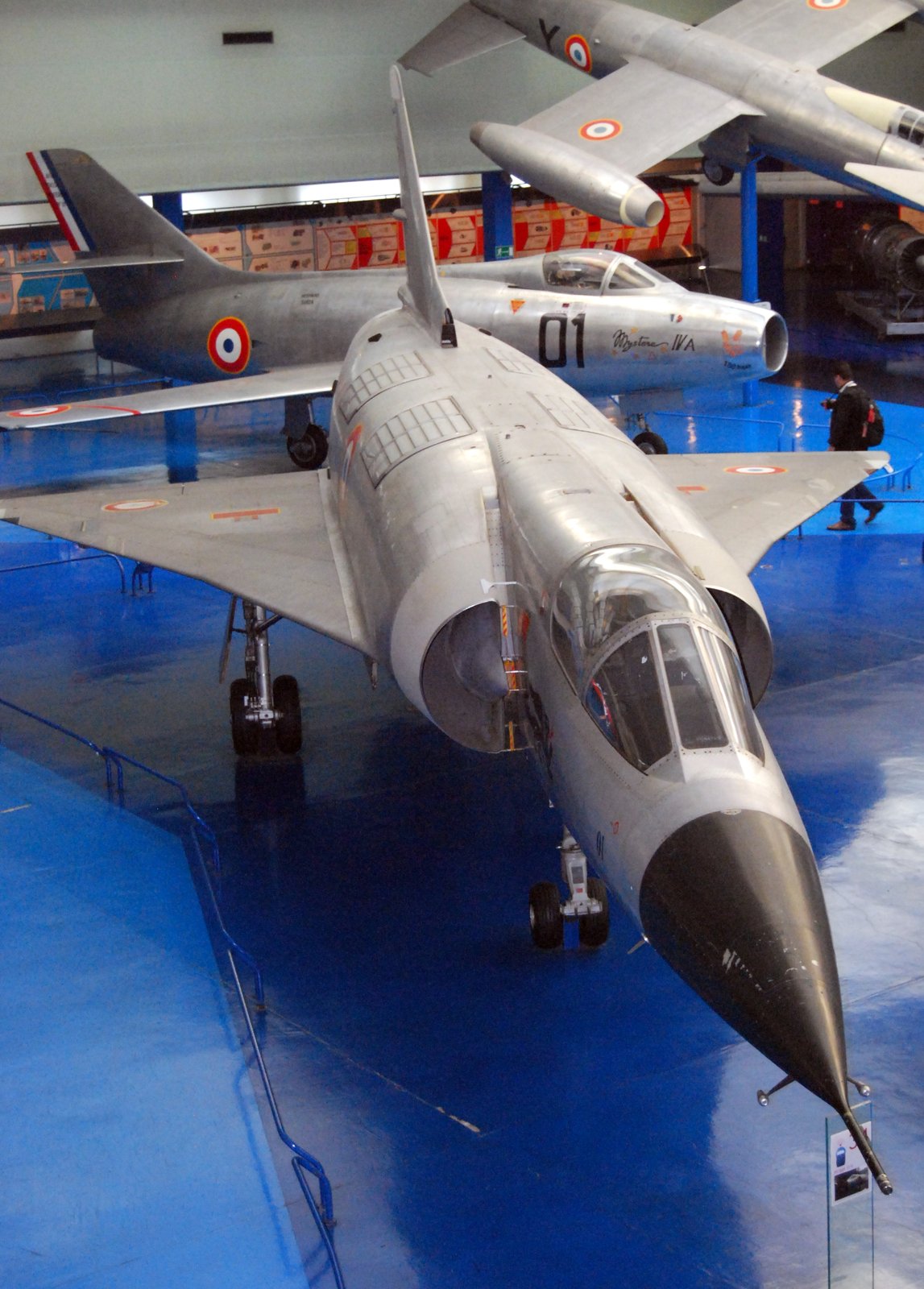
The Dassault Mirage IIIV (also designated Mirage III V) was an experimental supersonic vertical take-off and landing (VTOL) fighter prototype developed in France during the mid-1960s. The project originated from a 1960 French Air Force requirement for a supersonic VTOL aircraft, which was approved in September of that year. On 29 August 1961, the Direction Technique Industrielle de l’Aéronautique (DTIA) officially ordered the design and development of two prototypes. The program was also aligned with NATO Basic Military Requirement 3 (NBMR-3) of 1961, which sought a VTOL strike fighter capable of dispersing to improvised airstrips with a 2,000 lb payload and a combat radius of approximately 250 nautical miles.
Designed and manufactured by Générale Aéronautique Marcel Dassault (GAMD)—the predecessor to the modern Dassault Aviation—the aircraft was led by the corporate leadership of Marcel Dassault. The Mirage IIIV was derived from the Mirage III, utilizing a delta-wing airframe capable of Mach-2 speeds. Its most distinctive feature was a nine-engine propulsion system. For forward flight, it employed a single Pratt & Whitney / SNECMA TF104 afterburning turbofan, which produced 88.26 kN of thrust. For vertical lift, the aircraft utilized eight Rolls-Royce RB162-1 turbojets mounted vertically in pairs around the centerline. These lift engines provided between 15.7 kN and 19.61 kN of thrust each, depending on the version, totaling between 125 kN and 157 kN of lift thrust.
The first prototype, Mirage III V-01, made its maiden flight on 12 February 1965, focusing on conventional flight and subsequent VTOL testing. A second, more advanced prototype, the Mirage III V-02, was later constructed and achieved higher speeds during the test program. Performance figures indicated a maximum speed of Mach 2.04 at altitude, with some projected figures suggesting Mach 2.3 at height and Mach 1.15 at low altitude. The aircraft reached a service ceiling of 18,000 meters and a rate of climb of 150 m/s.
Despite its technical achievements, the program was plagued by complexity. The Mirage IIIV never entered operational service, as it was strictly a testbed and did not carry operational weapons. The program ended abruptly following the crash of the second prototype on 28 November 1966, from which the pilot ejected safely. Dassault and French authorities concluded that the multi-engine VTOL concept was impractical due to severe weight penalties, high fuel consumption, and stability issues during transition. This failure contributed to a shift in NATO's approach toward single-engine vectored-thrust designs, such as the Harrier. No widely documented museum examples of the Mirage IIIV exist today.