
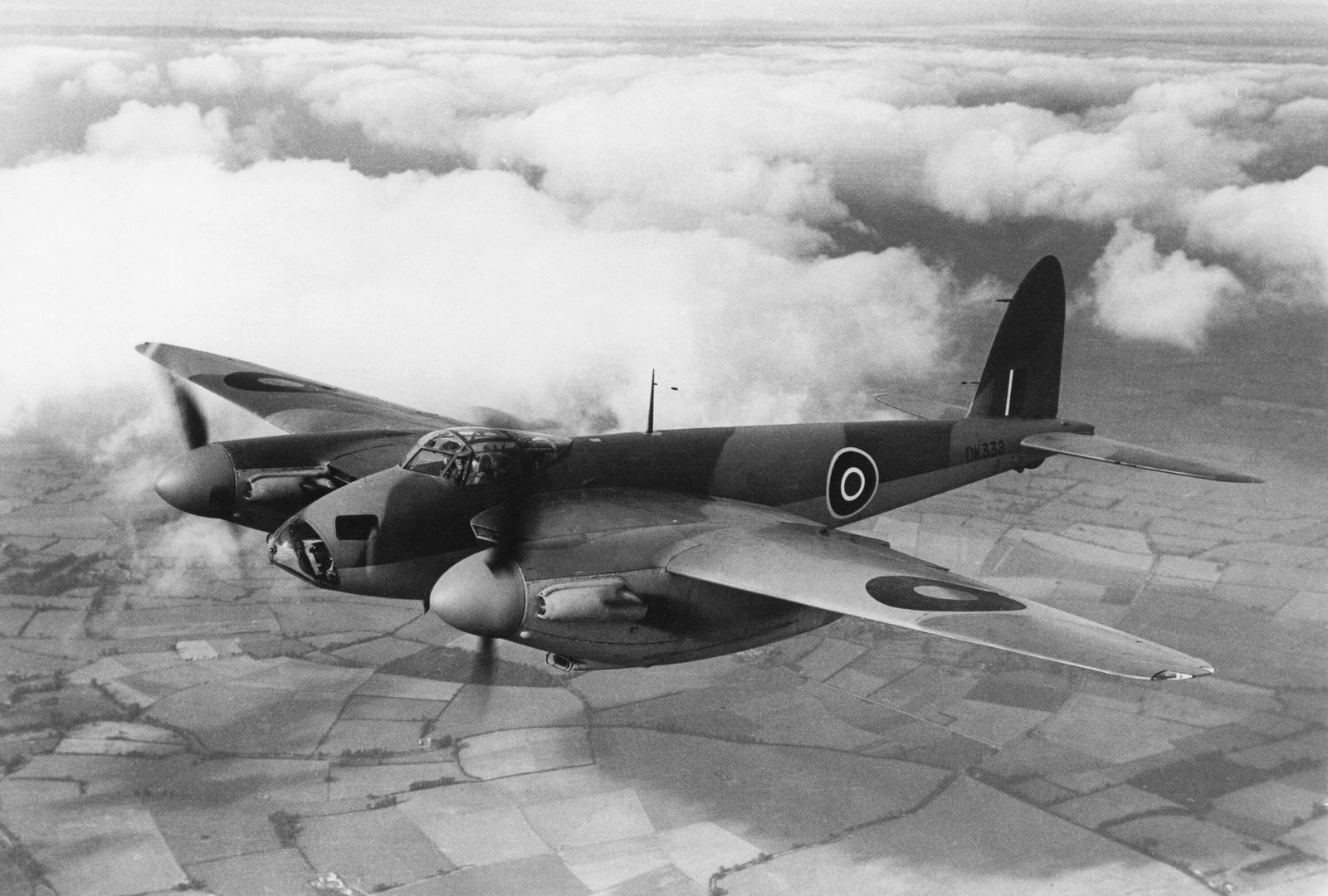
The de Havilland DH.98 Mosquito was a British twin-engine combat aircraft that became one of the most versatile assets of the Second World War. Conceived by Sir Geoffrey de Havilland, the aircraft was designed around the philosophy of an unarmed bomber that relied on high speed and altitude for survivability rather than defensive armament. This concept was initially resisted by the British Air Ministry, but the aircraft eventually proved faster than many contemporary fighters. The prototype, W4050, made its first flight from Hatfield on November 24, 1940.
One of the most distinctive features of the Mosquito was its "Wooden Wonder" construction. To conserve strategic metals like aluminium, the airframe utilized a plywood-balsa-plywood sandwich structure for the fuselage and wooden wings. This allowed the manufacturer to utilize subcontractors from the furniture and piano industries. Production ran from 1941 until late 1950, with a total of 7,781 aircraft built across 43 different marks. Manufacturing took place in the United Kingdom at the de Havilland Aircraft Company's Hatfield site, as well as through licensed production by de Havilland Aircraft of Canada in Toronto, Ontario, and de Havilland Aircraft Pty Ltd in Bankstown, New South Wales.
Power was provided by liquid-cooled, supercharged V-12 Rolls-Royce Merlin piston engines. The prototype utilized Merlin 21 engines producing 1,460 hp each, while later fighter-bomber variants, such as the FB Mk 26, used Merlin 25 engines producing 1,610 hp each. The FB Mk 26 reached a maximum speed of 415 mph and featured a service ceiling of 37,000 ft. Its armament typically included four 20 mm Hispano cannon and four 0.303 in Browning machine guns in the nose, with the ability to carry up to 2,000 lb of bombs and eight 60 lb rockets.
Operationally, the Mosquito served in nearly every combat theater of WWII. Its first operational sortie occurred in September 1941 (cited as either the 17th or 20th) for photo-reconnaissance. It operated as a day/night bomber, pathfinder, night-fighter, and maritime strike aircraft. Notable missions include Operation Jericho on February 18, 1944, a low-level raid on the Amiens prison involving No. 487 Squadron RNZAF, No. 464 Squadron RAAF, and No. 21 Squadron RAF. Primary operators included the Royal Air Force (RAF), Royal Canadian Air Force (RCAF), Royal Australian Air Force (RAAF), and Royal New Zealand Air Force (RNZAF).
Following the war, a small number of aircraft were adapted for civil use as high-speed transports or cargo planes. Today, the original prototype W4050 is preserved at the de Havilland Aircraft Museum, and the Smithsonian National Air and Space Museum holds a B/TT Mk.35. The Military Aviation Museum in the USA operates an airworthy FB Mk 26 (KA114) delivered to the RCAF in February 1945.