
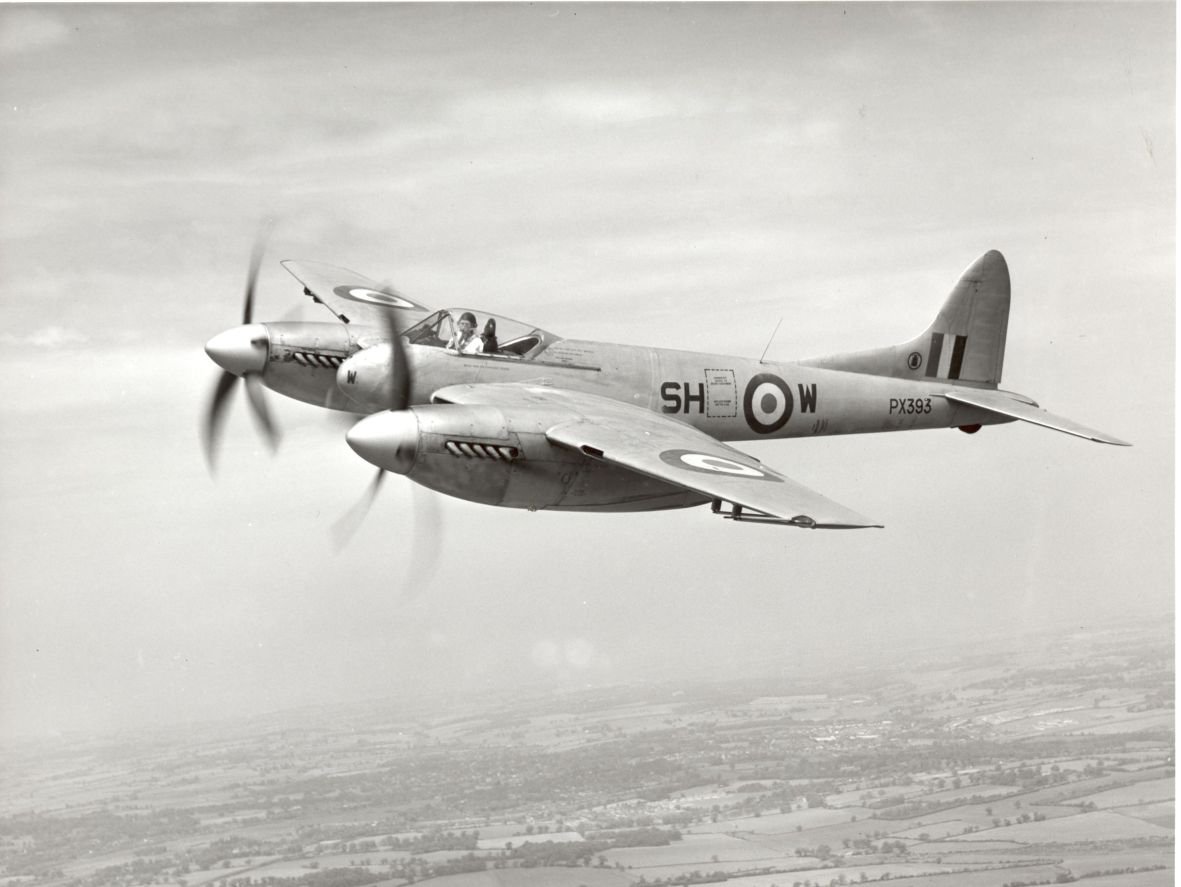
The de Havilland DH.103 Hornet was conceived in 1941 as a private venture by the de Havilland Aircraft Company. Designed as a high-performance, long-range single-seat fighter intended for the Pacific Theatre of World War II, the aircraft utilized a refined plywood semi-monocoque construction derived from the Mosquito. This design was slimmer and more aerodynamically efficient than its predecessor, allowing it to achieve exceptionally low drag. The prototype, serial RR915, first flew on July 28, 1944, at Hatfield.
Technical superiority was achieved through the installation of two Rolls-Royce Merlin 130 and 131 series liquid-cooled V-12 engines, each producing 2,070 hp. To eliminate torque effects, the engines drove four-blade, constant-speed, variable-pitch propellers in opposite-handed (contra-rotating) configurations. These specifications allowed the Hornet to reach a maximum speed of approximately 485 mph (780 km/h) at 22,000 feet during trials at Boscombe Down, marking it as one of the fastest piston-engined fighters ever built.
Production took place between the mid-1940s and 1951, with approximately 383 airframes produced. Initial production occurred at de Havilland's main works in Hatfield, Hertfordshire, while later large-scale production—including 211 aircraft—was handled at the Chester factory in Hawarden. The aircraft entered RAF service in mid-1946, first equipping No. 64 Squadron. Other operators included No. 19, 41, 65, 80, and 152 Squadrons. The RAF utilized the F.1 and F.3 day-fighter variants, as well as the PR.2 photo-reconnaissance version. The Hornet's most significant combat role occurred during the Malayan Emergency in the early 1950s, where it flew over 4,500 operational sorties as a strike fighter, replacing older types like the Bristol Beaufighter and Brigand.
Parallel to the RAF's efforts, the Royal Navy's Fleet Air Arm operated the Sea Hornet. This navalized version featured folding wings, an arrestor hook, and a strengthened rear fuselage. Variants included the single-seat F.20, the two-seat NF.21 night fighter equipped with radar, and the PR.22 reconnaissance aircraft. Sea Hornets served from 1947 until 1957. By mid-1956, all RAF Hornet variants were withdrawn as jet aircraft rendered piston fighters obsolete. Today, the Hornet is considered a "lost" aircraft, as no complete airframes are known to survive in museums or flying condition.