
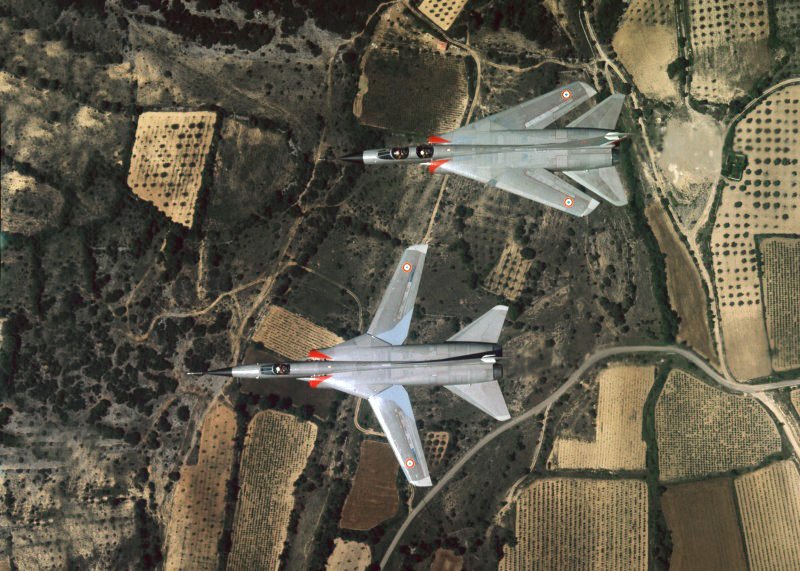
The Dassault Mirage G was a French variable-geometry experimental fighter developed during the mid-1960s to explore the advantages of swing-wing aerodynamics. Tasked by French authorities to develop a high-speed, multi-role combat aircraft, Dassault designed the Mirage G as a derivative of the Mirage F2. The project received official design approval in October 1965, with manufacturing of the sole Mirage G prototype beginning in January 1966. The aircraft made its first flight on November 18, 1967.
Technically, the Mirage G was notable for being the first Dassault aircraft to feature variable-sweep wings, which could be adjusted from 22° in the forward position to 70° when swept aft. This configuration allowed the aircraft to maintain efficient takeoff and landing performance while achieving high-speed supersonic cruise. The original prototype was a single-engine aircraft powered by a Pratt & Whitney turbojet, featuring split semi-circular side inlets located along the cockpit walls. While the original G was a two-seat design, the program later evolved into the twin-engine Mirage G8 prototypes. The G8 variants were powered by two SNECMA Atar 9K50 afterburning turbojets, each producing 49.03 kN of dry thrust and 70.1 kN of afterburning thrust.
The Mirage G8 prototypes, which first flew in 1971 and 1972, were intended as multi-role interceptors for the Armée de l’Air. They featured advanced avionics for the era, including a Thomson-CSF radar and a low-altitude navigation-attack system derived from the Dassault Milan and SEPECAT Jaguar. The G8 achieved a maximum speed of Mach 2.2 (approximately 2,336 km/h), a service ceiling of 18,500 meters, and a range of 3,850 km.
Despite its technical promise, the Mirage G never entered series production. The original program was cancelled in 1968, and the sole Mirage G prototype was lost in an accident on January 13, 1971. Although two G8 prototypes were completed, the French defense budget for 1971–1976 provided no funding for production, leading to the project's abandonment. The program's legacy remains its role as a technology demonstrator; the experience gained in swing-wing structures and high-Mach handling influenced French aerospace engineering, though France ultimately decided that variable-geometry was too expensive and opted for fixed-wing delta or delta-canard designs for subsequent aircraft like the Mirage 2000 and Rafale.