
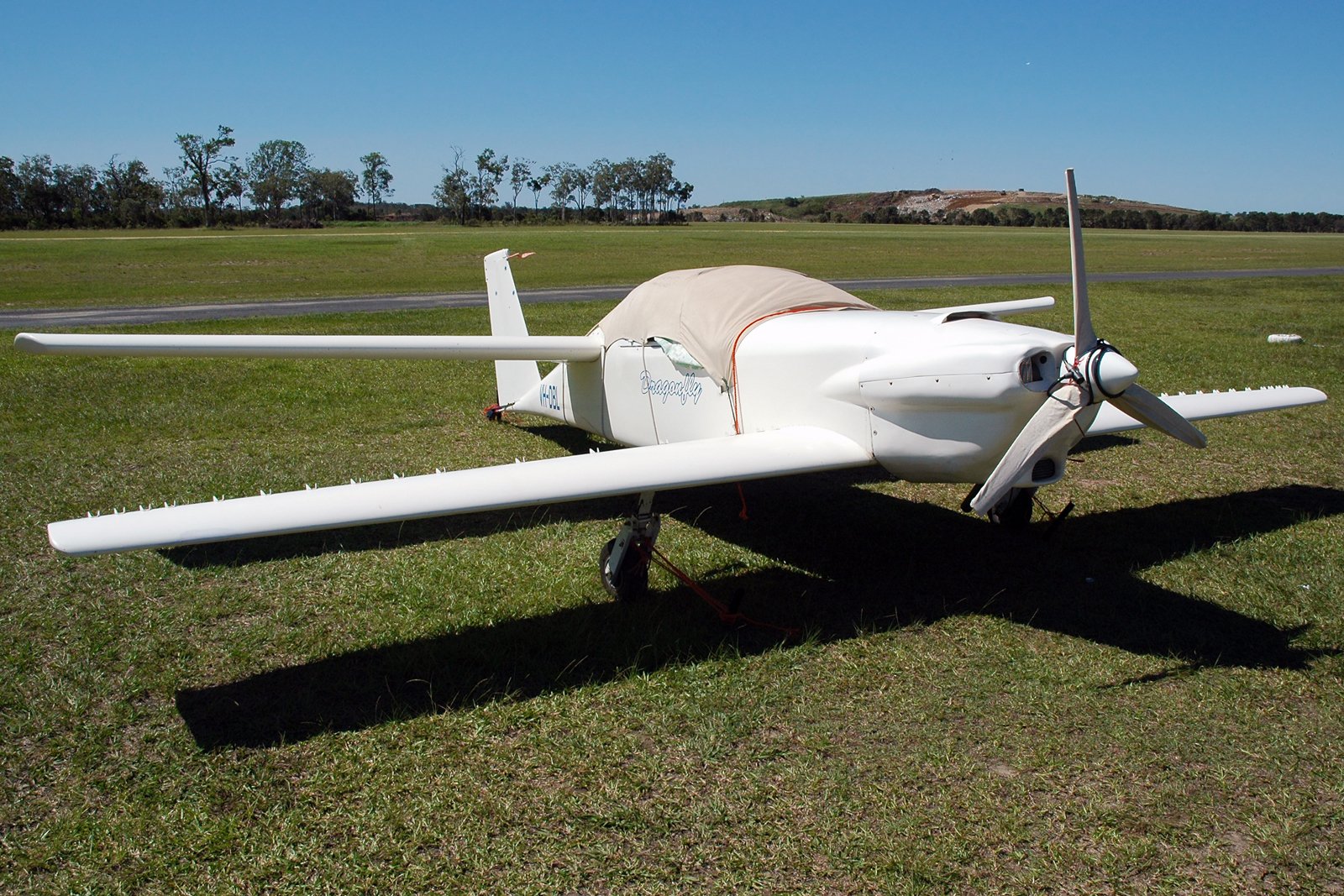
Revolutionary Design Philosophy
Bob Walters, a Navy fighter pilot and aeronautical engineer, conceived the Dragonfly as a direct challenge to expensive aviation. His design objectives centered on creating a genuine high-performance aircraft that ordinary builders could afford to construct and operate. The prototype required just 14 hours of flight testing before Walters confidently flew it to the 1980 Oshkosh AirVenture, where it captured the EAA Outstanding New Design award and stunned the homebuilding community.
The Dragonfly's canard layout provided inherently safe stall characteristics through its forward-mounted elevator, while the main wing's exceptionally low loading of just 11 pounds per square foot delivered gentle handling and short-field capability. Unlike contemporary designs that emphasized speed above all else, Walters deliberately chose larger airfoils to reduce stall speeds and improve docility, making the aircraft accessible to pilots with modest experience.
Manufacturing Success
Viking Aircraft Company, founded by Walters in 1979, initially operated from Elkhorn, Wisconsin, supplying complete kits that builders could assemble in 700 to 1200 hours. The company's remarkable success stemmed from its comprehensive approach – kits included pre-molded composite components, detailed plans, and support for automotive engine conversions that cost a fraction of traditional aircraft powerplants.
In 1983, Walters sold Viking Aircraft to Rex Taylor, owner of HAPI Engines, who immediately upgraded the standard powerplant from the 45-horsepower Volkswagen 1600cc engine to his company's enhanced 60-horsepower HAPI 1835cc conversion. Taylor's engines featured dual ignition systems, electric starters, and optimized cooling, addressing the primary concerns of automotive engine reliability in aircraft applications.
Technical Innovation
The Dragonfly's construction methodology represented a significant advancement in homebuilt aircraft technology. Its foam-core, fiberglass-skinned structure with carbon fiber spars provided exceptional strength-to-weight ratios while remaining within amateur builder capabilities. The 43-inch-wide cockpit accommodated side-by-side seating under a expansive bubble canopy, offering visibility that rivaled purpose-built touring aircraft costing many times more.
Three variants addressed different operational requirements: the Mark I featured main landing gear mounted on wing-mounted outrigger fairings suitable for paved runways, while the Mark II incorporated cantilever gear legs with hydraulic brakes for rough-field operations. The Mark III adopted tricycle landing gear for pilots preferring conventional ground handling characteristics.
Performance Excellence
With its 60-horsepower HAPI engine, the Dragonfly achieved a maximum speed of 168 mph and cruised at 140 mph while consuming merely 3.5 imperial gallons per hour. Its 17,000-foot service ceiling and 500-mile range with reserves provided genuine cross-country capability, while the impressive 14.5:1 glide ratio offered safety margins approaching those of purpose-built gliders.
The aircraft's competition record validated Walters' design philosophy. At the 1983 CAFE 400 efficiency contest, a Dragonfly won the Tom Jewett Memorial Award by demonstrating 48 miles per gallon at 128 mph – performance figures that modern aircraft struggle to match four decades later.
Global Distribution
By 1998, Viking had supplied over 2,000 kits worldwide, with confirmed flying examples exceeding 500 aircraft. Australia emerged as a particularly strong market, with more than a dozen registered examples including VH-LSD, the first Australian-built Dragonfly that flew in November 1984. New Zealand registered ZK-PJM in July 1992, operated by a syndicate until its withdrawal from service in March 2014.
Modern Evolution
Contemporary builders have adapted the basic design to modern powerplants, including 85-horsepower Jabiru 2200 four-stroke engines and Subaru automotive conversions. Dutch researchers at Inholland University developed an electric-powered variant, replacing the traditional piston engine with battery propulsion to explore sustainable aviation technologies.
Legacy and Impact
The Dragonfly's influence extended far beyond its production numbers. It demonstrated that composite construction could be mastered by amateur builders, that automotive engines could provide reliable aircraft propulsion, and that exceptional efficiency remained achievable without sacrificing performance. The design proved particularly significant in democratizing aviation access – builders could construct a genuine touring aircraft for costs comparable to purchasing a used family automobile.
Today, surviving Dragonflies continue flying in private hands worldwide, with notable examples displayed at aviation museums including VH-HIM at Temora, New South Wales. The aircraft's fundamental design principles continue influencing modern kit aircraft, proving that Bob Walters' vision of affordable high-performance aviation remains as relevant today as it was at Oshkosh in 1980.