
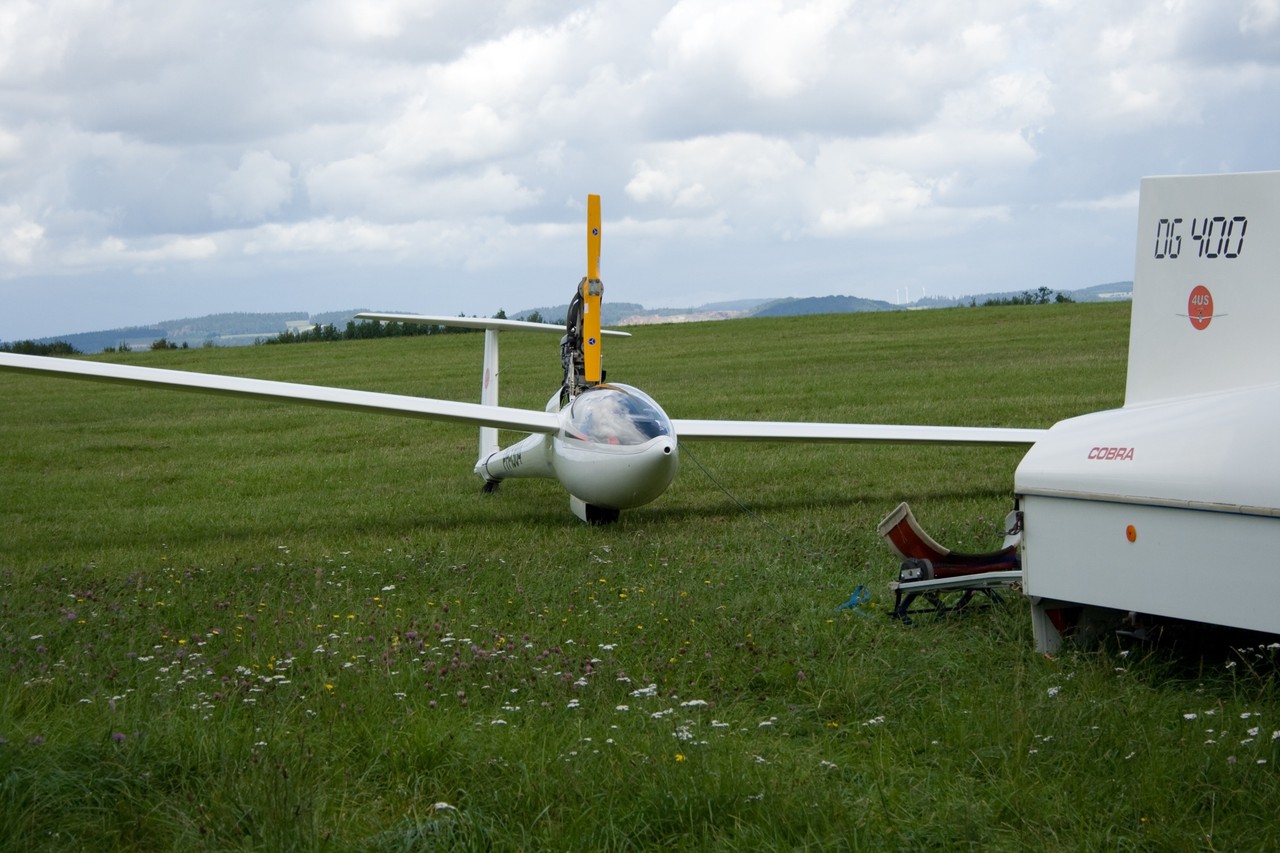
Revolutionary Design Achievement
The DG-400 emerged from a breakthrough in materials technology that transformed motorglider possibilities. By the late 1970s, carbon fiber costs had dropped sufficiently to enable its use in wing spars of high-performance gliders. Designer Wilhelm Dirks recognized that carbon fiber wings offered the span, strength, and remarkably low weight necessary to accommodate a self-launching powerplant without compromising soaring performance in weak thermal conditions.
Dirks based his design on the proven DG-202, utilizing its wings and primary systems while modifying the fuselage with a slightly enlarged tailcone and strategic carbon fiber reinforcements. This approach minimized development risks while maximizing the benefits of the established aerodynamic platform.
The Manufacturer's Legacy
Glaser-Dirks Flugzeugbau GmbH was founded by Gerhard Glaser, who owned a civil engineering business, and Diplom Ingenieur Wilhelm Dirks. The partnership began aircraft production in 1972 with their first glider, the DG-100. The company rapidly established itself as a major producer of high-performance sailplanes and motorgliders, developing a continuous range of aircraft to meet diverse market demands throughout the German soaring community and international markets.
The success of the DG-400 positioned Glaser-Dirks as a pioneering force in motorglider technology, setting standards that influenced the industry for decades. Their innovative approach to combining pure sailplane performance with practical self-launch capability created an entirely new category of recreational aircraft.
Engine and Technical Innovation
The heart of the DG-400's success lay in its powerplant installation. The aircraft featured a single Rotax 505 two-stroke, air-cooled piston engine producing 32 kilowatts (43 horsepower). This relatively large unit incorporated a user-friendly engine control system that made the DG-400 significantly easier to operate than competing self-launching gliders of the era.
The complete powerplant assembly—consisting of the Rotax 505 engine, 2-bladed Hoffman fixed-pitch propeller measuring 1.29 meters in diameter, and supporting pylon—constituted a single retractable unit. Electric systems handled both engine starting and the retraction sequence, with the entire assembly extending into the airflow when deployed and retracting flush with the fuselage when not needed.
Performance Capabilities
With an empty weight of just 305 kilograms (672 pounds) and maximum takeoff weight of 460 kilograms (1,014 pounds), the DG-400 achieved impressive performance figures. The aircraft demonstrated a maximum glide ratio of 45:1 at 110 kilometers per hour, with a minimum sink rate of 0.5 meters per second. Under power, it could climb at 3.90 meters per second while maintaining 80 kilometers per hour.
Standard fuel capacity of 20 liters could be expanded to 50 liters with optional tanks, while 90 liters of water ballast allowed pilots to optimize wing loading for varying conditions. The aircraft's service ceiling reached 5,000 meters (16,000 feet), with a soaring range of 750 kilometers under favorable conditions.
Operational Success and Records
Designed specifically for leisure flying rather than competition, the DG-400 nevertheless achieved remarkable recognition in the soaring community. More than 250 examples were delivered worldwide, establishing it among the most successful motorgliders ever produced. The type's capabilities were dramatically demonstrated when a DG-400 operating in Switzerland established a world 500-kilometer speed record at 170.66 kilometers per hour (105.7 mph).
Pilots appreciated the aircraft's docile handling characteristics and robust construction, with G-limits of +6/-4 providing substantial safety margins. The wing loading of 43.5 kilograms per square meter struck an optimal balance between thermal sensitivity and cross-country speed.
Technical Specifications and Airfoil Design
The DG-400's aerodynamic efficiency resulted from carefully selected Wortmann airfoils—the FX-67-K-170-17 at the wing root transitioning to the FX-60-K-126 at the tips. This combination provided excellent low-speed handling while maintaining high-speed performance across the flight envelope.
Optional wingtip extensions allowed pilots to increase wingspan from the standard 15 meters to 17 meters, further improving soaring performance for specific conditions or pilot preferences.
Legacy and Evolution
The DG-400's success established the foundation for subsequent developments, including the DG-500 and DG-600 series motorgliders. The lessons learned from 290 DG-400 aircraft informed the design of the DG-800, which first flew in 1991 and represented the next generation of self-launching gliders with more advanced features and systems.
Production concluded in 1992 after eleven years, but the DG-400's influence on motorglider design principles continues today. The aircraft proved conclusively that high-performance sailplanes could incorporate retractable engines without substantial performance penalties, establishing engineering and operational principles that define modern motorglider development.