
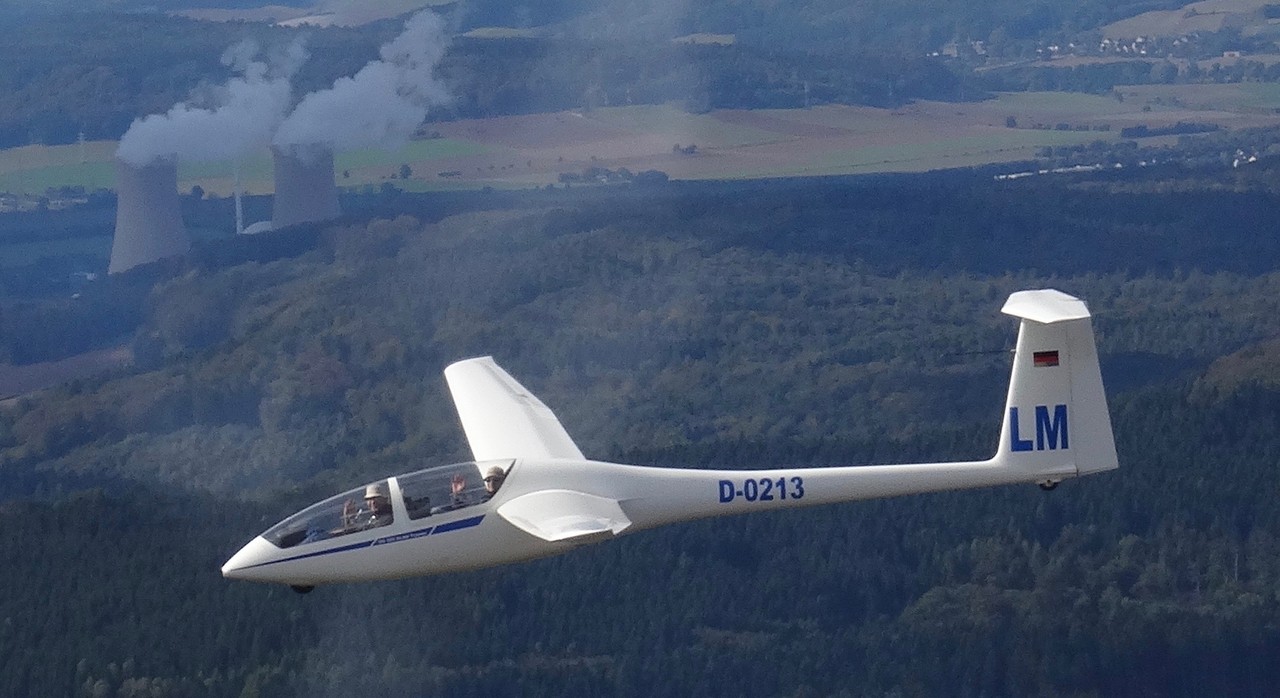
Revolutionary Self-Launch Design
The DG-500M represented a breakthrough in motorglider technology by successfully integrating a retractable powerplant without compromising soaring performance. The Rotax 535C engine mounted on a retractable pylon behind the cockpit could extend for takeoff and climb, then retract completely into the fuselage along with its propeller. This innovative design eliminated the aerodynamic penalties that plagued earlier motorgliders, allowing the aircraft to achieve the same glide ratios as pure sailplanes while maintaining independent launch capability.
With a maximum takeoff weight of 1,819 pounds and useful load of 609 pounds, the DG-500M could carry two pilots plus up to 220 pounds of water ballast for performance optimization. The aircraft's dual electronic ignition system provided reliability crucial for engine-out landings, while fuel capacity ranged from 10 gallons standard to 20.6 gallons optional, providing flexibility for extended cross-country flights.
Glaser-Dirks: Composite Aviation Pioneers
Glaser-Dirks Flugzeugbau GmbH was founded in 1972 by Gerhard Glaser, a civil engineering business owner, and Diplom Ingenieur Wilhelm Dirks. The company quickly established itself as an innovator in sailplane design, producing its first glider, the DG-100, in 1972 with 105 units manufactured at their Bruchsal facility. An additional 222 DG-100s were built under license at the Elan factory, demonstrating early international recognition of their designs.
The company pioneered carbon fiber wing construction in the early 1980s with the DG-400, marking a significant advancement in composite sailplane technology. By the time the DG-500M entered production, Glaser-Dirks had delivered 484 examples of their successful DG-300 model, establishing a reputation for high-performance competition sailplanes.
Financial challenges led to the company's bankruptcy in the early 1990s, but the assets were acquired and production continued under DG Flugzeugbau GmbH. This successor entity remains active today, producing modern sailplanes including the DG-1000S and DG-600, with recent examples delivered as late as 2017.
Production and Variants
DG-500M production spanned from 1987 through at least 1995, with documented serial numbers including 5E-126M53 from 1994. The aircraft was part of Glaser-Dirks' total production of 641 aircraft across all models, though the exact number of DG-500M units remains unspecified in company records.
Several variants expanded the DG-500 family's capabilities. The DG-500/22 featured extended 22-meter (72-foot) wings for enhanced high-altitude performance, while the DG-500/18 incorporated aerobatic certification. The DG-500T Elan Trainer variant emphasized instructional use with full dual controls, and the basic DG-500 remained available for those preferring conventional ground launch methods.
Record-Breaking Legacy
The DG-500M's most famous example achieved immortality in aviation history through the Perlan project. A 1995 production aircraft was extensively modified by removing the Rotax engine and installing oxygen systems, a drogue parachute, and specialized double-wall canopy for extreme altitude flight. On August 29, 2006, this modified DG-500M carried Steve Fossett and Einar Enevoldson to a glider altitude record of 50,720 feet (15,460 meters) while wearing pressure suits.
The Perlan glider exploited stratospheric mountain waves over Argentina to achieve this unprecedented altitude in unpowered flight. Though later superseded by the purpose-built Perlan II reaching 52,221 feet in 2017, the modified DG-500M demonstrated the robust design and performance potential inherent in the basic airframe.
Operational Service
In the United States, distributor Oliver Dyer-Bennet conducted extensive flight testing of early DG-500M examples, initially in the Experimental category before Standard category certification with limited aerobatic approval for lazy eights, chandelles, spins, and loops. Flight testing revealed sluggish acceleration at maximum gross weight but confirmed the aircraft's ability to self-launch from a 1,500-foot runway even on 100°F days.
Gliding clubs and training organizations became the primary operators, appreciating the reduced dependence on tow aircraft and the ability to launch during marginal soaring conditions. The tandem seating arrangement with full dual controls made the DG-500M particularly valuable for commercial glider instruction and cross-country training flights.
Current Status
At least several DG-500M aircraft remain airworthy today, including U.S.-registered N88DM with an FAA certificate valid through November 2028. The famous Perlan example resides permanently at the Seattle Museum of Flight, where visitors can examine the pressure suit equipment and specialized modifications that enabled its record-breaking stratospheric flight.
The DG-500M's influence on motorglider design continues through modern self-launching sailplanes that employ similar retractable engine concepts, validating the pioneering engineering decisions made by the Glaser-Dirks team in the late 1980s.