
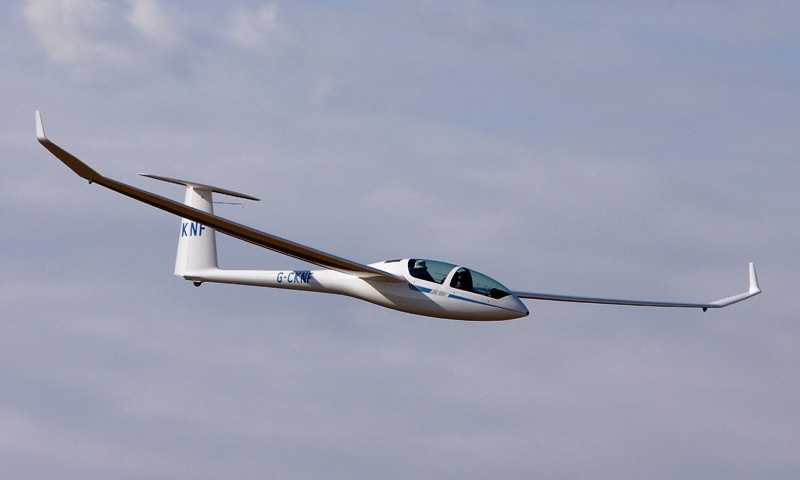
Development and Design Philosophy
The DG-800 emerged from Glaser-Dirks' ambitious vision to create the ultimate competition sailplane with self-launching capability. The aircraft incorporated advanced wing sections developed by L.M. Boermans from the Technical University of Delft, optimized specifically for the 18-meter wingspan configuration. This collaboration between German manufacturing expertise and Dutch aerodynamic research produced wing profiles that would set new standards for gliding performance.
Both the motorized DG-800A and pure glider DG-800S variants completed their maiden flights simultaneously in May 1993, demonstrating the design's versatility from its inception. The engineering team faced the complex challenge of integrating a retractable powerplant without compromising the aircraft's exceptional aerodynamic efficiency.
Manufacturing Evolution
Glaser-Dirks Flugzeugbau GmbH, founded by civil engineer Gerhard Glaser and Diplom Ingenieur Wilhelm Dirks, brought decades of sailplane expertise to the DG-800 program. The company had established its reputation with the DG-100 in 1972, followed by the highly successful DG-400 motorglider, which became one of the best-selling aircraft in its category.
The DG-800 represented the culmination of the company's experience with previous models including the DG-300 Club Elan, the two-seat DG-500 series, and the 15-meter DG-600. When DG Flugzeugbau GmbH assumed production responsibilities in 1997, they maintained the high manufacturing standards while introducing technical refinements.
Powerplant Options and Performance
The DG-800 series accommodates multiple engine configurations to meet diverse operational requirements. The 15-meter DG-800A utilizes the Austrian-built Rotax 505 engine producing 38 kW, while the 18-meter DG-808B and DG-808C variants employ German Solo engines generating 40 kW. The Solo 2325-1 powers the DG-808B, while the latest DG-808C features the Solo 2625 with the advanced DEI-NT Engine Control System.
These powerplants enable impressive climb performance of 5.2 meters per second, allowing pilots to reach optimal soaring altitudes quickly. Once the engine retracts, the aircraft transforms into a pure sailplane with a sink rate of just 0.50 meters per second and a maximum glide ratio exceeding 50:1 when equipped with winglets.
Competitive Success and Variants
The DG-800 series spawned numerous specialized variants tailored for specific roles. Competition-focused models like the DG-808S feature shorter, lighter fuselages built using DG-600 tooling, enabling pilots to achieve optimal wing loading configurations. These pure glider variants eliminate engine weight entirely, maximizing performance for championship-level competition.
The aircraft's 156-kilogram water ballast capacity allows pilots to adjust wing loading for varying conditions, while the 270 km/h maximum speed ensures efficient cross-country travel. These capabilities made the DG-800 series highly competitive in international soaring championships and club racing events.
Technical Specifications and Capabilities
The DG-808C represents the current pinnacle of the series, measuring 7.06 meters in length with an 18-meter wingspan and standing 1.35 meters high. Its 11.8 square meter wing area generates exceptional lift efficiency, while the 344-kilogram empty weight allows a maximum gross weight of 600 kilograms including pilot, fuel, and water ballast.
The aircraft's design incorporates modern safety features and ergonomic considerations for extended flight operations. Single-pilot operation requires comprehensive training in both powered and unpowered flight phases, as pilots must master engine management, retraction systems, and advanced soaring techniques.
Production Achievement and Market Impact
Since production began in 1993, manufacturers have delivered 401 DG-800 series aircraft, establishing it as a significant success in the specialized sailplane market. This production volume represents substantial achievement in a niche industry where annual deliveries typically number in dozens rather than hundreds.
The DG-800's influence extended beyond pure sales numbers, raising performance expectations across the self-launching sailplane category. Competitors responded with their own advanced designs, ultimately benefiting the entire soaring community through technological advancement.
Contemporary Operations
Today's DG-800 operators span private owners, soaring clubs, and commercial training operations worldwide. The aircraft serves dual roles as a high-performance competition machine and an efficient cross-country tourer, appealing to pilots seeking maximum versatility from a single aircraft.
The latest DG-808C variant continues the evolutionary development, incorporating lessons learned from three decades of operation while maintaining the fundamental design principles that made the original DG-800 successful. This ongoing refinement ensures the series remains competitive in the modern sailplane market.