
Design and Development
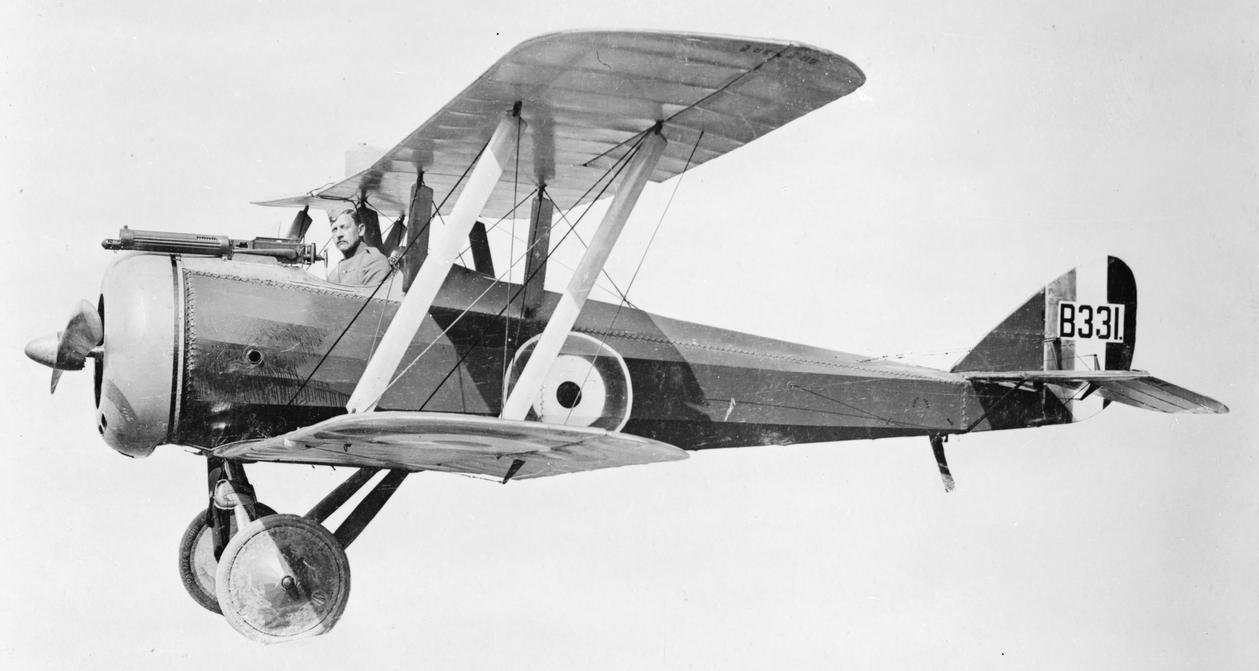
Designed by Captain Geoffrey de Havilland, the Airco DH.5 was developed throughout 1916 as a single-seat scout intended to replace the DH.2. To maintain the excellent forward visibility of the earlier pusher-style DH.2 while utilizing a tractor engine layout, de Havilland implemented a unique backward-staggered wing configuration. The upper wing was positioned 27 inches behind the lower wing, effectively placing it behind the pilot. Additionally, the DH.5 was among the first British fighters to feature an interrupter mechanism, allowing its single .303 in Vickers machine gun to fire safely through the spinning propeller arc.
Production and Manufacturer
The aircraft was produced between 1916 and 1917, with total production figures estimated between 550 and 552 units. While the Aircraft Manufacturing Company (Airco) was the original designer and primary contractor in Great Britain, other firms also undertook production, including British Caudron and March, Jones and Cribb in the UK, as well as Darracq in France. Airco, which had been founded in 1911 as "The Aircraft Company," became a pivotal British manufacturer during the war. However, the company collapsed following the post-war decline in military demand, and Geoffrey de Havilland resigned in 1920 to establish the de Havilland Aircraft Company. Airco itself did not survive as an independent entity.
Technical Specifications and Performance
The DH.5 was powered by a single 110 hp (82 kW) Le Rhône 9J nine-cylinder rotary piston engine. It featured a wingspan of 25 ft 8 in and a length of 22 ft 0 in, with a loaded weight of 1,492 lb. Performance figures indicate a maximum speed of 102 mph at 10,000 ft and a service ceiling of 16,000 ft. While its construction was robust, the aircraft suffered from limited climb rates—taking 12 minutes and 25 seconds to reach 10,000 ft—and was considered underpowered compared to contemporary German fighters.
Military Service
Entering service in early 1917, the DH.5 operated with the Royal Flying Corps (RFC) and the Australian Flying Corps (AFC). Five RFC squadrons utilized the type: Nos. 24, 32, 41, 64, and 65. The AFC operated 72 aircraft across No. 2 Squadron (originally No. 68 Squadron RFC) and No. 6 (Training) Squadron, with some possible use by No. 7 Squadron. Although designed as a fighter, its strong low-altitude handling led to its effectiveness in ground-attack roles. During the Battle of Cambrai in November 1917, No. 2 Squadron AFC utilized the DH.5 to carry four 25 lb bombs under the fuselage for close-support missions. By December 1917, the DH.5 was largely obsolete and replaced in front-line service by the Sopwith Camel and S.E.5a, with remaining airframes relegated to training roles in the UK.
Legacy
No original wartime DH.5 airframes are known to survive today. The only existing example is a single flying replica located at Omaka Aerodrome in New Zealand.