
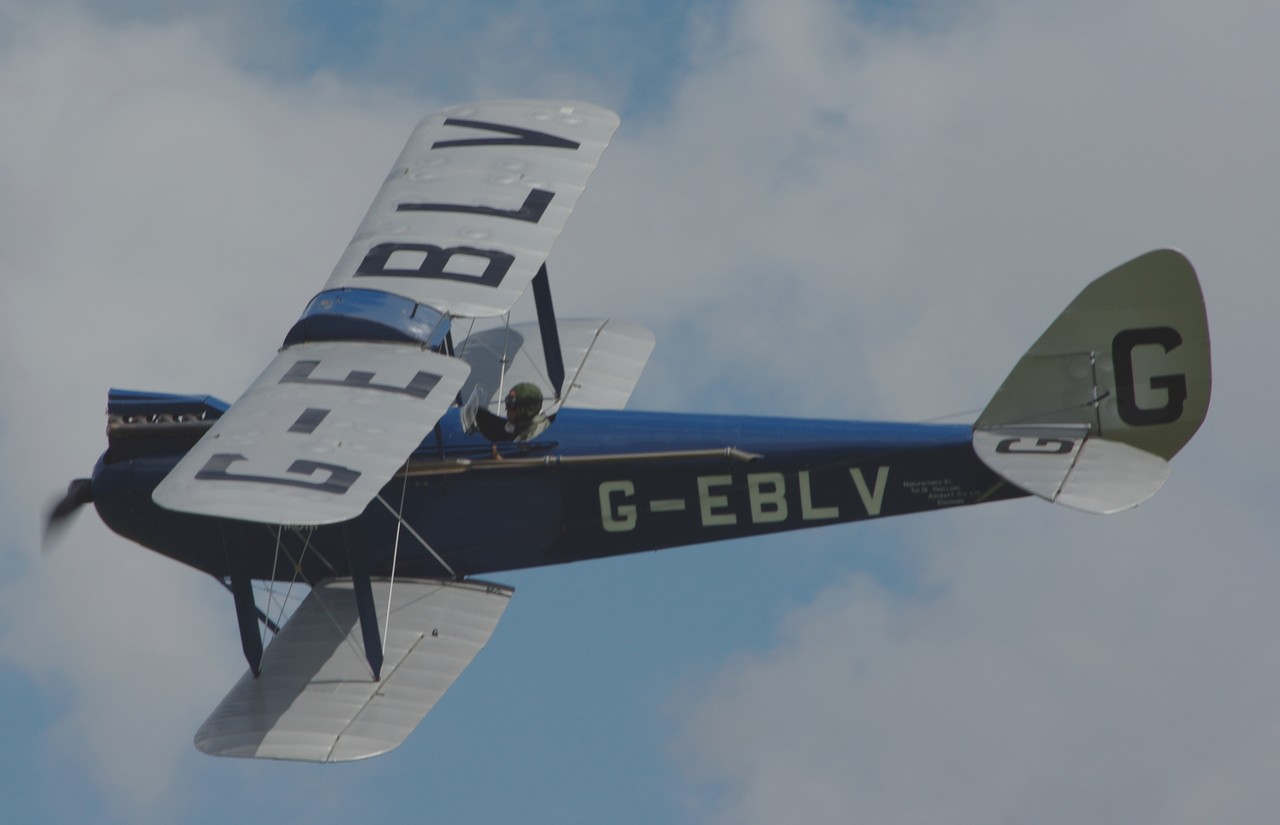
Revolutionary Impact on General Aviation
The DH.60 Moth's influence on aviation cannot be overstated. By the 1930s, Moths outnumbered all other aircraft types on the Canadian civil registry, demonstrating the design's overwhelming success in the general aviation market. The aircraft enabled the establishment of flying clubs worldwide and made flight training affordable for thousands of pilots who would later serve in World War II.
Design Innovation and Development
Geoffrey de Havilland personally flew the prototype G-EBKT on its maiden flight from Stag Lane Aerodrome, building upon lessons learned from his earlier DH.51 biplane. The Moth incorporated several practical innovations: a simple plywood box fuselage construction that kept costs low, folding wings on some variants for hangar storage, and exceptional adaptability that allowed conversion to floats or skis for varied operating conditions.
The aircraft's unequal-span wing configuration provided stable flight characteristics ideal for training, while the straightforward maintenance requirements made it practical for small flying clubs with limited technical support.
Production Excellence Across Continents
De Havilland built 39 aircraft at Stag Lane Aerodrome between 1925 and 1935, but the Moth's success spawned international production. The Moth Corporation in Lowell, Massachusetts produced 161 DH.60M variants from 1928 to 1930 before Curtiss-Wright acquired the operation. De Havilland Canada contributed 40 aircraft, while Morane-Saulnier manufactured 40 Gipsy Moths in France.
Australian production included seven aircraft by de Havilland Australia and one by Codock, while the General Aircraft Company (Genairco) built three examples. This distributed manufacturing approach brought total production to approximately 1,700 aircraft worldwide.
The de Havilland Legacy
De Havilland Aircraft Company, established by Geoffrey de Havilland in 1920 after his departure from the Royal Aircraft Factory, pioneered light aircraft development in the post-World War I era. The company operated independently until 1960, when it merged into Hawker Siddeley, subsequently becoming part of British Aerospace in 1977. Today, the de Havilland heritage continues within BAE Systems.
The Moth series established de Havilland's reputation for innovative light aircraft, leading to the famous Tiger Moth trainer and numerous other successful designs that shaped aviation history.
Engine Evolution and Performance
The original Moths utilized the ADC Cirrus inline engine, a four-cylinder air-cooled powerplant displacing 4.503 liters and producing 60 horsepower at 1,800 rpm. ADC Aircraft Ltd. manufactured these reliable engines during the 1920s, providing the consistent power that enabled remarkable long-distance flights.
Alan Cobham demonstrated the Cirrus engine's reliability on May 29, 1925, completing a round trip from Croydon to Zurich in 14 hours and 49 minutes. This achievement proved the Moth's capability for serious cross-country flying, not merely local training flights.
Later variants received more powerful engines: the Cirrus II delivered 80 horsepower in 1927, followed by the 85-horsepower Cirrus III. De Havilland's own Gipsy series engines appeared in 1931, featuring inverted mounting that improved propeller ground clearance and enhanced the aircraft's utility.
Record-Setting Achievements
Moths established numerous aviation records that captured public imagination. The first Moth reached Australia aboard ship on November 5, 1925, registered as G-AUAE and later VH-UAE. This aircraft became the foundation for widespread Moth operations across the continent.
During 1930, Moths completed several England-to-Australia flights, while 1931 saw a Moth successfully cross the Tasman Sea. These achievements demonstrated that light aircraft could accomplish serious long-distance travel, inspiring countless pilots to attempt their own adventures.
Military Applications
While designed for civilian use, the RAF adopted early Moths for training purposes. The Central Flying School performed formation aerobatics with Moths at the 1927 Hendon Air Display, showcasing the type's versatility and precision handling.
Between 1931 and 1935, 20 DH.60G III fuselages were converted into Queen Bee radio-controlled target drones, representing an early application of unmanned aircraft technology. The Royal Canadian Air Force received its first 27 Moths in 1927 for the Hudson Strait Expedition, later adopting the type as its standard trainer throughout the 1930s.
Surviving Legacy
At least three Moths remain airworthy today. BAE Systems maintains a DH.60 Cirrus III at the Shuttleworth Collection in Old Warden, UK - remarkably, this aircraft was the eighth Moth built and first flew on August 29, 1925. The Australian-registered VH-UAE, dating from 1925, holds the distinction of being the world's longest-registered airworthy Moth.
The Shuttleworth Collection also preserves G-EBLV, the sixth pre-production Moth from 1925. Ingenium Canada displays G-CAUA, a 1928-built DH.60X acquired in 1988, representing the type's significant Canadian service.
The Moth's greatest legacy lies not in museums but in its fundamental transformation of aviation from an elite activity into a pursuit accessible to ordinary enthusiasts, training the generation of pilots who would later serve with distinction in World War II.