
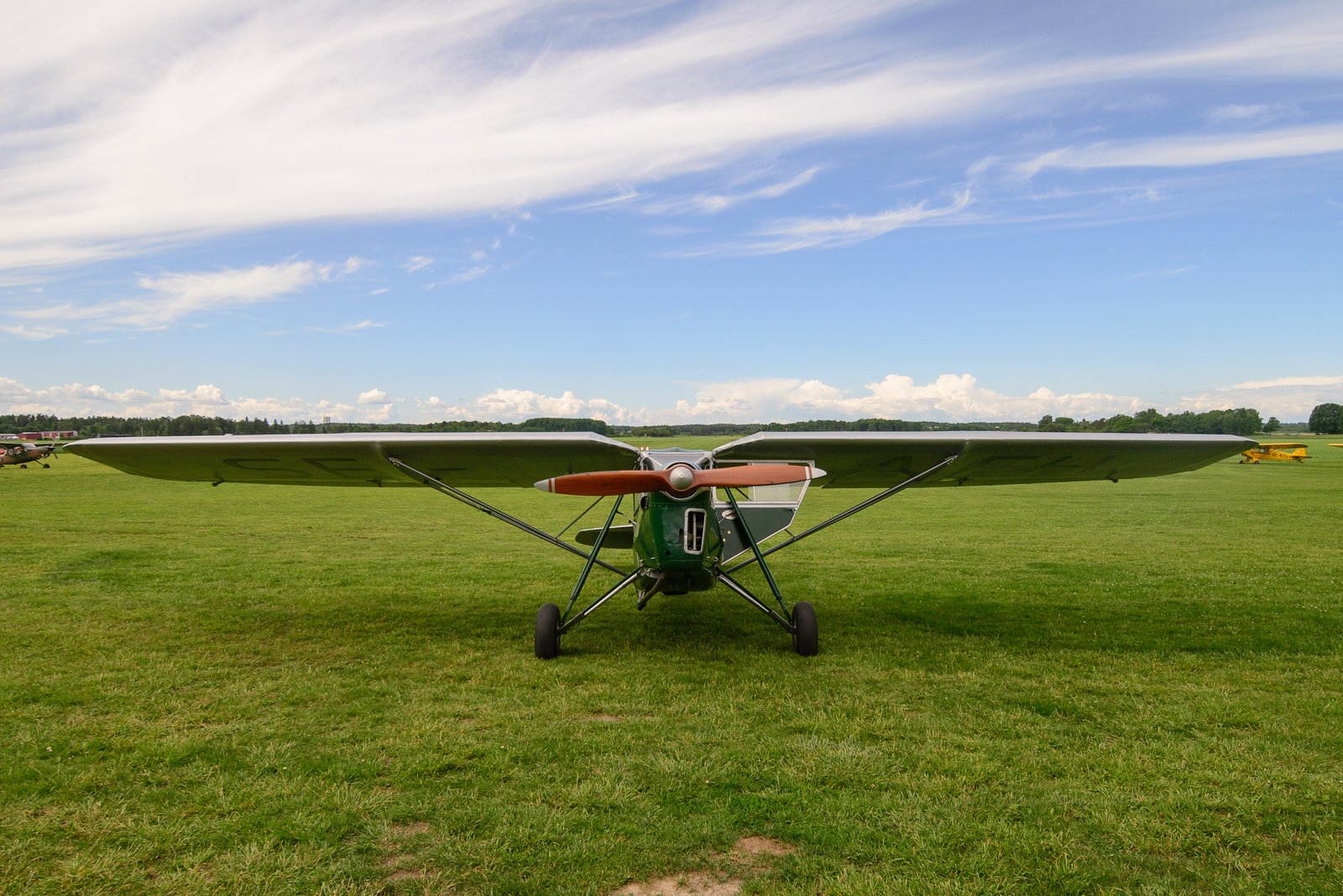
Revolutionary Design Achievement
The Puss Moth represented a quantum leap in private aircraft performance during aviation's golden age. Captain Geoffrey de Havilland personally piloted the prototype's maiden flight from Stag Lane Aerodrome, initially marketing the aircraft as the "Moth Three" before adopting the Puss Moth name at its April 1930 launch. The design philosophy centered on providing private aviators with airline-like enclosed comfort combined with performance previously unavailable in the civilian market.
Engineering Innovation and Early Challenges
De Havilland's engineers initially constructed the prototype with all-wooden construction, but production aircraft featured a fabric-covered steel-tube fuselage that proved more practical for manufacturing. The inverted inline Gipsy III engine in the prototype gave way to the more powerful 130-horsepower Gipsy Major in production models, providing the thrust needed for the aircraft's impressive 124 mph cruise speed.
However, the Puss Moth's early operational history was marred by a series of catastrophic wing flutter failures during turbulent conditions. The most tragic incident claimed renowned Australian aviator Bert Hinkler on January 7, 1933, when his aircraft CF-APK crashed while crossing the Alps. Additional wing failures occurred near Perth, Australia, on October 13, 1930, and in two separate South African incidents the following year. De Havilland engineers eventually resolved the flutter problem by installing jury struts connecting the front wing struts to the rear wing root fittings, effectively stiffening the wing structure.
Record-Breaking Service
Despite early technical challenges, the Puss Moth quickly established itself as the aircraft of choice for long-distance record attempts and pioneering flights. Nevill Vintcent achieved the first England-to-Ceylon flight in G-AAXJ during early 1931, demonstrating the aircraft's remarkable range capabilities. Captain James Douglas Mail's epic journey from Croydon to Bulawayo in G-ABIU, nicknamed "Baby Tank," covered the distance in just 8 days with 73 hours 50 minutes of actual flight time on May 25, 1931.
The aircraft's performance attracted operators across twelve countries worldwide, from private owners seeking fast personal transportation to commercial airlines requiring efficient short-haul service. North Queensland Airways operated four Puss Moths, including flights from Saltpan Landing Field in Cairns, Queensland, during 1935, showcasing the type's versatility in challenging tropical conditions.
Manufacturing and Global Distribution
De Havilland's Stag Lane facility produced 259 aircraft between 1929 and 1933, while de Havilland Canada assembled an additional 25 examples at their Downsview plant. The first production aircraft flew in March 1930 and immediately embarked on a sales tour of Australia and New Zealand, establishing the type's international reputation.
In Australia, ten incomplete airframes were shipped to Sydney for final assembly by De Havilland Aircraft Pty Ltd at Mascot Aerodrome. Four of these received completion using locally-manufactured woodwork and fabric covering, demonstrating the aircraft's adaptability to international production methods.
The De Havilland Legacy
Geoffrey de Havilland founded his aircraft company in 1920, establishing one of Britain's most innovative aerospace manufacturers. The company pioneered numerous aviation technologies throughout the 20th century, from light aircraft engines to jet-powered airliners. Following acquisition by Hawker Siddeley in 1960, the de Havilland name continued as a symbol of engineering excellence and innovation.
Technical Specifications and Performance
The production DH.80A featured a fabric-covered steel-tube fuselage with wooden wings and tail surfaces, representing optimal construction methods for its era. The reliable Gipsy Major engine, manufactured in-house by de Havilland, became one of the most successful light aircraft powerplants of the 1930s. The inverted inline configuration provided pilots with excellent forward visibility by eliminating protruding cylinder heads above the engine cowling.
With accommodation for up to three occupants, the Puss Moth offered cramped but weather-protected transportation at speeds approaching modern light aircraft performance. The enclosed cabin represented luxury for private aviators accustomed to open-cockpit flying in all weather conditions.
Production End and Successor
De Havilland replaced the Puss Moth with the DH.85 Leopard Moth, which featured a lighter plywood fuselage that reduced manufacturing costs while improving performance despite using the same 130-horsepower Gipsy Major engine. This transition reflected the company's continuous pursuit of engineering refinement and manufacturing efficiency.
Survival and Historical Significance
Only eight Puss Moths survive today, making the type extremely rare among vintage aircraft. These survivors represent an important chapter in aviation history, demonstrating the transition from basic flying machines to sophisticated touring aircraft that made long-distance private flying practical for the first time. The Puss Moth's influence extended far beyond its brief production run, establishing design principles that influenced light aircraft development throughout the following decades.