
Service History
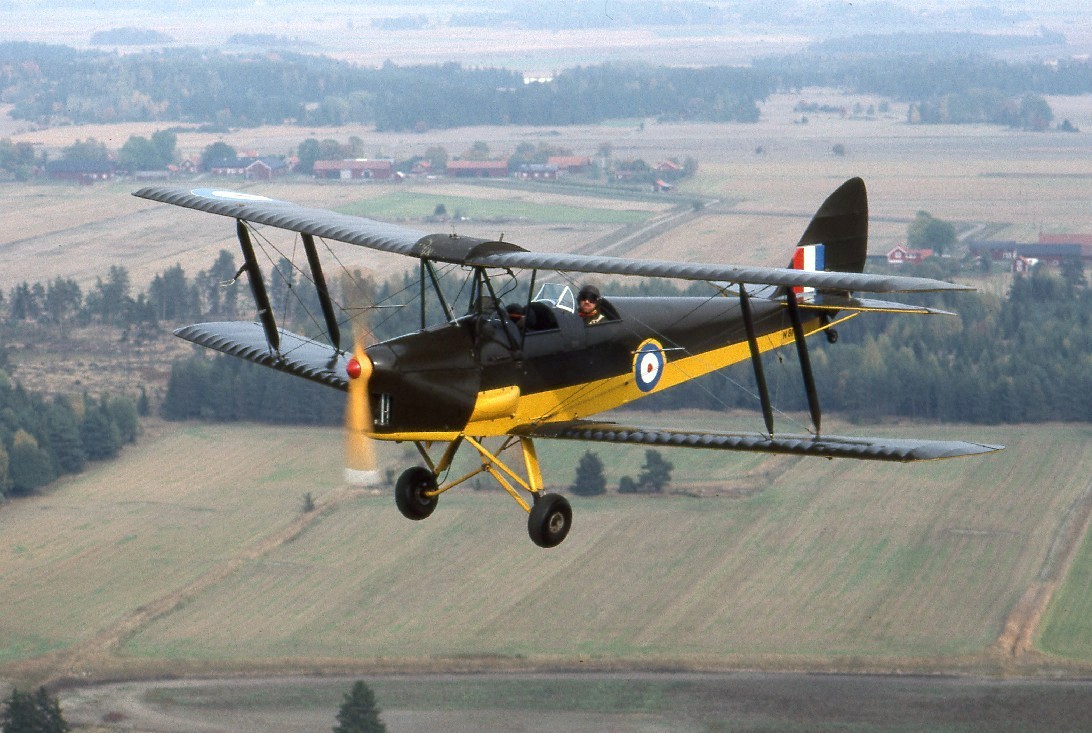
The Tiger Moth dominated elementary flight training across the British Commonwealth from the mid-1930s through the 1950s. Over 4,000 served with the Royal Air Force alone, while the Royal Canadian Air Force, Royal Australian Air Force, and numerous civilian flying clubs operated hundreds more. By 1939, the aircraft had become the standard ab initio trainer throughout the Empire, with flying clubs from Britain to New Zealand relying on its forgiving handling characteristics and robust construction.
Wartime Operations
During World War II, the Tiger Moth served as the backbone of the Commonwealth Air Training Plan, the massive program that trained aircrew for Allied forces. The standard military variant, designated DH.82A, featured minor modifications for service use, while Canada developed the DH.82C with an enclosed cockpit for cold-weather operations. Beyond training duties, some Tiger Moths were pressed into auxiliary roles including target towing, anti-submarine patrols, and even defensive reconnaissance missions during the Battle of Britain in 1940, though they carried no standard armament.
The Manufacturer
Geoffrey de Havilland founded the de Havilland Aircraft Company in 1920, establishing it as a pioneer in light aircraft design. Under chairman Alan Samuel Butler from 1924, the company focused on developing affordable aircraft for the emerging civil aviation market. The Tiger Moth evolved from the earlier DH.60 Gipsy Moth, incorporating lessons learned from that aircraft's widespread adoption by flying clubs. De Havilland operated as an independent manufacturer until 1960, when Hawker Siddeley acquired the company. The Canadian subsidiary, established in 1928, followed a separate trajectory and continues today as De Havilland Aircraft of Canada Limited under Longview Aviation Capital.
Engine and Technical Innovation
The Tiger Moth's reliability stemmed largely from its powerplant, the de Havilland Gipsy Major inline engine. This four-cylinder inverted air-cooled engine produced 130 horsepower while weighing under 300 pounds dry. The inverted configuration positioned cylinders below the crankshaft, improving forward visibility for pilots. De Havilland manufactured over 14,000 Gipsy Major engines across all variants between 1929 and the post-war era, establishing a reputation for exceptional reliability in training roles.
The aircraft's wooden construction with fabric covering kept costs low while providing adequate strength for aerobatic training. Geoffrey de Havilland's design team incorporated improved aileron geometry that reduced adverse yaw, making the aircraft more responsive and predictable for student pilots. The redesigned engine mount compared to the earlier Gipsy Moth enhanced the aircraft's aerobatic capabilities, essential for military training programs.
Pilot Perspective
Pilots praised the Tiger Moth for its forgiving flight characteristics and excellent training qualities. The aircraft's maximum speed of 109 mph and service ceiling of 13,000 feet provided adequate performance for instruction, while its 700 feet per minute climb rate allowed efficient pattern work. The tandem seating arrangement with the student in front facilitated instruction, though communication remained challenging in the open cockpits. Many pilots fondly remembered their first solo flights in Tiger Moths, as the aircraft's predictable handling built confidence in new aviators.
The 260-mile range proved sufficient for cross-country training flights, while the aircraft's robust landing gear tolerated the inevitable hard landings of student pilots. Veterans often noted the distinctive sound of the Gipsy Major engine and the aircraft's responsive controls, characteristics that made it an ideal stepping stone to more advanced military types.
Production and Legacy
Manufacturing occurred primarily in Britain, with licensed production in Australia, Canada, and New Zealand meeting wartime demand. The 8,868 aircraft produced made the Tiger Moth the most numerous de Havilland trainer, far exceeding the company's initial expectations. Production ceased in 1944 as military training requirements shifted toward more advanced aircraft and the post-war market contracted.
Today, over 250 Tiger Moths remain airworthy worldwide, testament to the design's enduring appeal and robust construction. Notable examples are preserved at the RAF Museum Hendon, Imperial War Museum Duxford, and Canadian Warplane Heritage Museum. The aircraft appeared in films including "The First of the Few" (1942) and "Reach for the Sky" (1956), cementing its place in popular culture as the quintessential British trainer. The Tiger Moth's legacy extends beyond its training role to its fundamental impact on British aviation, making flying accessible to thousands and establishing the foundation for the Commonwealth's wartime pilot training success.