
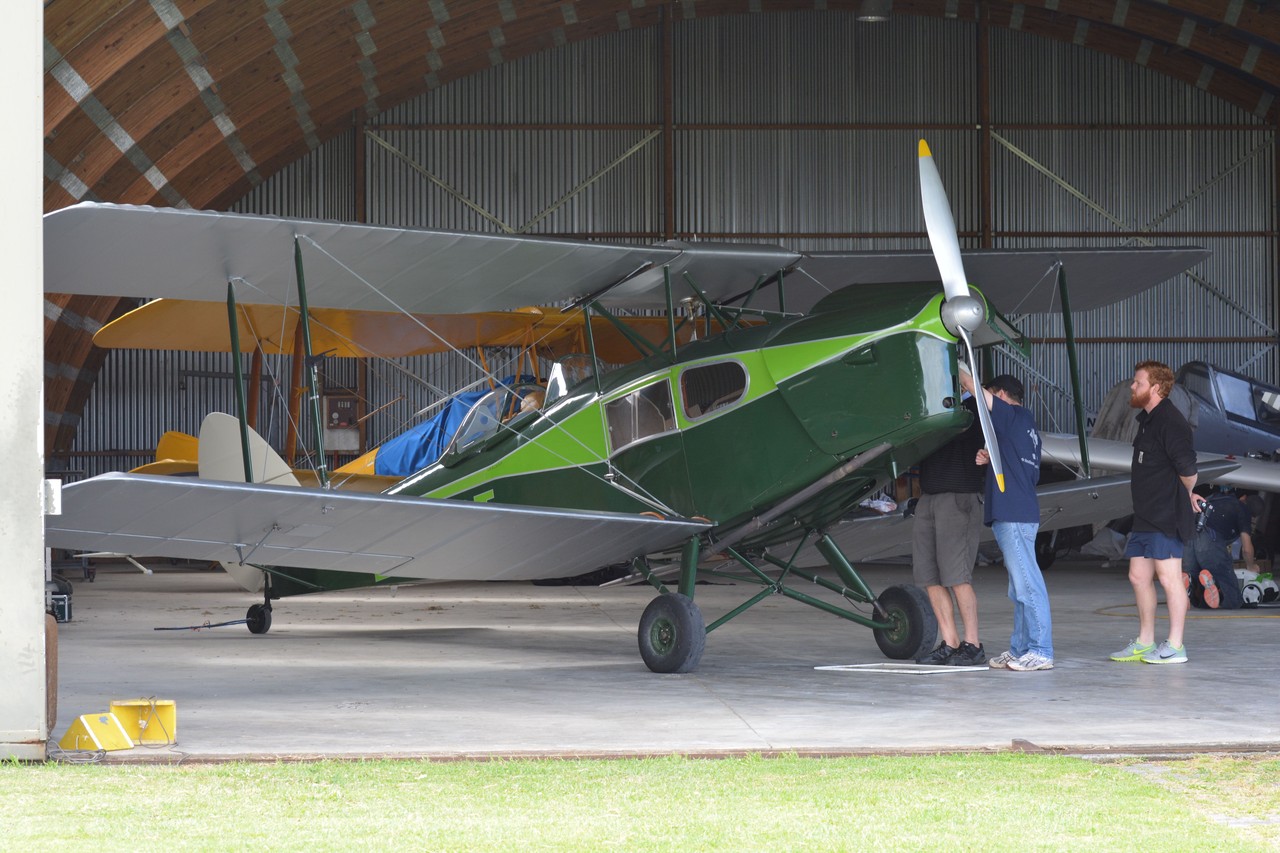
Commercial Aviation Pioneer
The Fox Moth revolutionized short-haul commercial aviation by proving that airline operations could be profitable without government subsidies. Australian National Airways launched the type into service on the Bass Strait route between Launceston and Whitemark in October 1932, using VH-UQM Miss Currie purchased for £1,450 by Victor Holyman. This 108-mile route demonstrated the aircraft's viability for feeder services connecting remote communities to major transport networks.
Qantas adopted the Fox Moth for Flying Doctor Service operations, replacing their aging DH.50s with the more economical design. The aircraft's ability to operate from short, unprepared strips made it invaluable for medical evacuations and passenger services in Australia's remote regions. W.R. Carpenter & Co. operated Fox Moths in New Guinea, while Canadian bush operators including Arthur Fecteau and Max Ward used the type for wilderness transport operations.
Innovative Design Approach
Designer A.E. Hagg created the Fox Moth in late 1931 by ingeniously combining proven components from the successful DH.82 Tiger Moth with an entirely new fuselage design. The aircraft reused the Tiger Moth's wings, tailplane, fin, rudder, and engine mounts, reducing development costs and manufacturing complexity. The new plywood-covered fuselage, constructed from ash and Sitka spruce, drew inspiration from the larger DH.50 while accommodating smaller, more economical engines.
This component-sharing strategy enabled de Havilland to offer the Fox Moth at a competitive price while maintaining structural integrity and performance. The separate passenger cabin provided weather protection and comfort previously unavailable in light aircraft, with two hammock seats in the rear and one forward-facing dicky seat.
Production Across Three Countries
De Havilland manufactured between 153 and 158 Fox Moths across multiple facilities and time periods. The original UK production run from 1932 to 1934 yielded 98 aircraft built at the company's Stag Lane and Hatfield facilities. Seven additional aircraft were assembled in Canada during the prewar period, while de Havilland Aircraft Pty Ltd constructed two examples in Australia at their Mascot hangar facility in Sydney during 1937.
Postwar Canadian production proved most significant, with de Havilland Aircraft of Canada Ltd manufacturing 53 to 54 DH.83C variants between 1945 and 1947. These Canadian-built aircraft featured the more powerful Gipsy Major I engine producing 145 horsepower, compared to the 120-130 horsepower Gipsy III engines used in most UK production aircraft. Thirty-nine of the Canadian Fox Moths remained in domestic service, supporting the country's expanding bush aviation network.
The de Havilland Legacy
The de Havilland Aircraft Company, founded by Geoffrey de Havilland in 1920, established itself as a pioneer in both military and civilian aviation before merging into Hawker Siddeley in 1960. The company's philosophy of practical, economical design influenced numerous successful aircraft types, with the Fox Moth sharing components and design DNA with the legendary Tiger Moth trainer.
Subsequent corporate changes saw the brand pass through British Aerospace in 1977 and eventually into BAE Systems in 1999. De Havilland Canada followed a different path, becoming part of Bombardier Aerospace in the 1970s before being revived under Longview Aviation in 2019 as an independent entity continuing the de Havilland tradition.
Engine and Performance
The Fox Moth's powerplant options reflected de Havilland's vertical integration strategy, using the company's own Gipsy series engines. Early UK aircraft typically mounted the Gipsy III or IIIa inline piston engines, while the postwar Canadian DH.83C variants received the improved Gipsy Major I. These reliable inverted inline engines provided excellent forward visibility for the pilot while delivering sufficient power for the aircraft's intended role.
The engine installation enabled cold-weather operations with skis and water operations with floats, expanding the Fox Moth's operational envelope for Canadian and Australian bush flying. This versatility proved crucial for operators serving remote locations year-round.
Wartime Service
During World War II, Fox Moths served in auxiliary roles rather than combat missions, functioning as communication aircraft, transports, and ambulances. British, Australian, and New Guinea forces operated the type, with several aircraft serving in the challenging New Guinea theater. VH-UQP crashed in the Bitoi Valley on October 30, 1941, illustrating the hazardous conditions these civilian aircraft faced when pressed into military service.
Surviving Aircraft
Several Fox Moths remain airworthy today, including C-FYPM operated by Vintage Wings of Canada in Royal Guards markings. Museums preserve the type's legacy, with CF-DJB, a 1947 Canadian-built DH.83C, displayed at Ingenium Canada, and CF-BNP housed at the Royal Aviation Museum of Western Canada. These survivors represent the Fox Moth's lasting contribution to aviation history as the aircraft that proved light transport operations could succeed commercially without government support.