
Commercial Aviation Pioneer
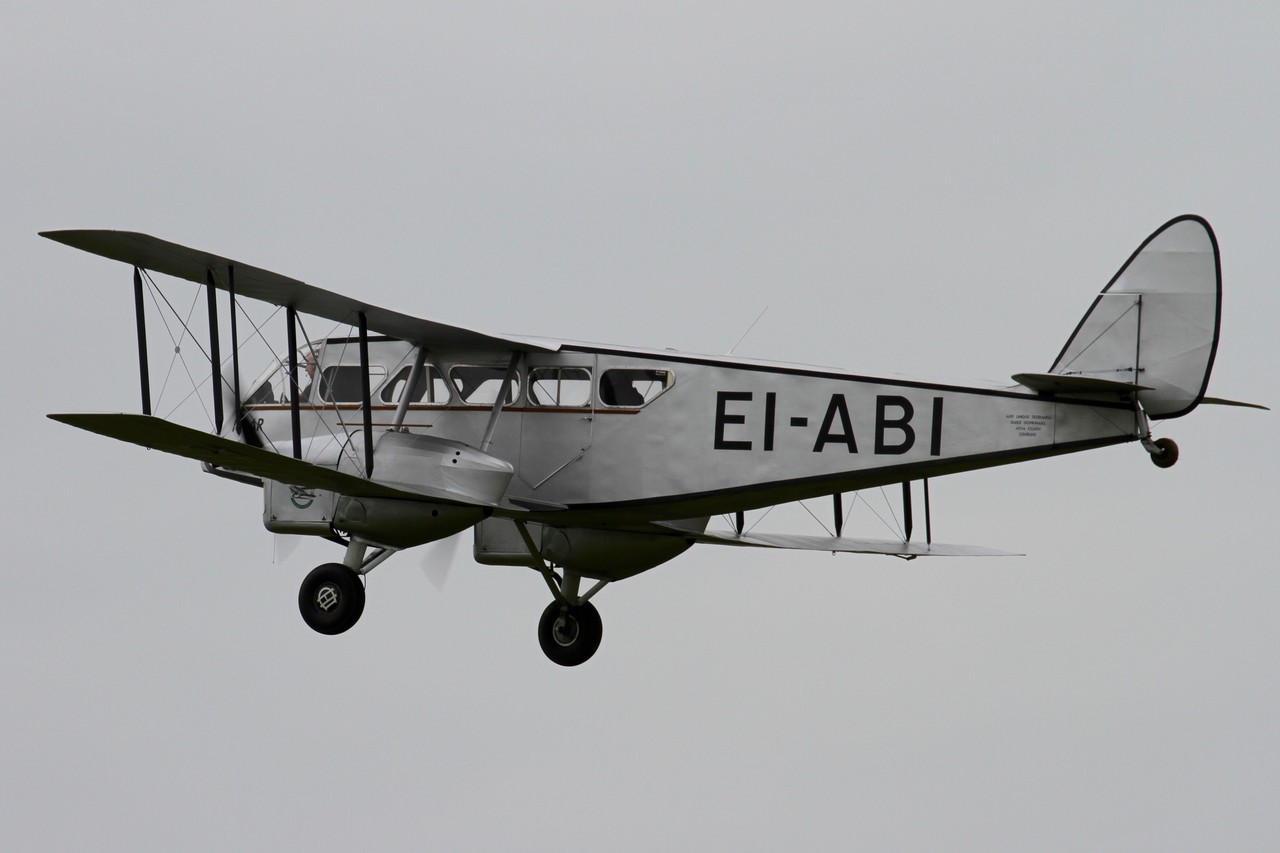
The Dragon transformed short-haul commercial aviation by offering twin-engine reliability on routes previously served by less capable single-engine aircraft. Hillman Airways, a predecessor to British Airways, operated the first four production aircraft and inaugurated regular London-Paris passenger service in April 1933. The aircraft's economic efficiency, consuming just 13 gallons of fuel per hour, made it ideal for European routes where passenger comfort and safety outweighed pure speed.
Aer Lingus adopted the Dragon for its early Dublin-Britain routes, recognizing the aircraft's value for establishing reliable scheduled services. The enclosed cabin provided weather protection and comfort that open-cockpit aircraft could not match, while the twin-engine configuration offered security over water and difficult terrain that single-engine designs lacked.
Design Innovation and Development
Sir Geoffrey de Havilland led the design team at the company's Hatfield facility, evolving the concept from the single-engine DH.83 Fox Moth to accommodate more passengers with enhanced safety. The design team prioritized efficiency for short routes, incorporating innovative features including foldable wing panels outboard of the engines for compact hangar storage and a generous baggage allowance of 45 pounds per passenger.
Each passenger seat was carefully designed for the era's expectations, with large windows providing excellent visibility during flight. The biplane configuration, while appearing dated even in 1932, offered structural strength and gentle handling characteristics that proved valuable for airline operations and pilot training.
Military Adaptation and Wartime Service
During World War II, the Dragon found extensive military application across multiple air forces. The Royal Australian Air Force utilized the type as a navigation trainer, leading to renewed production in Australia by de Havilland Australia Pty Ltd at Bankstown, New South Wales. This Australian production run delivered 87 aircraft specifically built for RAAF requirements.
The Royal Air Force impressed 17 civilian Dragons into military service, while the Royal New Zealand Air Force operated the type for transport and training duties. The military variant DH.84M featured armament capabilities including two machine guns and provisions for sixteen 20-pound bombs, with examples exported to Denmark, Iraq, and Portugal for light military duties.
The de Havilland Legacy
The de Havilland Aircraft Company, established in 1920, had built a reputation for innovative wooden construction techniques derived from World War I experience. By 1932, the company had already achieved success with the Moth series of light aircraft, and the Dragon represented their entry into commercial aviation. The company's wooden construction expertise, later demonstrated dramatically in the World War II Mosquito fighter-bomber, proved ideal for the Dragon's lightweight yet strong airframe.
Following acquisition by Hawker Siddeley in 1960, the de Havilland name passed through British Aerospace in 1977 and ultimately became part of BAE Systems in 1999. The company's pioneering spirit lived on through these corporate transitions, though the original de Havilland identity disappeared as an independent manufacturer.
Power and Performance
Two de Havilland Gipsy Major I inline piston engines, each producing 130 horsepower, powered the Dragon to its cruise speed of 109 mph. The Gipsy Major's reliability stemmed from extensive development for the Tiger Moth trainer, which was already in large-scale Australian production when Dragon manufacturing resumed there during World War II.
The engines provided sufficient power for takeoff with full passenger loads while maintaining fuel efficiency crucial for commercial operations. The improved Dragon 2 variant added 5 mph to top speed and extended range by 85 miles through aerodynamic refinements including a faired undercarriage and revised window framing.
Production Achievement
Total Dragon production reached 202 aircraft across two countries and two distinct periods. United Kingdom production at Stag Lane Aerodrome delivered 115 aircraft between 1932 and 1937, establishing the type's commercial reputation. Australian wartime production added 87 aircraft specifically for military training requirements, demonstrating the design's versatility and continued relevance a decade after its first flight.
Special variants included the Seafarer configuration with additional fuel tanks, which supported Amy Johnson and Jim Mollison's ambitious 1933 long-distance record attempt, showcasing the Dragon's adaptability beyond routine passenger service.
Surviving Legacy
Today, 10 DH.84 Dragons survive worldwide, with 5 remaining airworthy. Notable among these is ZK-AXI in New Zealand, which underwent complete restoration in 1997 and continues flying demonstrations. These survivors typically represent post-war civilian roles rather than military service, having been preserved by collectors and museums recognizing the type's historical significance.
The Dragon's greatest legacy lies in inspiring the highly successful DH.89 Dragon Rapide, which incorporated lessons learned from Dragon operations. The Rapide's production of 727 aircraft between 1934 and 1946 proved that de Havilland's twin-engine biplane concept had lasting commercial viability, even as monoplane designs began dominating aviation development.