
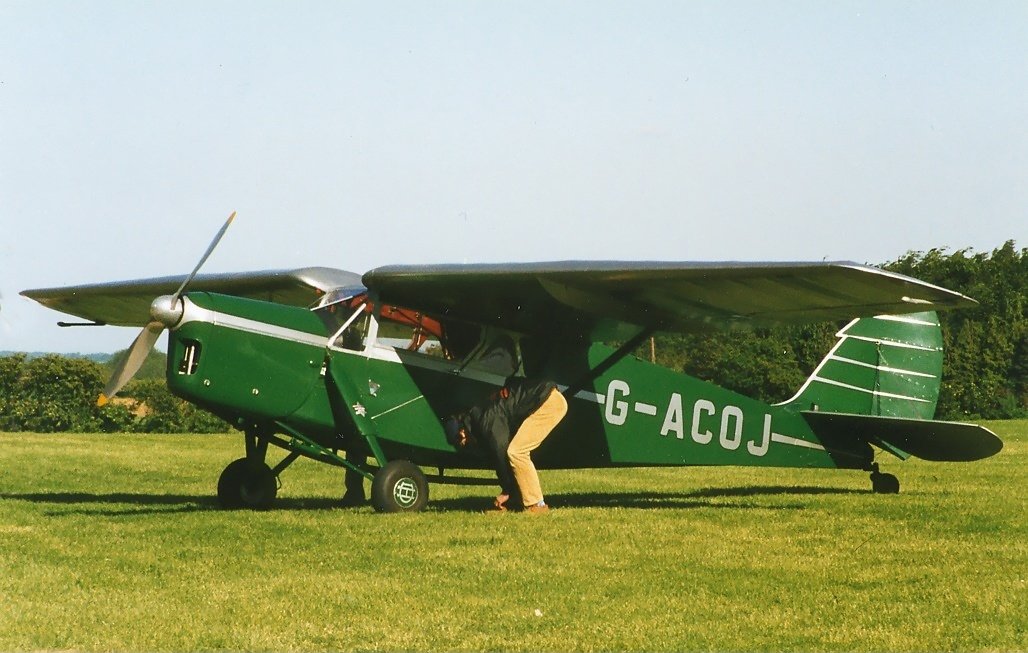
Design Innovation and Development
Geoffrey de Havilland's design team created the DH-85 Leopard Moth to fill a specific gap in the private aviation market. While the earlier DH-60 Gipsy Moth had sparked Britain's flying club movement, pilots demanded higher performance for long-distance touring. The Leopard Moth answered this call with several key innovations that set it apart from its fabric-covered predecessors.
The aircraft featured a fully streamlined plywood fuselage rather than the traditional fabric covering used on other Moth variants. This construction method, combined with a low-drag NACA cowling around the inverted Gipsy Major engine, enabled the Leopard Moth to achieve cruise speeds 4-5 mph faster than comparable aircraft of its era. The optional variable-pitch propeller further enhanced performance, allowing pilots to optimize engine efficiency across different flight phases.
Production and Technical Specifications
De Havilland manufactured 67 Leopard Moths between 1933 and 1938 at their Hatfield works. Each aircraft was powered by the reliable Gipsy Major I, a 130-horsepower four-cylinder air-cooled inverted inline engine produced at de Havilland's Stag Lane engine facility. This powerplant, which would eventually see more than 14,000 units built across all variants through the 1960s, provided the Leopard Moth with a maximum speed of 137 mph and an impressive climb rate of 900 feet per minute.
The aircraft's performance specifications made it attractive to serious private pilots and small commercial operators. With a service ceiling of 14,000 feet and range of 630 miles, the Leopard Moth could undertake long cross-country flights that were impractical in slower training aircraft. The generous fuel capacity and efficient cruise performance at 130 mph made it particularly suitable for Channel crossings and continental touring.
Commercial and Private Operations
Private owners and flying clubs formed the primary market for the Leopard Moth, though small commercial operators also found uses for the type. Hillman's Airways operated several examples on air taxi services, while private pilots used the aircraft for record attempts and long-distance flights. Notable aviator Amy Johnson flew a Leopard Moth variant during her 1934 record attempts, demonstrating the type's capability for serious cross-country work.
The aircraft's three-seat configuration proved versatile, allowing for either two passengers plus baggage or cargo equivalent. This flexibility made it popular with flying clubs that needed an aircraft capable of both training advanced pilots and providing charter services to offset operating costs.
Wartime Service
When World War II began in 1939, the Royal Air Force and Royal Navy impressed approximately 20 Leopard Moths for military service. These civilian aircraft were pressed into communications, training, and target-towing duties between 1940 and 1944. Some examples received the military designation "Messenger Moth" when converted for liaison work.
While the Leopard Moth never served in combat roles, its reliability and performance made it valuable for hack duties and pilot training. The type's docile handling characteristics and robust Gipsy Major engine proved well-suited to the demanding conditions of wartime operations. Most impressed aircraft returned to civilian registers after the war's end.
The De Havilland Legacy
The de Havilland Aircraft Company, founded in 1920 by Geoffrey de Havilland with early backing from George Holt Thomas's £10,000 investment in 1919, had established itself as Britain's premier light aircraft manufacturer by the time of the Leopard Moth's development. Under chairman Alan Samuel Butler, who joined in 1924, the company shifted focus toward civil aircraft and sparked the flying club movement that made private aviation accessible to middle-class pilots.
The original de Havilland company operated until absorption into Hawker Siddeley in 1960, with the aircraft division later nationalized as British Aerospace in 1977. While the UK parent company ceased independent operations, de Havilland Canada followed a separate path, eventually becoming the modern De Havilland Aircraft of Canada Limited under Longview Aviation Capital ownership from 2019.
Current Status and Preservation
Approximately 10-12 Leopard Moths remain airworthy worldwide as of 2023, with additional examples undergoing restoration. The Shuttleworth Collection at Old Warden maintains G-ACBT in flying condition, while the Australian Museum of Flying in Mudgee, New South Wales, displays VH-UKP. These surviving aircraft represent important examples of 1930s wooden construction techniques and the evolution from biplane to monoplane configuration in light aviation.
The Leopard Moth's cultural significance extends beyond aviation museums. The type appeared in films including The First of the Few (1942) and various World War II documentaries, serving as a symbol of pre-war civil aviation's golden age. Its efficient wooden construction and streamlined design influenced subsequent de Havilland designs, including the post-war Hornet Moth, cementing the company's reputation for combining performance with traditional craftsmanship in an era increasingly dominated by metal construction.