
Commercial Success and Innovation
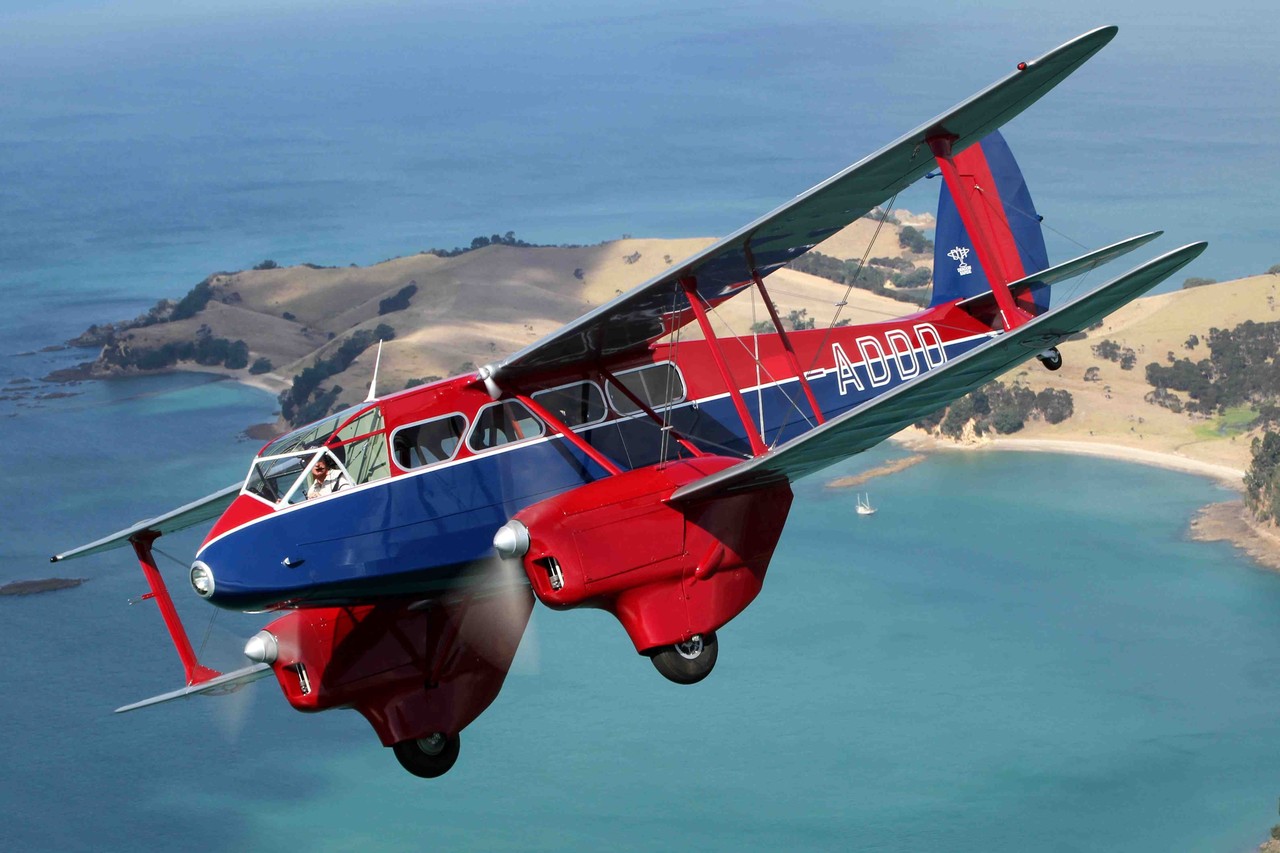
The Dragon Rapide emerged from de Havilland's need to create a profitable short-haul airliner that could operate without the subsidies required by larger aircraft. Designer Arthur Ernest Hagg developed the DH-89 as an improved successor to the DH-84 Dragon, essentially creating a twin-engine version of the four-engine DH-86 Express but scaled for regional operations. The prototype, piloted by Hubert Broad, achieved 175 mph in trials before being limited to 160 mph for operational service.
Hillman Airways became the first operator, taking delivery of G-ACPM on July 13, 1934, and immediately putting it to work from Maylands Airport in Romford. The aircraft's economic advantages became apparent quickly - Broad flew it at 158 mph in the King's Cup Air Race before hail damage ended the competition flight. By the outbreak of World War II, 205 Dragon Rapides had been delivered to airlines and private owners worldwide, establishing new standards for regional aviation profitability.
Global Operations and Manufacturing
Production occurred at two primary facilities to meet demand. De Havilland's Hatfield Aerodrome in Hertfordshire produced 346 aircraft by 1942, after which manufacturing shifted to Brush Coachworks Ltd. at Loughborough. This transfer freed Hatfield's production capacity for the critical Mosquito program while Brush completed an additional 346 Dragon Rapides from 1943 to 1945.
Australian operators embraced the type early, with West Australian Airways ordering two new DH-89s in 1934 specifically for Perth-Adelaide transcontinental service, replacing their DH-84 Dragons. Local assembly began at Mascot Aerodrome in Sydney, with the first Australian-built example completed in March 1935. This international production demonstrated the aircraft's appeal beyond British markets.
Military Service as the Dominie
World War II transformed the Dragon Rapide into a military asset designated the DH-89 Dominie. The Royal Air Force operated the type from 1935, with No. 24 Squadron among the early users for transport and training missions. More than 500 Dominies were produced for military service, primarily serving as radio-navigation trainers after the Air Ministry ordered 17 aircraft before 1938 specifically for this role.
Military variants featured improved de Havilland Gipsy Queen engines rather than the standard Gipsy Six powerplants. Export customers included Australia with eight aircraft serving from 1935 to 1944, Iran operating three from 1936 to 1949, and Uruguay flying one example from 1936 to 1960. Spain and Lithuania also operated military versions, though specific numbers and service periods vary in historical records.
The de Havilland Legacy
Geoffrey de Havilland founded the de Havilland Aircraft Company in 1920, establishing it as a pioneer in wooden aircraft construction and innovative design. The company dominated British aviation during the interwar period with aircraft like the Moth series and continued this success during World War II with types including the Mosquito. Hawker Siddeley acquired de Havilland in 1960, later incorporating it into British Aerospace in 1977. Today, the legacy continues under BAE Systems.
The Dragon Rapide represented a crucial bridge between the experimental aviation of the 1920s and the established airline industry of the post-war era. Its success validated the concept that smaller, more efficient aircraft could serve regional routes profitably, influencing decades of subsequent airliner development.
Technical Excellence and Performance
Powered by two de Havilland Gipsy Six inline engines producing 200 horsepower each, the Dragon Rapide achieved the perfect balance of performance and economy for its intended role. The Gipsy Six, a six-cylinder evolution of the proven Gipsy Major, entered production around 1933 and powered numerous de Havilland aircraft with remarkable reliability.
The aircraft's all-wood biplane construction incorporated several innovations including tapered wings and streamlined fairings that avoided the operational difficulties encountered by the larger DH-86. With accommodation for one pilot and eight passengers, the Dragon Rapide could maintain profitable operations on routes where larger aircraft struggled financially.
Enduring Appeal
Several Dragon Rapides remain airworthy today, testament to their robust construction and enduring appeal. The de Havilland Aircraft Museum at Hatfield preserves a DH-89A Dragon Rapide, maintaining the connection to the aircraft's birthplace. These survivors continue to demonstrate the qualities that made the type successful: economic operation, reliable performance, and distinctive character that defined an era of aviation development.
The Dragon Rapide's significance extends beyond mere statistics. As the first truly successful British short-haul airliner, it proved that innovative design could create new market opportunities while establishing de Havilland's reputation for producing aircraft that combined technical excellence with commercial viability.