
Design Innovation and Market Position
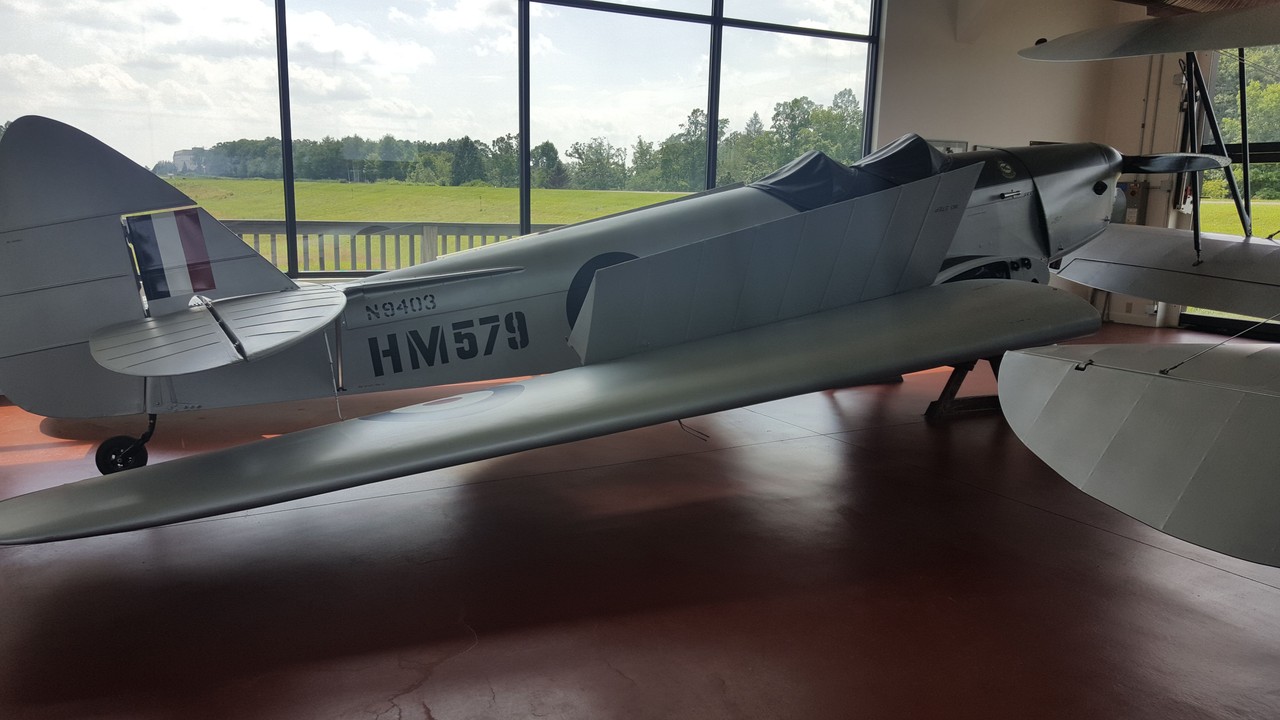
The DH.94 Moth Minor emerged from Geoffrey de Havilland's vision to create an affordable enclosed touring aircraft for the private aviation market of the late 1930s. Priced at £495, it was designed to bridge the gap between open-cockpit biplanes and more expensive cabin monoplanes. The aircraft featured several innovations for its class, including an all-wooden stressed-skin fuselage using plywood torsion-box construction, folding wings for hangar storage, and a fully enclosed cabin—a rarity among light aircraft of the pre-war era.
Led by chief designer Geoffrey de Havilland himself, with structural work by R. E. Bishop and aerodynamics by E. C. Hall, the design team achieved a 15 percent drag reduction compared to the Tiger Moth through improved engine cowling design. The aircraft's wooden construction reflected de Havilland's mastery of timber techniques that would later prove invaluable in producing the legendary Mosquito bomber.
Limited Production and Market Impact
Production began in late 1937 following certification on September 21, with Geoffrey de Havilland personally conducting the maiden flight from Hatfield Aerodrome two months later. The timing proved unfortunate, as the approaching war severely limited the civilian market. Of the 75 aircraft built, 43 were delivered as pre-war civil variants to operators including Channel Airways in the UK and Air Service in New Zealand, along with various flying clubs and private owners.
The aircraft found modest success in the private touring role, with notable appearances at events like the 1938 Blackpool Air Pageant. Its 460-mile range and 900-feet-per-minute climb rate made it suitable for cross-country flights, while the short-field performance inherited from the Tiger Moth lineage proved valuable for operations from small grass airfields.
Wartime Service
When World War II began, approximately 32 Moth Minors were impressed into military service with the Royal Air Force and Royal New Zealand Air Force. Unlike their combat-proven Tiger Moth cousins, these aircraft were relegated to non-combat roles including communications, target-towing, and liaison duties. The RNZAF's No. 32 Squadron operated several examples on ferry flights during 1941, while RAF stations used them as station hacks for local transport and training support.
The military conversions retained the basic airframe but were fitted with radio equipment and occasional marker systems. No armament was ever installed, and the type saw no combat action. Approximately 10 aircraft were lost to accidents during the war years, with no losses attributed to enemy action.
The de Havilland Legacy
The de Havilland Aircraft Company, founded by Geoffrey de Havilland on September 25, 1920, had established itself as Britain's premier light aircraft manufacturer through the success of the Moth series. By the time of the DH.94's development, the company had already produced thousands of Moths and was pioneering the wooden construction techniques that would define British aviation through the war years.
The company operated independently until 1960, when it was acquired by the Hawker Siddeley Group and fully absorbed by 1963. The corporate lineage continued through Hawker Siddeley's merger into British Aerospace in 1977, and subsequently into BAE Systems in 1999. Meanwhile, the Canadian subsidiary de Havilland Canada followed a separate path, eventually being revived in 2019 as De Havilland Aircraft of Canada Limited under Longview Aviation Capital.
Engine and Performance
Powering the Moth Minor was the reliable de Havilland Gipsy Major I, a 130-horsepower inverted inline four-cylinder engine that had proven itself across the Moth family. This air-cooled powerplant, manufactured at de Havilland's Hatfield engine works, delivered exceptional reliability with time-between-overhaul ratings exceeding 1,000 hours. The inverted cylinder configuration provided better pilot visibility while the supercharger options available in later marks enhanced high-altitude performance.
The aircraft achieved a maximum speed of 124 mph at sea level with a service ceiling of 14,500 feet. Its 1,810-pound maximum takeoff weight allowed for two adults plus a child, with 6 cubic feet of baggage space—generous accommodation for a light aircraft of the era.
Surviving Legacy
As the final wooden monoplane design in the Moth lineage, the DH.94 represents a technological bridge between the fabric-and-wire biplanes of the 1920s and the all-metal aircraft that would dominate post-war aviation. Its limited production numbers have made survivors extremely rare, with only four examples remaining airworthy as of 2023—two in the UK, one in New Zealand, and one in Australia.
Museum examples can be found at the de Havilland Aircraft Heritage Centre in London Colney, UK, which displays G-AEFK, a 1938 civil variant, and at the RNZAF Museum in Christchurch, New Zealand, home to NZ452, a former RAF aircraft. These preserved examples serve as reminders of de Havilland's foundational role in developing light aviation, contributing to a Moth family total exceeding 13,000 aircraft across all variants.