
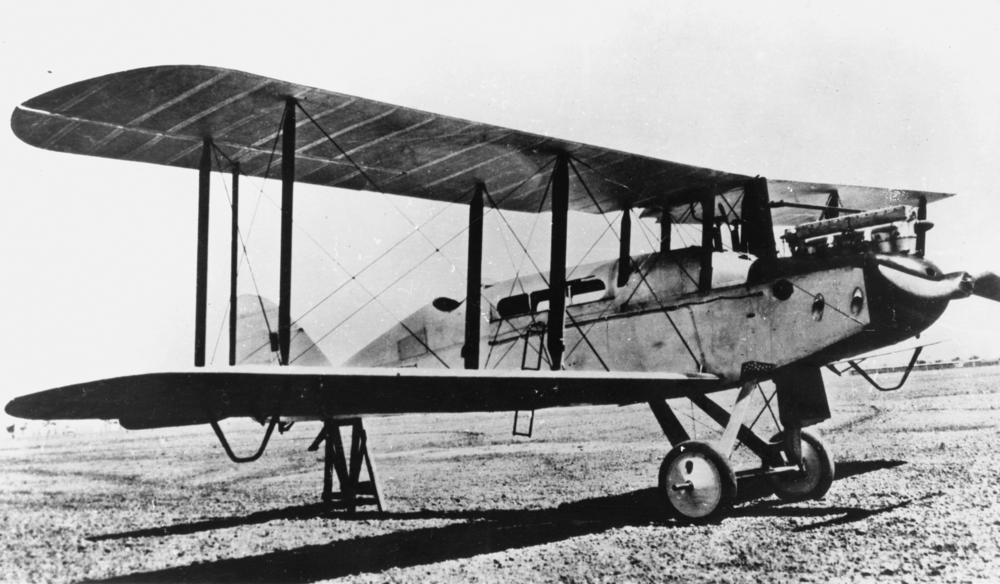
The Airco DH.9C was not a distinct production aircraft but a civil passenger conversion of the Airco DH.9, a wartime day-bomber. Designed by Geoffrey de Havilland for the Aircraft Manufacturing Company (Airco), the base DH.9 airframe first flew in July 1917. While the military version was one of Britain's first purpose-built strategic bombers, the DH.9C variant re-purposed this design for peacetime commercial use, appearing from 1919 into the early 1920s.
The conversion process transformed the bomber into a light airliner or utility transport. The primary modification involved re-configuring the aft fuselage to accommodate a cabin for three passengers and one pilot, totaling four seats. These conversions were carried out in Britain, primarily by the de Havilland organization and associated firms, using surplus military airframes. While thousands of DH.9s were produced during the war—including 3,024 in Britain and 1,415 in the United States—the exact number of DH.9C conversions is not reliably recorded.
Technically, the DH.9C retained the general characteristics of the base DH.9, featuring a wood and fabric two-bay biplane structure with a length of approximately 30 ft 6 in and a wingspan of 45 ft 11 in. Most conversions likely utilized the Siddeley Puma water-cooled inline piston engine, which produced approximately 200 hp. Although this engine was noted for unreliability in military service, it remained the standard for many early civil conversions. The aircraft's performance envelope was based on the DH.9, which had a maximum speed of roughly 110–115 mph and a range of 350–400 miles.
In civil service, the DH.9C operated on short regional and feeder routes within the British Isles and the British Empire. Documented operations include scheduled services in 1923, where three DH.9B/C aircraft completed 311 flights between April and October. Additionally, photographic evidence confirms the operation of a DH.9C in Queensland, Australia, between 1924 and 1926. While the original manufacturer, Airco, became defunct by 1920–1921, the design lineage continued through the de Havilland Aircraft Company. Today, while a restored DH.9 bomber (G-CDLI) is airworthy, no surviving aircraft are explicitly documented in the DH.9C passenger configuration.