
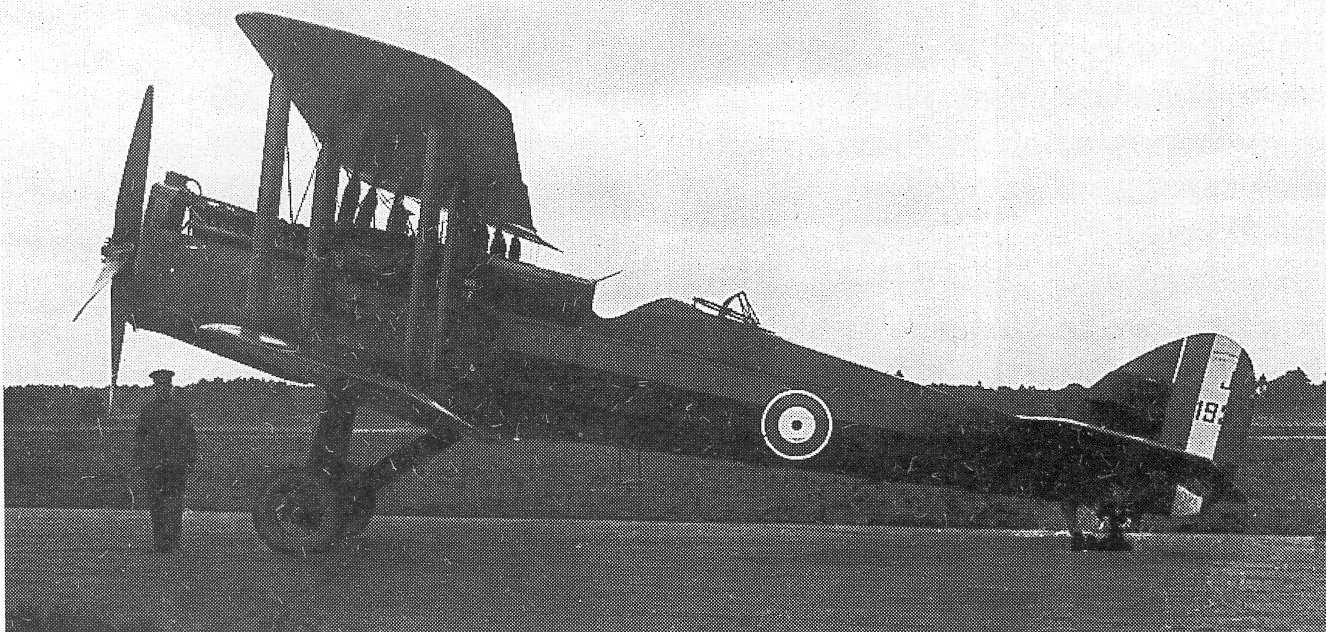
Designed by Captain Geoffrey de Havilland, the Airco DH.14 Okapi was conceived between 1918 and 1919 as a replacement for the Airco DH.4 and DH.9 day bombers. The aircraft was essentially a scaled-up version of the DH.9, utilizing a similar two-bay biplane configuration with tandem open cockpits for the pilot and observer/gunner. To enhance performance and payload, de Havilland integrated a significantly more powerful Rolls-Royce Condor I water-cooled V-12 engine, producing 525 hp, which was a substantial increase over the engines used in its predecessors.
Production took place at the Aircraft Manufacturing Company Ltd (Airco) works in Hendon, north-west London. Only three airframes were ever completed. Two were built as military bombers, designated J1938 and J1939, while a third was developed as a civil variant, the DH.14A. The DH.14A was a private venture long-range mailplane (registered as G-EAPY, c/n E46) powered by a 450 hp Napier Lion engine, intended to compete in a Daily Mail long-distance air mail competition.
Technically, the military DH.14 was notable for its internal bomb stowage, featuring two fuselage bomb bays that carried six 112-lb (51 kg) bombs to reduce aerodynamic drag. Its armament included one fixed forward-firing 0.303 in Vickers machine gun and one 0.303 in Lewis gun mounted on a Scarff ring in the rear cockpit. Performance figures for the bomber variant included a maximum speed of 122 mph at 10,000 ft, a rate of climb of 400 ft/min, and an endurance of five hours.
Despite its technical advancements, the Okapi never entered series production. The Royal Air Force declined to place an order due to severe post-World War I budget cutbacks and a surplus of existing wartime aircraft. The prototype J1938 was reportedly lost or seriously damaged after hitting trees at Burnham Beeches on February 10, 1922. The failure of the project coincided with the financial collapse of Airco, which was acquired by BSA in early 1920, leading Geoffrey de Havilland to establish his own independent company later that year. No complete examples of the DH.14 or DH.14A are known to survive today.