
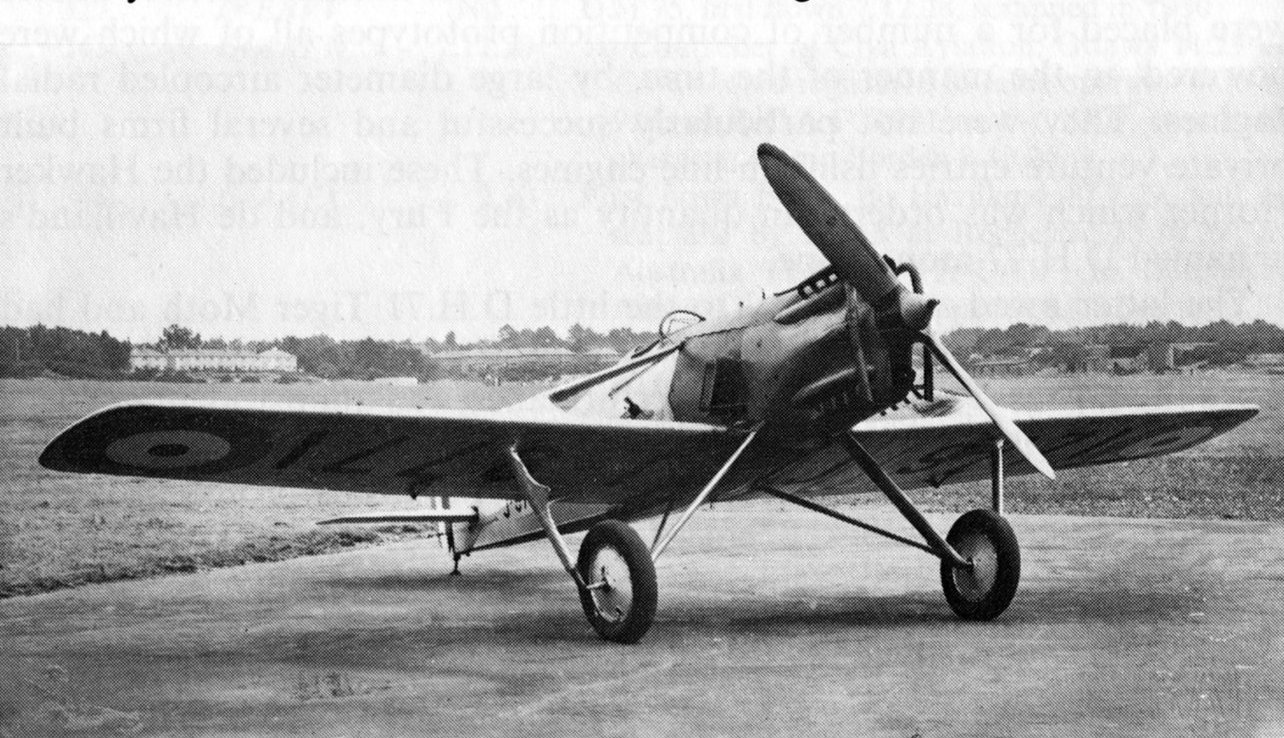
The de Havilland DH.77 was developed in the late 1920s as a response to a 1927 Air Ministry specification for a high-altitude interceptor. Designed to meet the needs of the Royal Air Force (RAF), the aircraft was a small, lightweight low-wing monoplane. This configuration was highly unconventional for the era, as most contemporary fighter contenders—including the eventual production winner, the Hawker Fury—were biplanes. The DH.77 utilized a mixed construction of metal and wood, representing the transitional engineering phase of the period.
Central to the DH.77's design was the installation of a Napier Rapier I engine. This air-cooled 16-cylinder H-engine, produced by D. Napier & Son, delivered 300 hp (220 kW). Although this power output was modest, the H-layout provided a very low frontal area, which significantly reduced drag and enhanced the aircraft's aerodynamic efficiency. This efficiency allowed the DH.77 to achieve performance levels that rivaled the more powerful Hawker Fury prototypes during evaluations conducted around 1929. The aircraft's primary objective was rapid climb performance to effectively counter bomber threats at high altitudes.
Technically, the DH.77 featured a length of 24 ft 4¾ in (7.44 m) and a wingspan of 32 ft 2 in (9.80 m). With an empty weight of 1,655 lb (751 kg) and a loaded weight of 2,279 lb (1,034 kg), it reached a maximum speed of 204 mph (328 km/h) at 10,000 ft (3,000 m). Its rate of climb was 1,885 ft/min (9.58 m/s), and it possessed a service ceiling of 25,900 ft (7,900 m). For armament, it was equipped with two 0.303 in Vickers machine guns synchronized and mounted on either side of the cockpit.
Despite its technical promise, the Air Ministry rejected the DH.77 in favor of the Hawker Fury biplane. Only one prototype was ever built, and it never entered series production. The sole aircraft remained in use for experimental testing at the Aeroplane and Armament Experimental Establishment (A&AEE) at Martlesham Heath until 1934. No examples of the DH.77 survive today. However, the aircraft's legacy persists through the Napier Rapier engine; the work of designer Frank Halford on the Rapier eventually led to the development of the powerful Napier Sabre engine used in the Hawker Typhoon and Tempest during World War II.