
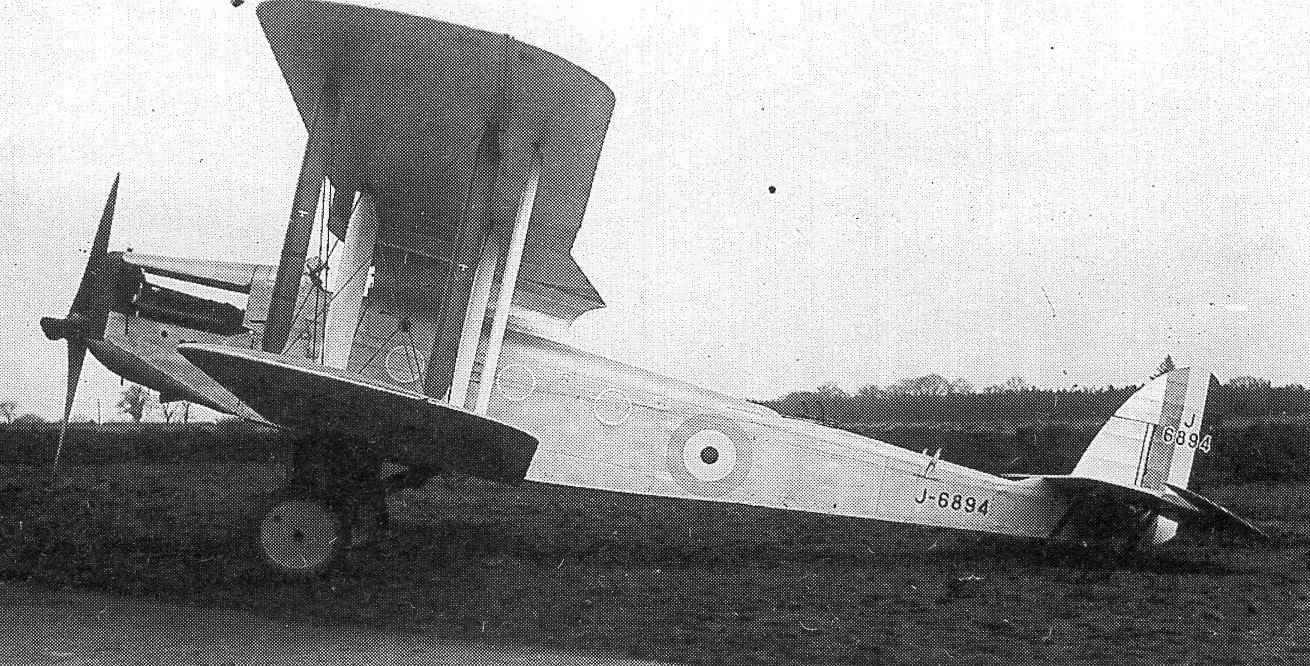
The de Havilland DH.27 Derby was developed in the early 1920s to meet Air Ministry Specification 2/20, which called for a long-range heavy day bomber. Designed under the leadership of Geoffrey de Havilland, the aircraft represented a transitional phase for the company as it moved from wartime production to new military contracts. The DH.27 was a large, two-bay biplane featuring a wooden and fabric construction. A distinctive design feature was its foldable wings, which allowed the aircraft's width to be reduced from a 64 ft 6 in span to just 30 ft for easier storage or hangar use.
Technically, the Derby was an ambitious attempt to power a heavy bomber with a single engine. It was equipped with one Rolls-Royce Condor III, a water-cooled, 60-degree V-12 piston engine producing approximately 650 hp (480 kW). This engine drove a four-bladed wooden fixed-pitch propeller. The aircraft had a crew of three, typically consisting of a pilot, a navigator/bomb-aimer, and a gunner. For defense, it carried a single 0.303 in Lewis gun mounted on a Scarff ring in the dorsal cockpit. Its offensive capabilities included the ability to carry up to four 550 lb bombs externally, for a total maximum bomb load of roughly 2,200 lb.
Only two prototypes were constructed at the de Havilland Aircraft Company's facility at Stag Lane Aerodrome in Edgware, north London. The first prototype flew on 13 October 1922. Despite its technical capabilities, including a maximum speed of 105 mph and a range of 550 miles, the aircraft never entered series production. The two prototypes were utilized for trials and general duties at the RAF Martlesham Heath (the Aeroplane and Armament Experimental Establishment) and the naval station on the Isle of Grain. These evaluations continued until approximately 1924, after which the project was terminated and the airframes were presumably scrapped.
While the DH.27 Derby did not see operational service or combat, it provided valuable experience for de Havilland in handling heavy bomb loads and integrating high-power engines. Today, no examples of the aircraft survive, though archival documents are held by the Smithsonian National Air and Space Museum.