
Revolutionary Design and Development
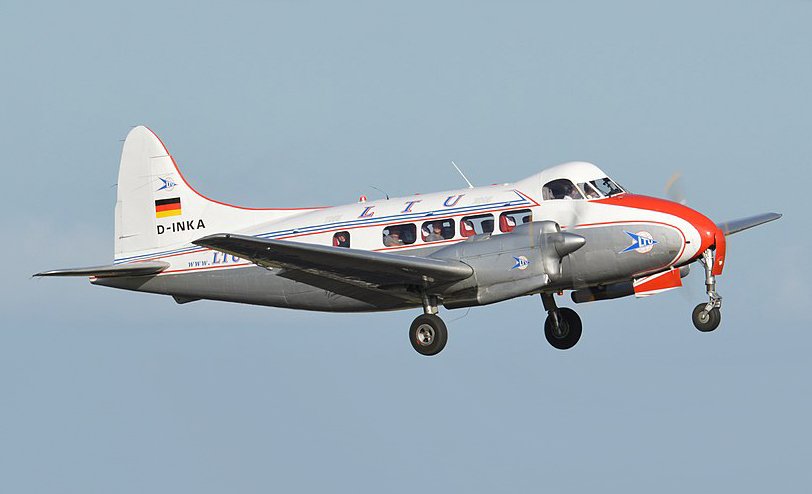
The Dove emerged from the post-war Brabazon Committee's vision for British aviation dominance in the short-haul feeder market. De Havilland's in-house design team created the aircraft as a direct successor to their pre-war DH.89 Dragon Rapide biplane, incorporating cutting-edge construction techniques that would define modern airliner manufacturing. The prototype G-AGPJ (construction number 04001) took to the skies on September 25, 1945, at Hatfield airfield in Hertfordshire, marking a pivotal moment in British aviation history.
Technical Innovation and Manufacturing Excellence
De Havilland pioneered several revolutionary features in the Dove's design. The aircraft became the first British transport to incorporate reversible-pitch propellers for braking assistance, dramatically improving short-field performance. More significantly, it represented the first all-metal British airliner constructed primarily using advanced bonding techniques rather than traditional riveting, earning it the distinction of being "glued together." This semi-monocoque construction method would influence aircraft manufacturing for decades.
Production began at de Havilland's historic Hatfield facility before shifting to the Broughton plant near Chester in 1951. The company maintained consistent output through changing ownership structures, continuing production even after the 1960 merger with Hawker Siddeley. Notable among production aircraft was VH-DHI (Dove 2), constructed at Hawarden on January 22, 1953, which demonstrated the aircraft's international appeal.
Powerplant and Performance
The Dove's heart consisted of two de Havilland Gipsy Queen inline piston engines, available in several variants producing between 330 and 340 horsepower each. The Gipsy Queen 70-3 delivered 246 kW (330 hp), while later versions including the 70-4 and Mk 2 variants generated 254 kW (340 hp). American export models received uprated powerplants for enhanced performance in diverse operational conditions. The engines drove three-blade hydromatic feathering propellers, providing pilots with unprecedented control during approach and landing phases.
Commercial Success and Global Operations
The Dove achieved immediate commercial success, entering revenue service with Central African Airways in December 1946. Airlines (WA) Ltd introduced the first Australian Dove, VH-AQP (construction number 04012), on March 25, 1947, subsequently operating five aircraft by 1955 and establishing regular scheduled services across the continent. South African Airways deployed ZS-BCC (construction number 04079) from 1948 to 1951 on routes connecting Palmietfontein to Windhoek and Mozambique, demonstrating the aircraft's capability for demanding African conditions.
The aircraft's versatility attracted operators across more than 15 countries, with configurations ranging from 6-passenger executive layouts in the Dove 2 and 6 variants to high-density 11-passenger arrangements in the Dove 1. Specialized applications included photographic survey work, with companies like Fairey Surveys operating modified aircraft for aerial mapping missions.
Military Service and Government Operations
While designed for civilian use, the Dove found extensive military application in the post-war era. The Royal Air Force adopted the type as the Devon C-1 for communications duties, while the Royal Navy operated the Sea Devon variant for similar roles. The Royal New Zealand Air Force acquired 30 Devons (serial numbers NZ1801 through NZ1830, construction numbers 04050 and 04169-04428) in 1952, utilizing them for communications and navigation training until replacement by Cessna 414s in the late 1970s.
The de Havilland Legacy
The de Havilland Aircraft Company, founded by aviation pioneer Geoffrey de Havilland in 1920, established itself through innovations like the Moth training series and the legendary Mosquito fighter-bomber. The Dove represented the company's first major post-war success, bridging the gap between pre-war biplane transports and the approaching jet age. Following the 1960 merger with Hawker Siddeley, production continued under new ownership, with the final Dove Mk.8 completed in 1968.
Enduring Influence and Preservation
With 544 aircraft constructed over 23 years of production, the Dove became one of Britain's most successful post-war aircraft programs. The type fundamentally transformed short-haul aviation by proving that small airlines could operate modern, all-metal aircraft economically. More than five decades after production ended, dozens of Doves remain airworthy worldwide, testament to their robust construction and enduring appeal.
Museum preservation efforts maintain the Dove's legacy, with notable examples including a Dove Mk.8 at the de Havilland Museum and a Dove 6 in the British Airliner Collection. These preserved aircraft serve as tangible reminders of Britain's post-war aviation renaissance and the innovative spirit that characterized de Havilland's approach to aircraft design and manufacturing.