
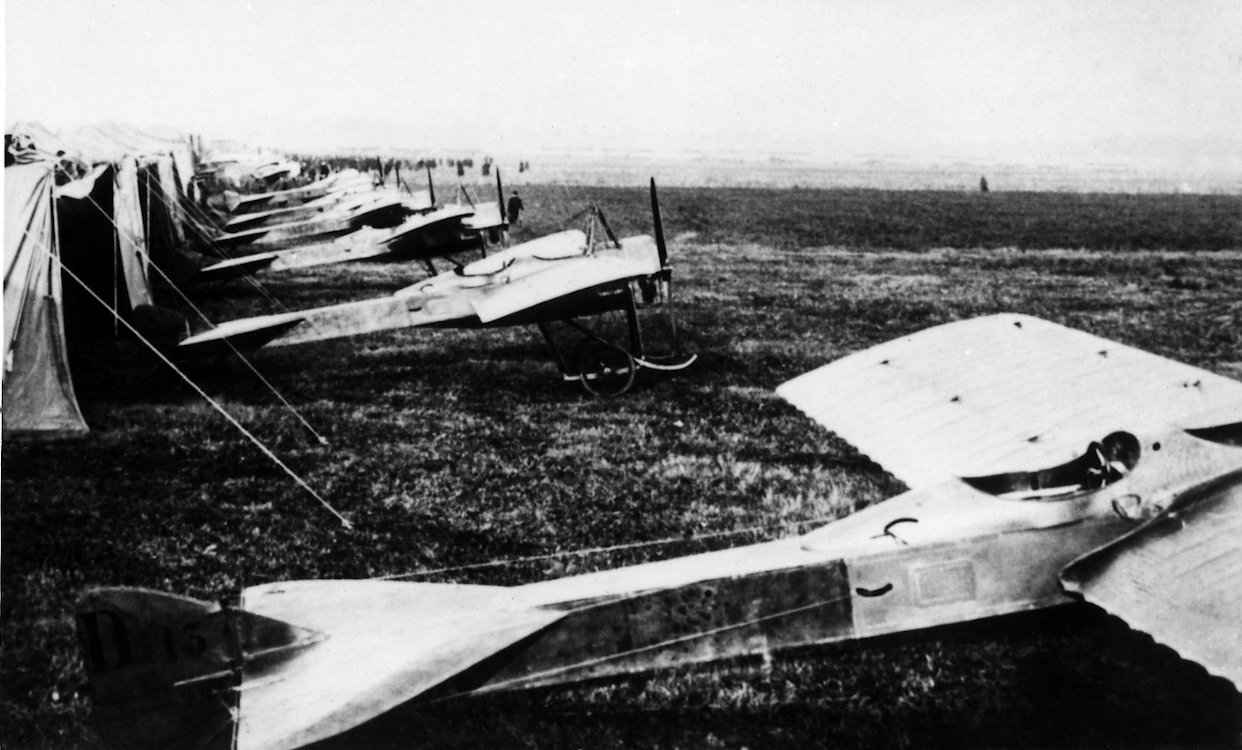
The Deperdussin TT was a two-seat military reconnaissance monoplane introduced in 1911. Developed by the firm founded by Armand Deperdussin, the aircraft was designed during a period when military aviation was transitioning from experimental prototypes to standardized reconnaissance types. The TT was characterized by its mid-wing monoplane configuration and was powered by a single 80 hp Gnome rotary piston engine manufactured by the Société des Moteurs Gnome.
Production of the TT was marked by significant international export success. While early examples and prototypes were associated with the firm's operations at Bétheny near Reims, the aircraft was widely license-built abroad. In Russia, the Lebedev company produced 63 units, and additional aircraft were manufactured in Highgate, London, by the British Deperdussin company. This widespread production indicates the TT's role as a capable military machine in the years leading up to the First World War.
In terms of design and development, the TT was flying by September 1911, as evidenced by its participation in a military competition at Reims-Bétheny as a two-seat model. While the firm was led by Armand Deperdussin, the specific engineer responsible for the TT is not named in available records, though the company later became famous for the designs of Louis Béchereau. The TT served as a precursor to the Deperdussin T, a 1912 reconnaissance monoplane that shared similar engine ratings and configurations.
The manufacturer underwent several corporate transformations. Originally established as Aéroplanes Deperdussin (or Société Pour les Appareils Deperdussin) in January 1911, the company was renamed Société de Production des Aéroplanes Deperdussin (SPAD) in 1912. Following a financial scandal involving Armand Deperdussin, the company was reconstituted in 1914 as Société Pour L’Aviation et ses Dérivés. This entity eventually produced the renowned SPAD VII and XIII fighters before merging with Blériot Aéronautique in 1921 to form Blériot-SPAD. The original company is now defunct.