
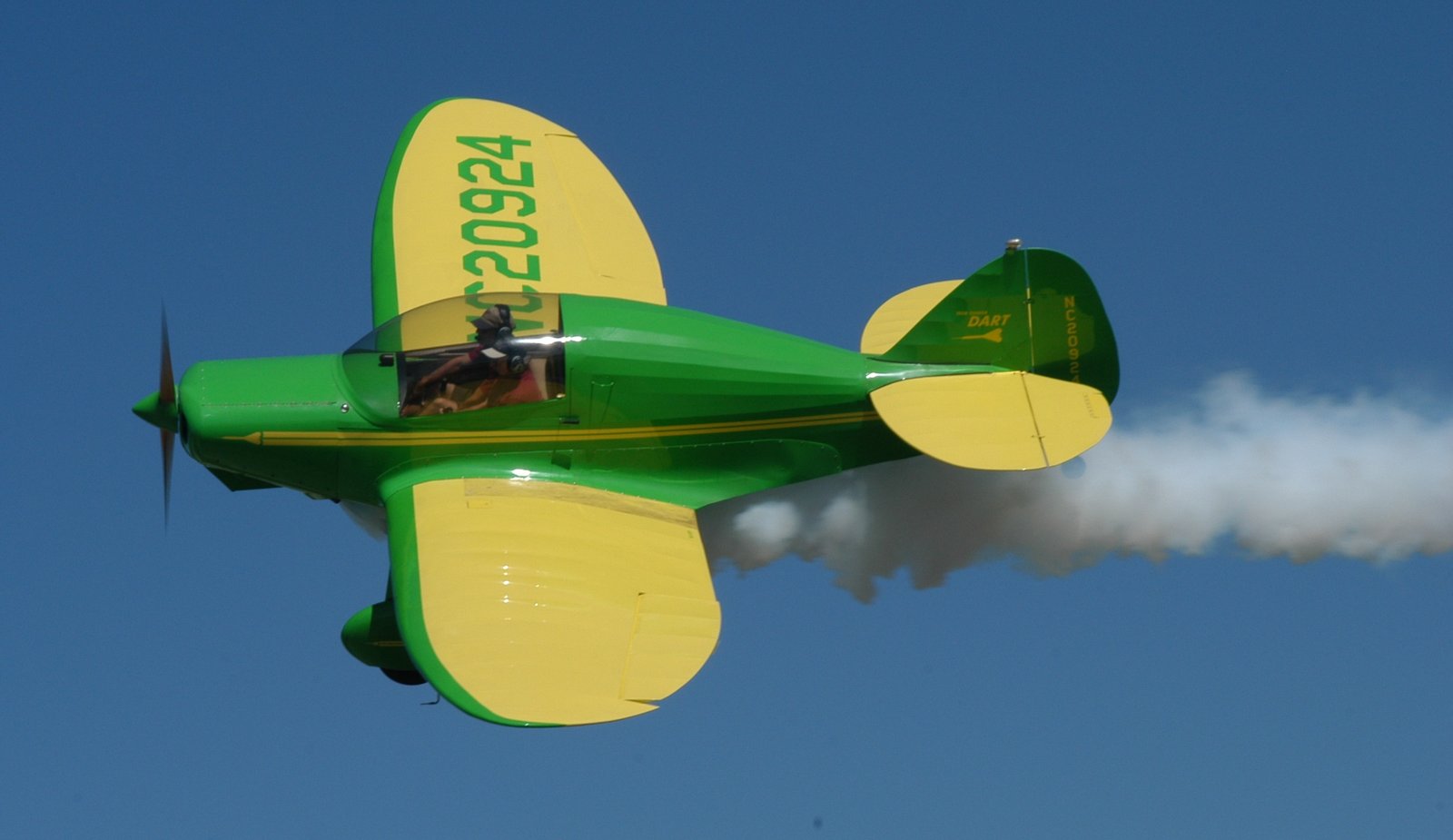
Design and Development
The Dart Model G emerged from the skilled hands of Al Mooney, who had previously contributed to the Alexander Eaglerock design before joining Lambert Aircraft Corporation as chief engineer. Mooney's design philosophy focused on creating a compact cabin monoplane that would offer improved performance and comfort over contemporary open-cockpit aircraft. The aircraft featured mixed construction techniques, combining a welded steel tube fuselage with wooden wings, wrapped in an enclosed cabin configuration that earned it a distinctively "chubby" appearance.
The design incorporated several advanced features for its era, including NACA cowling for improved streamlining and a widened fuselage to accommodate comfortable side-by-side seating. The low-wing configuration provided good ground stability and handling characteristics, while the enclosed cabin offered protection from the elements that open-cockpit pilots had long endured. Mooney's attention to visibility resulted in generous window areas that gave occupants excellent sightlines during flight.
Manufacturing History
The aircraft's production story reflects the turbulent nature of small aircraft manufacturers during the late 1930s. Originally developed under Lambert Aircraft Corporation at Lambert Field in St. Louis, Missouri, the design transitioned through multiple corporate entities. Lambert Aircraft, founded in July 1934, evolved into Monocoupe Corporation before the designs and manufacturing rights were acquired by Dart Manufacturing Corporation, which subsequently reorganized as Culver Aircraft Company in 1939.
Production began in 1938 following the granting of Approved Type Certificate ATC #674 in April of that year. Dart Aircraft Company manufactured the first 50 aircraft before Culver Aircraft took over production. Manufacturing facilities shifted from the original St. Louis location to various sites including Wichita, Quincy, Michigan, and Elkhart, Indiana. Culver also contracted Meyers Aircraft in Tecumseh to assemble 14 GC variants during the postwar period. Total production reached exactly 51 aircraft before manufacturing ceased in 1941.
Engine Variants and Performance
The standard Dart Model G utilized a 90-horsepower Lambert five-cylinder radial air-cooled engine, though this powerplant proved problematic due to reliability issues that plagued the "orphan" engine manufacturer. To address these concerns, several engine variants were developed. The GK variant employed either a 90-horsepower Ken Royce or Le Blond radial engine, while the GW model featured a 90-horsepower Warner Scarab Junior radial paired with a Hamilton Standard aluminum propeller.
Postwar GC variants adopted the more reliable 100-horsepower Continental flat-six engine, representing a significant improvement in powerplant dependability. Experimental installations included 120-horsepower Ken Royce engines and various Warner configurations ranging from 125 to 145 horsepower. Some aircraft were later modified with 125-horsepower Lycoming or 165-horsepower Warner engines, demonstrating the design's adaptability to different powerplants.
With the standard 90-horsepower Lambert engine, the Dart G achieved a maximum speed of 135 mph and cruised at 118 mph at 65 percent power. Initial climb rate reached 850 feet per minute, with a service ceiling of 15,000 feet and a range of 580 miles at 70 percent power settings. The aircraft's gross weight of 1,550 pounds against an empty weight of 910 pounds provided a useful load of 640 pounds.
Operational Service
The Dart Model G served exclusively in civilian roles, finding its niche among private owners and sport pilots who valued its enclosed cabin comfort and reasonable performance. Unlike military trainers of the era, the Dart G was designed purely for personal transportation and recreational flying. Its side-by-side seating arrangement with dual controls made it suitable for flight training, though it never achieved significant adoption by flight schools.
Operational examples included aircraft based at Oakland, California, and McCook, Nebraska, with at least one example still flying as late as 1971. The McCook aircraft retained its original 90-horsepower Warner engine configuration, while the Oakland example was later rebuilt with a 165-horsepower Warner engine and relocated to Chatsworth, California, demonstrating the type's potential for performance upgrades.
Legacy and Survivors
The Dart Model G's primary historical significance lies in its representation of Al Mooney's design evolution, serving as a stepping stone toward his later acclaimed Mooney aircraft series. While the limited production run of 51 aircraft meant the type never achieved widespread recognition, it embodied the transition from open-cockpit flying to enclosed cabin comfort that characterized aviation's progression during the late 1930s.
Survival rates remain limited due to the small production numbers and the passage of eight decades. Historical records indicate at least two examples remained airworthy into the 1970s, though current flying status is uncertain. The aircraft's mixed construction techniques and relatively obscure engine options have likely complicated maintenance and restoration efforts. While not represented in major aviation museums, the Dart G remains an interesting footnote in the development of American light aircraft and Al Mooney's distinguished design career.