
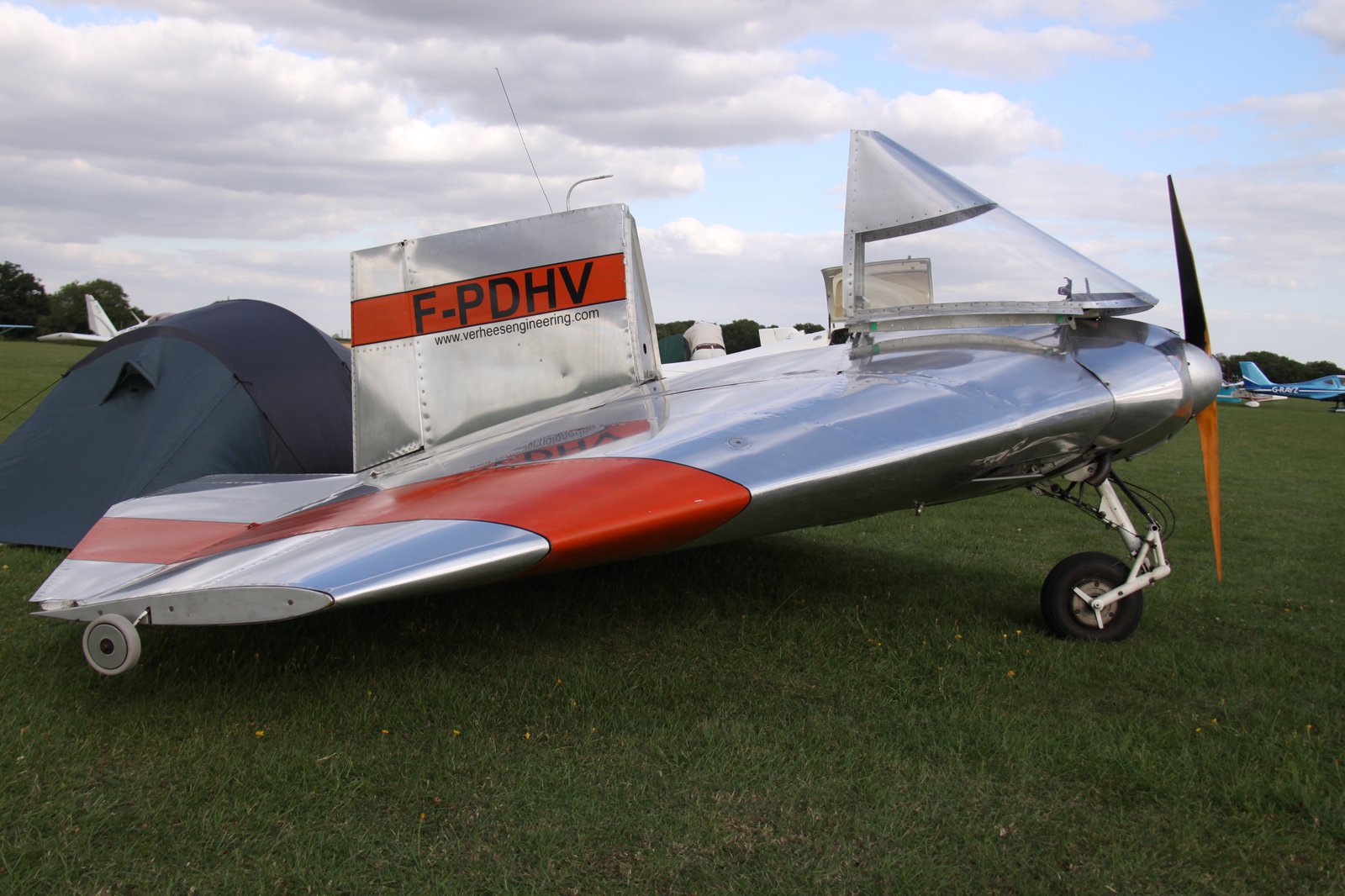
Design Philosophy and Innovation
The D-1 Delta emerged from Bart Verhees' deliberate rejection of conventional amateur-built aircraft design. While most homebuilt aircraft followed traditional Bleriot-influenced configurations, Verhees chose the delta-wing planform historically reserved for high-performance military aircraft like the Avro Vulcan and Dassault Mirage series. His objective was achieving superior stability and reduced turbulence sensitivity in a practical amateur-built aircraft, despite the unusual appearance that would inevitably draw skeptical attention at any airfield.
The design's most remarkable characteristic is its automatic pitch stability in turbulent conditions. When encountering updrafts or thermals, the D-1's nose automatically lowers slightly, limiting acceleration to approximately one g and providing exceptionally smooth flight in rough air. This inherent stability results from the delta wing's aerodynamic properties, which Verhees successfully adapted to low-speed flight regimes.
Technical Configuration
Constructed primarily from sheet aluminum, the D-1 measures 14 feet 9 inches in wingspan with a wing area of 110 square feet, resulting in an extremely low aspect ratio of 4.5. The aircraft employs two large elevons at each wing's trailing edge, combining aileron and elevator functions in a simplified control system requiring only two steering rods from the cockpit stick. A conventional vertical stabilizer with rudder completes the control arrangement, though the rudder serves primarily for engine torque compensation rather than turning.
The powerplant selection reflects the amateur-built market's emphasis on cost-effectiveness and accessibility. The 1.6-liter Subaru EA71 flat-four automotive conversion engine produces 50 horsepower, with its liquid-cooling radiator cleverly hidden within the right wing. This automotive powerplant drives the D-1 to a maximum speed of 170 mph and cruise speed of 140 mph, while maintaining a remarkably low stall speed of just 53 mph.
Verhees Engineering Legacy
Verhees Engineering, the Belgian company founded by Bart Verhees, continues operating as a specialist in unconventional amateur-built aircraft designs. Rather than manufacturing complete aircraft, the company supplies detailed construction plans to individual builders worldwide, supporting the experimental aviation community's do-it-yourself tradition. The D-1 project validated Verhees' design philosophy sufficiently to justify development of the larger D-Plane 2, which first flew in early 2018 with seating for two and a 100-horsepower Rotax 912ULS engine.
Operational Characteristics
Pilots report that the D-1's handling characteristics differ markedly from conventional aircraft. Takeoff technique requires maintaining a slightly aft stick position, allowing the aircraft to fly off naturally without excessive elevator input that would diminish wing lift and extend the ground roll. Landing approaches benefit from a fixed relationship between elevator position and airspeed, independent of power settings, enabling pilots to establish the correct elevator position and maintain it throughout final approach.
The aircraft's portability represents another practical advantage for amateur builders. The wings fold upward by removing a single pin, and complete assembly or disassembly requires approximately 15 minutes. This capability allows trailer storage and eliminates hangar rental costs, addressing a significant expense concern for recreational pilots.
Production and Current Status
Only one D-1 prototype was constructed and flown, accumulating more than 1,100 flight hours through 2012 when construction plans remained available to amateur builders. The single example served for personal flying and airshow demonstrations, proving the delta-wing concept's viability for light aircraft applications. With an empty weight of 463 pounds and gross weight of 750 pounds, the D-1 carries 60 liters of fuel while maintaining a wing loading of just 7.0 pounds per square foot.
The D-1's legacy extends beyond its flight hours to its influence on amateur aviation design thinking. By successfully adapting delta-wing aerodynamics to low-speed flight, Verhees demonstrated that unconventional configurations could offer practical advantages over traditional designs. The prototype's extensive flight testing provided data supporting development of the two-seat D-2 variant, which cruises at approximately 155 mph and continues the delta-wing lineage into current amateur-built aviation.