
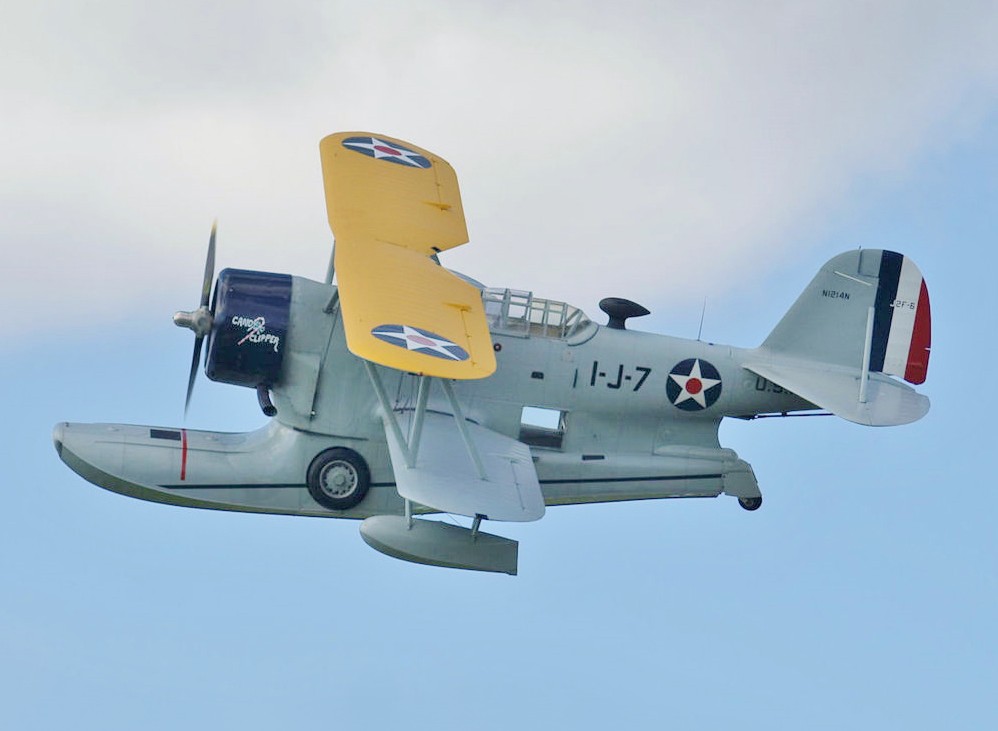
Service Dominance
The J2F Duck filled a critical niche in military aviation, serving simultaneously with the U.S. Navy, Marine Corps, Coast Guard, and later the Air Force as the OA-12. From 1934 through the early 1950s, it remained the primary amphibious utility aircraft for American forces, handling missions no other single aircraft could accomplish with equal versatility. The Coast Guard operated 15 JF-2 variants by 1936 for coastal patrol duties, while Navy and Marine variants performed everything from executive transport to anti-submarine warfare.
Wartime Operations
During World War II, the Duck proved invaluable in both combat and support roles. J2F-5 and J2F-6 variants carried 325-pound depth charges on underwing racks for anti-submarine patrol, while earlier JF-2 models featured nose and dorsal machine guns with bomb racks. The aircraft's ability to land on water made it ideal for search and rescue operations in the Pacific theater, where downed aircrews could be recovered from remote locations inaccessible to conventional aircraft. Beyond combat zones, 20 J2F-3 variants served as executive transports in 1939, carrying high-ranking military officials between bases and ships.
Design Innovation
Charles Tilgner's revolutionary 1931 design concept replaced the antiquated Loening amphibians with a completely integrated approach. Rather than mounting separate floats, Tilgner incorporated the hull directly into the fuselage, creating a streamlined single-step design that dramatically reduced drag. This innovation enabled the J2F-1 to set an amphibian speed record of 191 mph in 1937, proving that water-capable aircraft need not sacrifice performance for versatility.
The Manufacturer
Grumman Aircraft Engineering Corporation, founded in 1929, established itself as the Navy's premier contractor through the Duck's success. As World War II expanded production demands, Grumman transferred J2F manufacturing to Columbia Aircraft Corporation on Long Island in December 1941, freeing capacity for critical fighter production like the F4F Wildcat. Columbia built 330 J2F-6 variants, the most numerous of all Duck versions. Grumman continued operations until 1994, when it merged with Northrop to form Northrop Grumman, which remains a major defense contractor today.
Engine and Technical Specifications
Early prototypes utilized Pratt & Whitney R-1535-62 or R-1830-62 Twin Wasp engines producing 700 horsepower, but production aircraft standardized on Wright Aeronautical's R-1820 Cyclone series. The nine-cylinder radial engine evolved throughout the Duck's production run, culminating in the R-1820-54 generating 1,050 horsepower in late J2F-6 models. Wright's Cyclone proved exceptionally reliable in maritime patrol roles, featuring supercharging for improved high-altitude performance and the ruggedness necessary for water operations.
Production Legacy
Grumman's production planning reflected the aircraft's specialized role, with 632 total examples built across nine major variants. Initial JF-1 production comprised 27 aircraft in 1934, followed by JF-2 (21 units) and JF-3 (5 units). The J2F series began with 29 J2F-1s, progressing through 21 J2F-2s, 9 J2F-2As, 20 J2F-3s, 144 J2F-5s, and 330 J2F-6s. This measured production approach ensured each variant incorporated lessons learned from operational experience.
Current Survivors
At least one airworthy example remains active today: a 1944 Columbia-built J2F-6 bearing registration N1196N, displayed at the EAA Museum in Wisconsin. The Naval History and Heritage Command preserves another J2F-6 for historical study, representing the final production variant. These survivors serve as reminders of an era when amphibious aircraft provided essential military capabilities, bridging the gap between land-based aviation and naval operations in ways that pure seaplanes or conventional aircraft could not match.
Operational Impact
The Duck's significance extends beyond its technical innovations to its role in establishing amphibious aviation as a viable military discipline. Its service span from 1934 through the early 1950s demonstrated that specialized utility aircraft could remain relevant even as faster, more powerful designs emerged. The J2F proved that operational versatility often trumped pure performance, a lesson that influenced subsequent amphibious aircraft development and military procurement strategies for decades.