
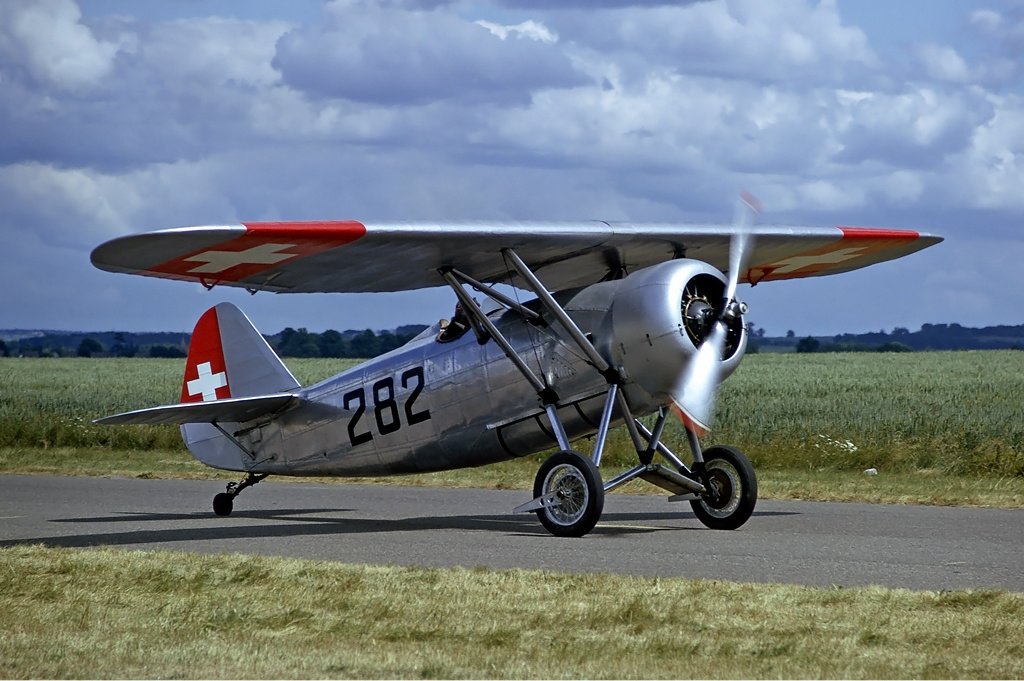
Service History
The D-26 served exclusively with the Swiss Air Force from 1931 to 1948, fulfilling a specialized role as an advanced military trainer for gunnery practice, formation flying, and air-to-air combat techniques. All 12 aircraft operated throughout the interwar period and World War II in neutral Switzerland, training Swiss pilots in combat maneuvers using gun cameras mounted on upgraded variants. The aircraft's design allowed for easy conversion to fighter configuration, sharing its airframe with the combat-oriented D-27.
Following military retirement in 1948, the entire fleet transferred to the Aero-Club der Schweiz (Swiss Aero Club), where the aircraft served as glider tugs until 1970. This secondary career extended the operational life of these rare machines for over two decades in civilian service.
The Manufacturer
Émile Dewoitine founded his aircraft company in 1920, initially achieving success with parasol-wing designs like the D-9 through military contracts in Switzerland and Italy. However, financial difficulties forced the company into liquidation in 1927. Dewoitine himself relocated to Switzerland that same year, partnering with SVAC (Société Suisse de Constructions Aéronautiques) to continue aircraft development.
The D-26 represented a significant technological leap for Dewoitine's designs, incorporating advanced all-metal semi-monocoque construction at the specific request of the Swiss military technical service. This construction method would influence Dewoitine's later work, including his famous D-520 fighter that served France during World War II after the company merged into nationalized French aviation efforts.
Engine & Technical Innovation
The aircraft utilized the Wright 9Qa (R-975) air-cooled radial engine, producing 250 kilowatts (340 horsepower) in its standard configuration. Ten aircraft received this original powerplant, while two additional machines and one retrofit incorporated higher-powered versions. Later restorations employed Hispano-Suiza 9Aa engines, licensed versions of the Wright design producing 350 horsepower from nine cylinders with 16-liter displacement.
The D-26's revolutionary semi-monocoque metal construction marked Switzerland's entry into modern aircraft technology. The stressed-skin fuselage provided structural integrity while reducing weight compared to traditional fabric-and-tube construction. The parasol wing configuration offered excellent visibility for training purposes, while the uncowled radial engine simplified maintenance and reduced complexity for military operations.
Design Philosophy
Émile Dewoitine's design objectives prioritized versatility and advanced training capabilities. The aircraft shared its basic airframe with the D-27 fighter, enabling rapid conversion between training and combat roles. This commonality reduced manufacturing costs and simplified maintenance logistics for the Swiss Air Force. The 300-400 kilogram weight reduction compared to the D-27 improved handling characteristics essential for training inexperienced pilots.
The single-seat configuration prepared pilots for solo combat missions while gun camera installations provided realistic gunnery training without live ammunition expenses. Provisions for machine gun synchronization equipment allowed conversion to operational fighter status when required.
Production & Legacy
Dewoitine manufactured components in France during 1931, with final assembly completed at the K+W Thun facility in Switzerland. This arrangement satisfied Swiss requirements for domestic aircraft production while utilizing Dewoitine's advanced engineering expertise. The limited production run of 12 aircraft reflected Switzerland's modest military aviation requirements and budget constraints during the early 1930s economic difficulties.
Today, two D-26 aircraft remain airworthy in original condition, representing extraordinary preservation efforts. HB-RAG (serial number 286) operates from Grenchen LSZG under ownership of the Hangar 31 association since May 2015. This aircraft underwent complete restoration from 2000-2010 by Albert Zeller and volunteers, receiving a replacement Hispano-Suiza 9Aa engine producing 350 horsepower.
HB-RAI (serial number 284), based at Lausanne LSGL, completed restoration between 2011-2014 under Michel Devaud and the GMP team. This meticulous project required over 9,000 individual stitches for wing fabric restoration and installation of a 350-horsepower Hispano-Suiza powerplant.
These surviving aircraft perform as the "Patrouille Dewoitine - Swiss Air Force 1931" at European airshows, demonstrating 1930s aviation technology to modern audiences. A third example resides in the Dübendorf Military Aviation Museum, preserving this significant chapter in Swiss aviation history.
The D-26's cultural significance extends beyond its modest production numbers, representing Switzerland's transition to modern military aviation and Émile Dewoitine's innovative engineering during the crucial interwar period. As rare survivors from 1931 production, these aircraft embody the experimental spirit that shaped aviation's golden age.