
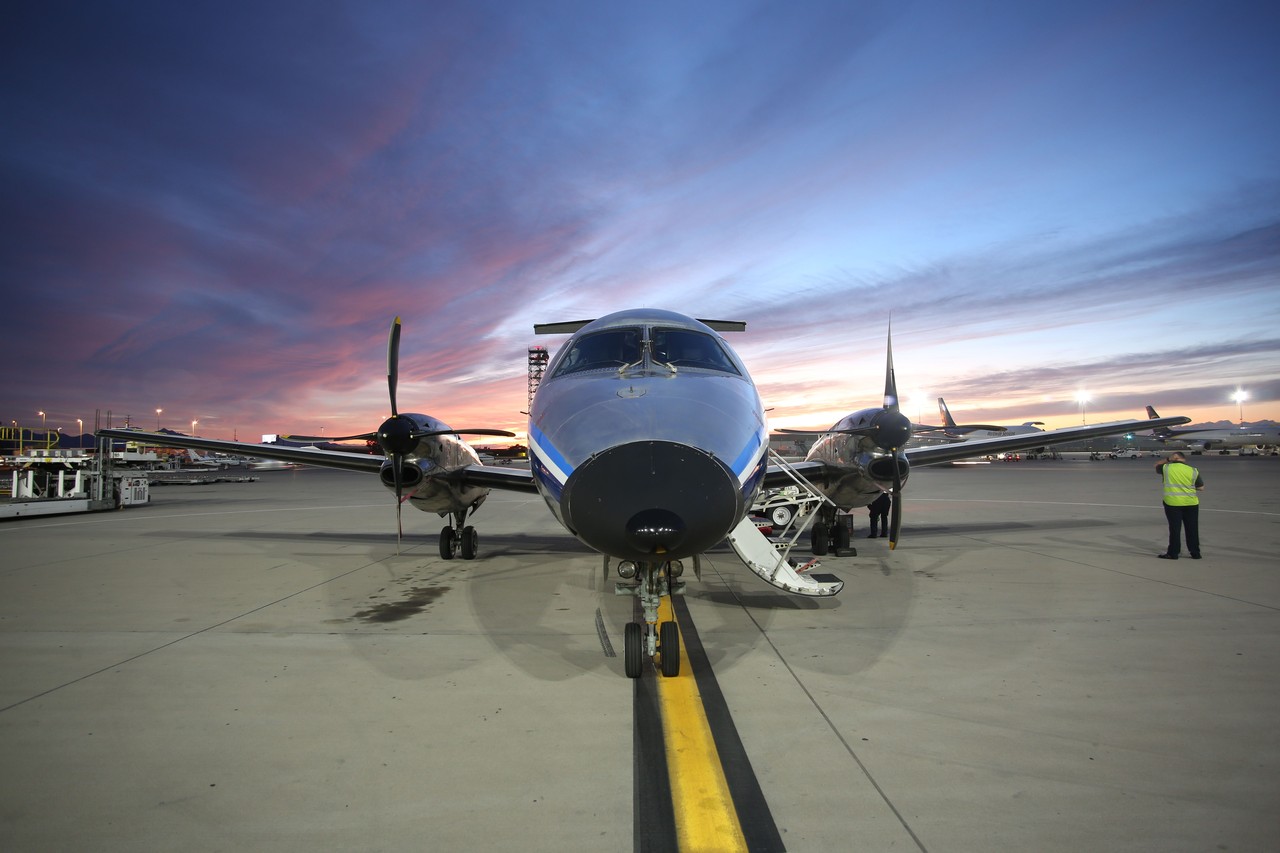
Regional Aviation Revolution
The Brasilia transformed regional aviation by offering jet-like speeds and comfort in turboprop economics. When Atlantic Southeast Airlines introduced the type to service in October 1985, regional carriers finally had an aircraft that could maintain schedules regardless of weather, climbing to altitudes above most turbulence while carrying passengers in pressurized comfort. The aircraft's 378 mph maximum speed at 20,013 feet made it the fastest turboprop of its era.
Development and Design Innovation
Embraer launched the Brasilia project in 1979 after abandoning an earlier modular aircraft family concept from 1974. The original Family 12X program would have produced three related aircraft sharing common components, but market analysis revealed that a dedicated 30-seat regional airliner offered better commercial prospects than the initially planned 24-seat design. Chief engineers incorporated several advanced features including a T-tail configuration for improved control authority, aluminum alloy construction with Kevlar reinforcement in critical areas, and low-mounted straight wings optimized for the aircraft's operational speed range.
The prototype took its maiden flight on July 27, 1983, powered by two Pratt & Whitney Canada PW115 turboprops producing 1,500 shaft horsepower each. Later production aircraft received the more powerful PW118 engines rated at 1,892 shaft horsepower, dramatically improving hot-and-high performance while maintaining power output at altitude.
Embraer's Strategic Success
Empresa Brasileira de Aeronáutica, established in 1969 as Brazil's state aerospace manufacturer, built the Brasilia program on experience gained from the smaller EMB-110 Bandeirante. The company navigated Brazil's economic turbulence of the 1990s, surviving privatization in 1994 before emerging as a global aerospace competitor. Today operating as Embraer S.A., the manufacturer has delivered thousands of regional jets worldwide, though the Brasilia marked their final turboprop airliner design.
Operational Excellence
Powered by Hamilton Standard 14RF19 four-bladed propellers, the Brasilia delivered performance that redefined regional aviation expectations. Pilots appreciated the aircraft's 101 mph stall speed with full flaps, providing comfortable approach speeds, while the 1,090-mile range with 30 passengers and 45-minute fuel reserves enabled non-stop service on routes like Miami to the Dominican Republic. The two-pilot cockpit featured modern instrumentation that simplified crew training transitions from smaller aircraft.
Operators across four continents embraced the Brasilia's capabilities. Spain's Swiftair utilized the type for European regional services, while France's Régional connected smaller cities to major hubs. Russia's Atlant-Soyuz operated Brasilias in the challenging climate of the former Soviet Union, and South African carriers converted aircraft for cargo operations across Africa's vast distances.
Enhanced Range Variant
Embraer announced the EMB-120ER extended-range variant in 1991, making it standard production by 1993. This version maintained the same passenger capacity while increasing operational range, enabling airlines to serve longer thin routes that couldn't support larger aircraft. The ER became particularly popular with cargo operators who converted passenger aircraft for freight service, taking advantage of the type's large cabin volume and excellent short-field performance.
Limited Military Service
Unlike many successful regional aircraft, the Brasilia saw minimal military application. The Brazilian Air Force operated a small number as VC-97 VIP transports, including aircraft serial 120003 designated FAB2000, but no combat variants were developed. Production timing from 1983 to 2001 occurred during a relatively peaceful period, limiting military interest in the design.
Operational Challenges
The Brasilia's safety record included the tragic Rico Flight 4815 accident on May 14, 2004, when PT-WRO crashed killing all 33 aboard, marking the deadliest accident involving the type. Despite isolated incidents, the aircraft maintained strong operational reliability across diverse operating conditions from Arctic routes to tropical cargo runs.
Production Legacy
Embraer delivered 357 Brasilias to 32 operators worldwide before ending production in 2001 without developing a direct turboprop successor. The company instead focused resources on developing the ERJ regional jet family, betting correctly that passengers preferred jet aircraft even on short routes. Many Brasilias continue operating today, particularly in cargo service where their large cabin cross-section and reliable twin-engine configuration remain valuable assets.
The Brasilia represented the final evolution of 30-seat turboprop technology, offering capabilities that bridged the gap between small commuter aircraft and regional jets. While Embraer moved beyond turboprops, the Brasilia's influence shaped the company's understanding of regional aviation markets, knowledge that proved crucial in developing the successful E-Jet series that followed.