
Military Service Dominance
The Xingu achieved its greatest success in military service, particularly with the French armed forces. France purchased 41 aircraft by the end of 1983, with 25 going to the Armée de l'Air and 16 to the Aéronavale. The first French Xingus arrived at Air Base 702 on March 29, 1983, replacing the aging Dassault 312 Flamant in liaison and training roles. By 2013, French Xingus had accumulated more than 330,000 flight hours, demonstrating exceptional reliability in military service.
The Brazilian Air Force operated the type from 1977 through 2010 via the Special Transportation Group based in Brasília. Unlike many executive aircraft that see limited military use, the Xingu proved itself as a dedicated military trainer and liaison aircraft, with 33 French examples still operational as of 2012 and 32 remaining in service by 2022.
The Manufacturer's Growing Ambitions
Embraer, founded in 1969 as a Brazilian state-owned enterprise, launched operations that same year with ambitious plans to establish Brazil as a serious aircraft manufacturer. The company had already proven its capabilities with the EMB-110 Bandeirante in the early 1970s, but the Xingu represented a significant technological leap forward as their first pressurized aircraft design.
The Xingu project utilized the proven wings and engines of the Bandeirante while incorporating an entirely new pressurized fuselage, demonstrating Embraer's ability to evolve existing designs into more sophisticated aircraft. Following privatization in 1994, Embraer continued expanding globally and remains active today as Embraer S.A., having become one of the world's leading regional aircraft manufacturers.
Technical Innovation and Design
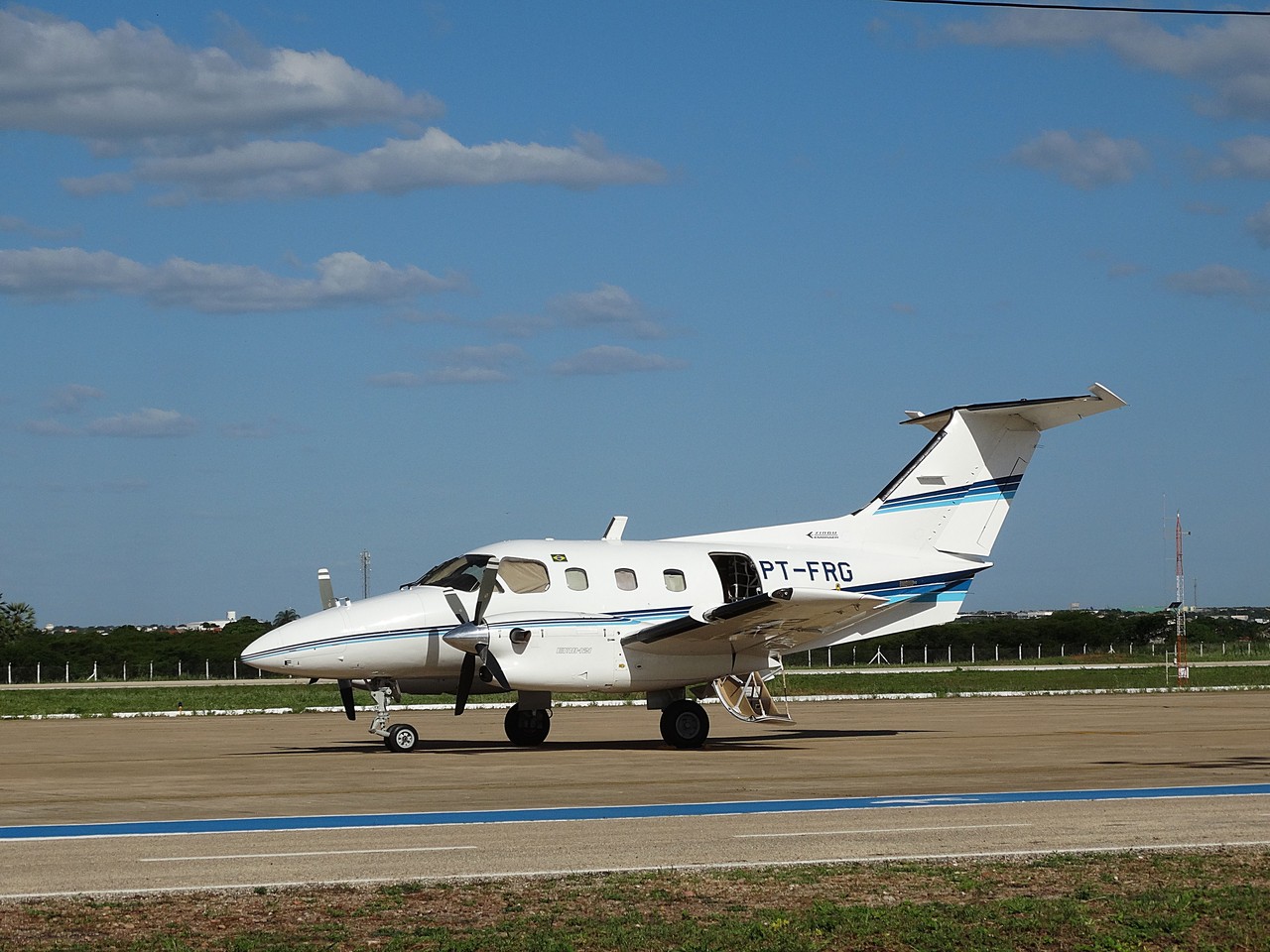
Powered by twin Pratt & Whitney Canada PT6A turboprops, the Xingu featured significant design innovations for its era. The original EMB-121A Xingu I used PT6A-28 engines producing 680 shaft horsepower each, while the improved EMB-121A1 Xingu II upgraded to PT6A-135 engines delivering 750 shaft horsepower. Four-bladed Hartzell propellers measuring 7 feet 9 inches in diameter provided efficient thrust conversion.
The aircraft's distinctive T-tail configuration served multiple purposes beyond aesthetics, positioning the horizontal stabilizer above propeller wash to reduce cabin vibration and noise. Engineers added swept wingtip extensions that increased wingspan by 0.4 meters compared to the Bandeirante, along with a ventral fin and yaw damper system for improved handling characteristics.
The pressurization system represented the Xingu's most significant advancement, enabling operations up to 28,000 feet while maintaining cabin altitude equivalent to 8,000 feet. This capability opened high-altitude airways previously inaccessible to unpressurized aircraft, providing significant operational advantages for executive transport missions.
International Recognition and Certification
The prototype PP-ZXI completed certification testing rapidly, earning Brazilian approval in May 1977 followed by UK CAA certification in July 1977. International certifications followed by 1979, enabling global sales. The prototype dramatically demonstrated transatlantic capability on May 26, 1977, successfully crossing the Atlantic Ocean and proving the design's reliability for international operations.
Production variants included the baseline EMB-121A Xingu I and the improved EMB-121A1 Xingu II, which featured increased fuel capacity and accommodation for 8-9 passengers. Engineers planned a stretched EMB-121B Xingu III with extended fuselage and PT6A-42 engines, but abandoned this variant by 1984 as production priorities shifted.
Limited Commercial Impact
Despite its technical achievements, the Xingu achieved limited success in civilian markets. Brazilian executive operators and corporate users represented the primary civil customer base, but the aircraft faced strong competition from established American manufacturers like Beechcraft and Cessna. Military sales dominated production, with 51 of the 106 aircraft built exported internationally.
The French military's sustained operation of the type proved exceptional in aviation history. A comprehensive modernization program in 2012, supported by Embraer, Daher-Socata, and Airbus Defence & Space, extended French service life to 2025, representing more than 40 years of continuous military operation.
Legacy and Current Status
Production ended in 1987 after 106 aircraft, with manufacturing concentrated at Embraer's São Paulo facility. The Brazilian Air Force retired its fleet by 2010, but French military examples continue operating today. As of 2022, 32 Xingus remained in French service, split between 22 Air Force and 10 Navy aircraft.
The Xingu's significance extends beyond production numbers, representing Brazil's emergence as a serious aircraft manufacturer capable of sophisticated pressurized designs. The successful export of 41 aircraft to France demonstrated South American aviation's growing international credibility and established important precedents for Embraer's future global expansion.