
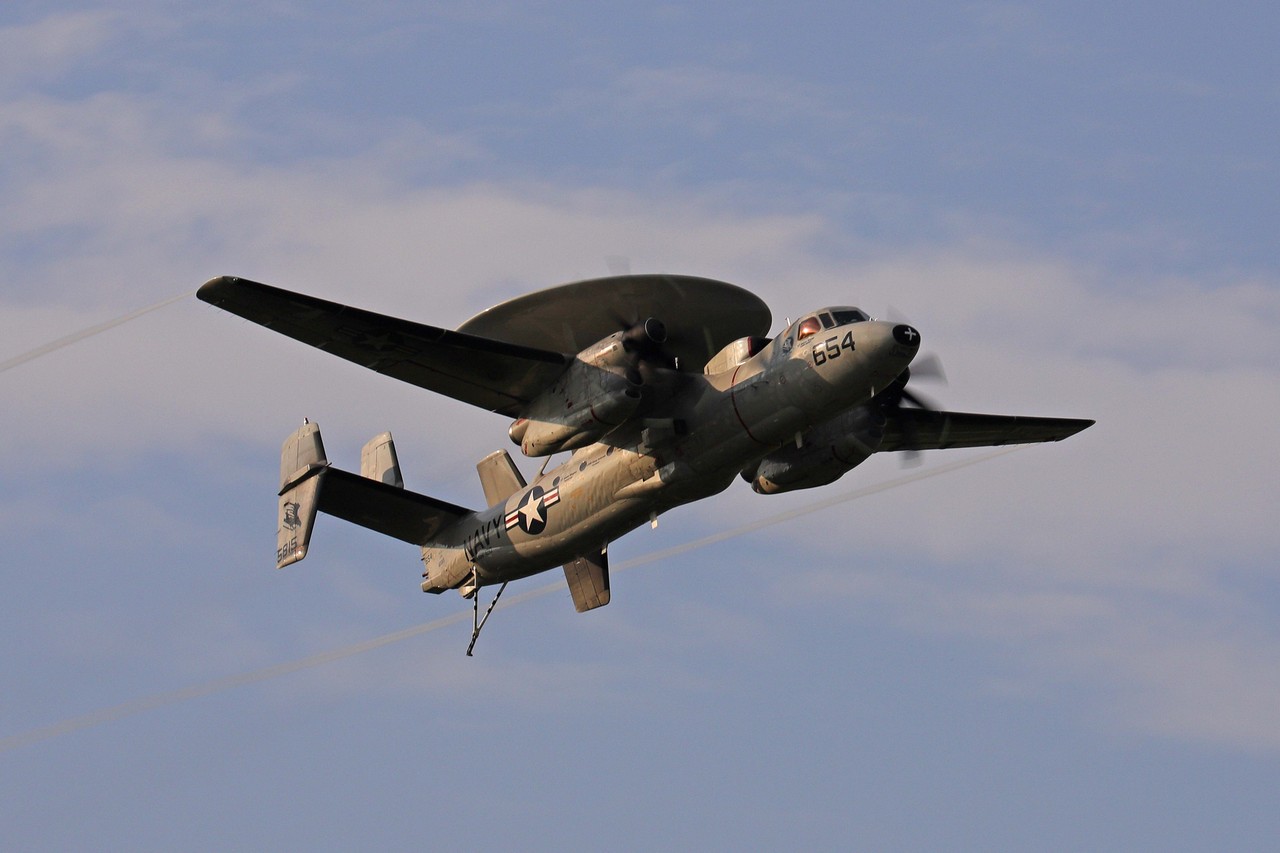
The Eyes of the Fleet
Since entering service in January 1964, the E-2 Hawkeye has served as the primary airborne command and control platform for the United States Navy, fundamentally changing how carrier battle groups conduct operations. Unlike previous airborne early warning aircraft that were modifications of existing designs, the E-2 represented a clean-sheet approach to naval surveillance, earning it the distinction of being the first purpose-built carrier AEW aircraft.
Operational Dominance
The Hawkeye's operational record spans six decades of continuous service, participating in every major American conflict since Vietnam. During the 1980s and 1990s, E-2C variants worked in tandem with F-14 Tomcats to create an integrated air defense network, with the Hawkeye detecting threats at extended ranges while the Tomcats provided the striking power. Beyond military operations, the aircraft proved its versatility during Hurricane Katrina, where it coordinated search and rescue missions across the devastated Gulf Coast region.
The aircraft's international success demonstrates its capabilities beyond American operations. Eight nations have operated the type, including Japan, which ordered additional E-2D variants as recently as August 2016. Taiwan's four E-2T aircraft received comprehensive upgrades to Hawkeye 2000 standard, completed in March 2013, while France operates the type from the carrier Charles de Gaulle.
Manufacturing Legacy
Grumman Aircraft Engineering Corporation won the Navy contract in March 1957, beating competing designs with their innovative approach to carrier-based early warning. The company faced unique challenges, as the aircraft needed to operate from World War II-era Essex-class carriers, imposing strict dimensional and weight constraints that influenced every aspect of the design. Ironically, by the time the E-2 entered service, it never actually operated from those smaller carriers.
Following Grumman's merger with Northrop Corporation, Northrop Grumman has continued E-2 production and development. The company secured major production contracts in 2013, including a $617 million order that underscored the military's commitment to the platform. This continuity has enabled the Hawkeye to achieve an unprecedented 60-plus years of continuous production.
Technical Evolution
The E-2's development path illustrates the challenges of pioneering technology. The initial E-2A variant suffered significant setbacks, with the entire 59-aircraft program cancelled in 1965 due to persistent cooling problems in the avionics compartment. Engineers solved these issues by upgrading 49 aircraft to E-2B standard with improved computer systems and enhanced environmental controls.
Subsequent variants marked steady technological advancement. The E-2C Group 0 entered service in 1973, followed by Group I aircraft in August 1981, exclusively operated by Atlantic Fleet squadrons initially. The Group II variant, delivered starting in June 1992, incorporated lessons learned from two decades of operational experience.
The Advanced Hawkeye
The E-2D Advanced Hawkeye represents the latest evolution of the design, with the first production aircraft completing its maiden carrier landing aboard USS Harry S. Truman on February 4, 2010. This variant received full-rate production approval on February 12, 2013, with initial operational capability achieved by 2015. The E-2D incorporated significant advances in radar technology and data processing, maintaining the Hawkeye's relevance in modern naval warfare.
A significant milestone occurred in December 2017 when an E-2D completed its first aerial refueling with a KC-130 tanker, dramatically extending the aircraft's operational endurance. This capability enhancement addressed one of the few remaining limitations of carrier-based early warning operations.
Performance Characteristics
The Hawkeye's performance envelope reflects its specialized mission requirements. With a maximum speed of 375 mph and service ceiling of 30,807 feet, the aircraft prioritizes endurance and sensor effectiveness over raw speed. Its operational range of 1,605 miles allows extended patrol missions far from the carrier, while a climb rate of 2,515 feet per minute ensures rapid deployment to operational altitude.
The distinctive 24-foot radome houses sophisticated radar systems capable of tracking multiple targets simultaneously while maintaining data links with fleet units. This integration with the Naval Tactical Data System allows real-time sharing of tactical information across the entire battle group.
Current Operations and Future
Approximately 75 E-2 variants remain in service worldwide, though this number continues to evolve as older aircraft retire and new E-2D models enter the fleet. The type's longevity stems from its unique capabilities and the absence of viable alternatives for carrier-based early warning missions.
The Hawkeye's legacy extends beyond its tactical contributions to naval aviation's fundamental transformation of carrier operations. From its troubled early years to its current status as an indispensable fleet asset, the E-2 demonstrates how persistent engineering refinement can overcome initial setbacks to create lasting military capabilities. As carrier aviation enters its second century, the Hawkeye continues evolving to meet emerging threats while maintaining its essential role as the eyes and ears of the fleet.