
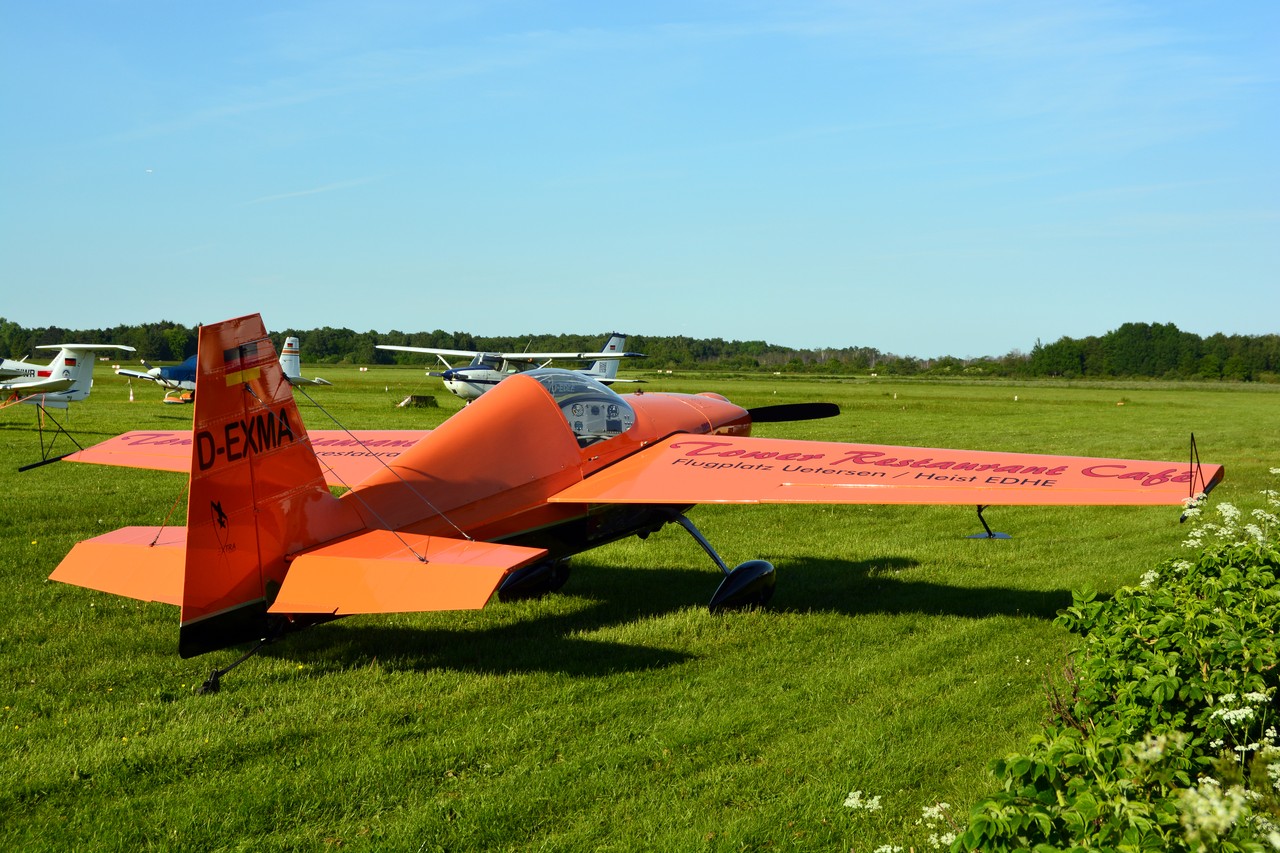
Design and Development
Walter Extra, a competitive aerobatic pilot and manufacturing engineer, conceived the EA-230 following his experience flying a modified Pitts Special in the 1980 World Championship. Drawing inspiration from the Laser 200 layout he had previously flown, Extra established his aircraft company in the early 1980s with the specific objective of creating a high-performance aerobatic aircraft with optimal structure, weight, and maneuverability characteristics.
The EA-230 prototype was completed in 1981, leading to its maiden flight on 14 July 1983. Extra's design innovations included a short-coupled mid-wing cantilever monoplane configuration with fixed tailwheel undercarriage, combining a steel tube fuselage and empennage with wooden wings and wire-braced tail surfaces. This structural approach enabled the aircraft to withstand extreme aerobatic loads while maintaining precise control authority.
Technical Specifications
Powering the EA-230 was a single Lycoming AEIO-360-A1E air-cooled flat-four piston engine producing 150 kilowatts (200 horsepower), driving a two-bladed Mühlbauer constant-speed propeller. The fuel-injected engine was specifically designed for inverted flight operations, crucial for sustained aerobatic sequences. With an empty weight of 440 kilograms (970 pounds) and maximum takeoff weight of 560 kilograms (1,235 pounds), the aircraft achieved a power-to-weight ratio that enabled exceptional performance characteristics.
The EA-230's dimensions reflected its specialized aerobatic mission: 5.82 meters (19 feet 1 inch) in length, 7.40 meters (24 feet 3 inch) wingspan, and 1.73 meters (5 feet 8 inches) in height. The aircraft incorporated MA 15S airfoil sections at the wing root transitioning to MA12S sections at the tips, contributing to its superior handling characteristics throughout the aerobatic envelope.
Performance Capabilities
The EA-230 demonstrated remarkable performance figures that established new standards in aerobatic aviation. Maximum speed reached 352 kilometers per hour (219 miles per hour) with a never-exceed speed of 407 kilometers per hour (253 miles per hour). The aircraft's stall speed of 71 kilometers per hour (44 miles per hour) provided a wide speed envelope for aerobatic maneuvers.
Most significantly, the EA-230 achieved structural limits of +10/-10 g and a roll rate of 200 degrees per second, performance figures that dominated unlimited aerobatic competition from the mid-1980s. With a rate of climb of 15.0 meters per second (2,950 feet per minute) and an endurance of 2 hours 30 minutes on 80 liters (21 US gallons) of fuel, the aircraft provided both performance and practical operational capability.
Competition Success
The EA-230 quickly established itself in aerobatic competition, with eight pilots flying the type at the 1987 FAI European Aerobatic Championship. Notable among these was Eric Müller, who achieved third place in this prestigious competition. In the United States, Clint McHenry captured the U.S. National Aerobatic Championships in both 1986 and 1987 flying an EA-230, demonstrating the aircraft's competitive superiority over established types.
The aircraft's success stemmed from Walter Extra's understanding of aerobatic requirements combined with his engineering expertise. Unlike previous aerobatic aircraft that were often modified from basic training or sport configurations, the EA-230 was purpose-built for unlimited aerobatic competition from the outset.
Production and Legacy
Extra Aircraft produced the EA-230 from 1983 to 1990, with production transitioning to the more advanced Extra 300 by 1990. While exact production numbers remain unspecified, the EA-230's limited production run reflected its specialized nature and the company's focus on quality over quantity.
The EA-230's significance extended beyond its competition victories. It established Extra Aircraft as a major force in aerobatic aircraft design and validated Walter Extra's engineering approach. The company, which began as a one-man operation, grew into an international success, producing multiple models that would be used by world aerobatic champions.
By 2003, Extra Aircraft had expanded under new U.S. ownership and management led by Ken Keith, continuing production of advanced models including the EA-300L, EA-400, and EA-500. The design principles established with the EA-230 - combining purpose-built aerobatic structures with modern materials and powerplants - became the foundation for all subsequent Extra aircraft.
Current Status
While production of the EA-230 ended in 1990, the aircraft remains listed as active in aviation databases. The type's influence on aerobatic aviation cannot be overstated, as it introduced design concepts and performance standards that dominated unlimited competitions throughout the 1980s and beyond. The EA-230 represented the transition from modified conventional aircraft to purpose-built aerobatic machines, establishing the template for modern competitive aerobatic aircraft design.