
Genesis of an Icon
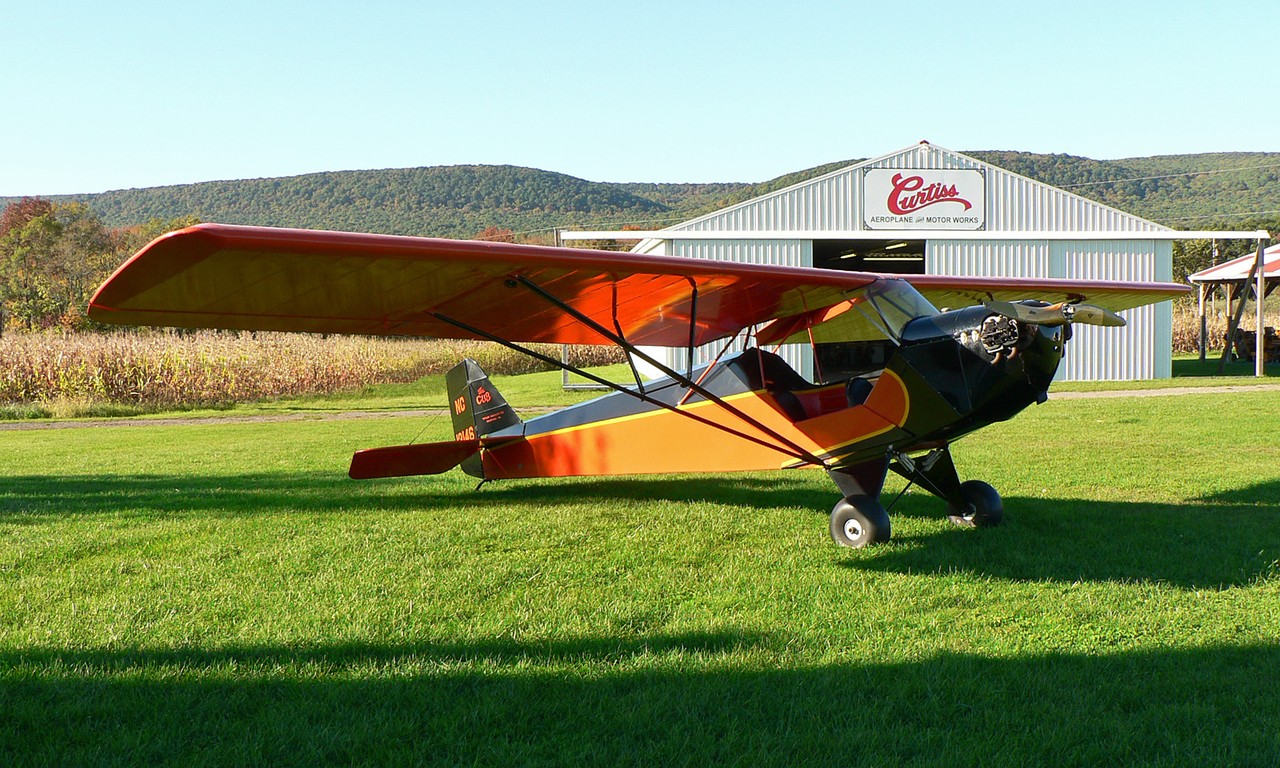
The E-2 Cub emerged during the depths of the Great Depression as C. Gilbert Taylor's answer to making flight accessible to ordinary Americans. Taylor's design philosophy centered on simplicity, affordability, and forgiving flight characteristics – principles that would define light aviation for generations. The aircraft evolved from Taylor's earlier Chummy design, but represented a dramatic departure toward practicality over luxury.
Development Challenges
The prototype's maiden flight in September 1930 revealed the perils of extreme cost-cutting. Powered by a meager 20-horsepower Brownbach Tiger Kitten engine, the aircraft barely managed to climb five feet above the ground during its September 12, 1930 test flight before running out of runway. Taylor briefly experimented with a French Salmson AD-9 radial engine in October 1930, which provided adequate performance but proved prohibitively expensive to maintain and operate.
Salvation came through Continental Motors' newly developed A-40 engine. This four-cylinder, air-cooled powerplant produced 37 horsepower at 2,550 RPM – a modest output that nonetheless transformed the E-2 into a viable aircraft. The Continental-powered variant entered production in February 1931, earning Category 2 "Memo" certificate 2-358 on June 15, 1931, followed by full Approved Type Certificate A-455 on November 7, 1931.
Production and Pricing
Taylor Aircraft Company manufactured the E-2 Cub at Emery Airport in Bradford, Pennsylvania, producing 353 aircraft over five years. The company sold twenty-two Cubs during 1931 at $1,325 each – roughly equivalent to a modest automobile of the era. By 1935, inflation and improvements had pushed the price to $1,475, still representing remarkable value for a complete aircraft.
The E-2's construction reflected Depression-era pragmatism: a welded steel tube fuselage covered in fabric, wooden wings utilizing the USA-35B airfoil, and an open cockpit that eliminated the weight and cost of an enclosed cabin. This combination delivered an empty weight of just 925 pounds and wing loading of 5.03 pounds per square foot, contributing to the aircraft's gentle handling characteristics.
Performance and Pilot Appeal
Pilots discovered an aircraft that prioritized safety over speed. The E-2 Cub cruised at 62 mph with a maximum speed of 70 mph – leisurely by any standard, but perfectly suited to its training and recreational roles. More importantly, it climbed at 400 feet per minute and could reach 12,000 feet, respectable performance for a 37-horsepower aircraft. The 180-mile range provided sufficient endurance for local flights and short cross-country adventures.
The tandem seating arrangement, with the student pilot positioned forward of the instructor, became a Cub trademark that enhanced training effectiveness. The aircraft's forgiving stall characteristics and predictable handling made it ideal for teaching fundamental flying skills to novice pilots.
Corporate Transformation
The E-2 Cub's success attracted the attention of William T. Piper, an oilman who had become interested in aviation's commercial potential. Piper gradually acquired controlling interest in Taylor Aircraft Company, serving as secretary-treasurer while C. Gilbert Taylor remained president and chief designer. This partnership proved transformational for both men and the aviation industry.
Tragedy struck in March 1937 when fire destroyed the Bradford factory, but the disaster prompted a strategic relocation to Lock Haven, Pennsylvania. In November 1937, the company officially became Piper Aircraft Corporation, with William Piper assuming full control as C. Gilbert Taylor departed to establish a new company.
Legacy and Impact
The E-2 Cub's greatest achievement lay not in its own modest production numbers, but in establishing the design DNA for the Piper J-3 Cub. The J-3, introduced in 1937, retained the E-2's high-wing configuration, tandem seating, and gentle handling while incorporating refinements that made it even more successful. During World War II, military variants of the Cub design served as L-4 liaison aircraft, introducing thousands of military personnel to aviation.
Beverly Dodge achieved a notable milestone in 1937 when she and a passenger established a women's altitude record of 16,800 feet in a Szekely-powered Taylor H-2, demonstrating the basic design's capabilities when equipped with more powerful engines.
Museum Preservation
Today, the National Air and Space Museum preserves the E-2 Cub's legacy through a detailed static model constructed of fiberglass, resin, aluminum, and plexiglass. This display educates visitors about the aircraft that democratized American aviation and launched one of general aviation's most enduring success stories.
The Taylor E-2 Cub proved that innovation sometimes lies not in pushing performance boundaries, but in making existing capabilities accessible to broader audiences. Its 353 examples directly enabled the production of over 20,000 J-3 Cubs and established Piper Aircraft as a major force in general aviation – a legacy that continues today through modern Super Cub variants and the company's current aircraft lineup.