
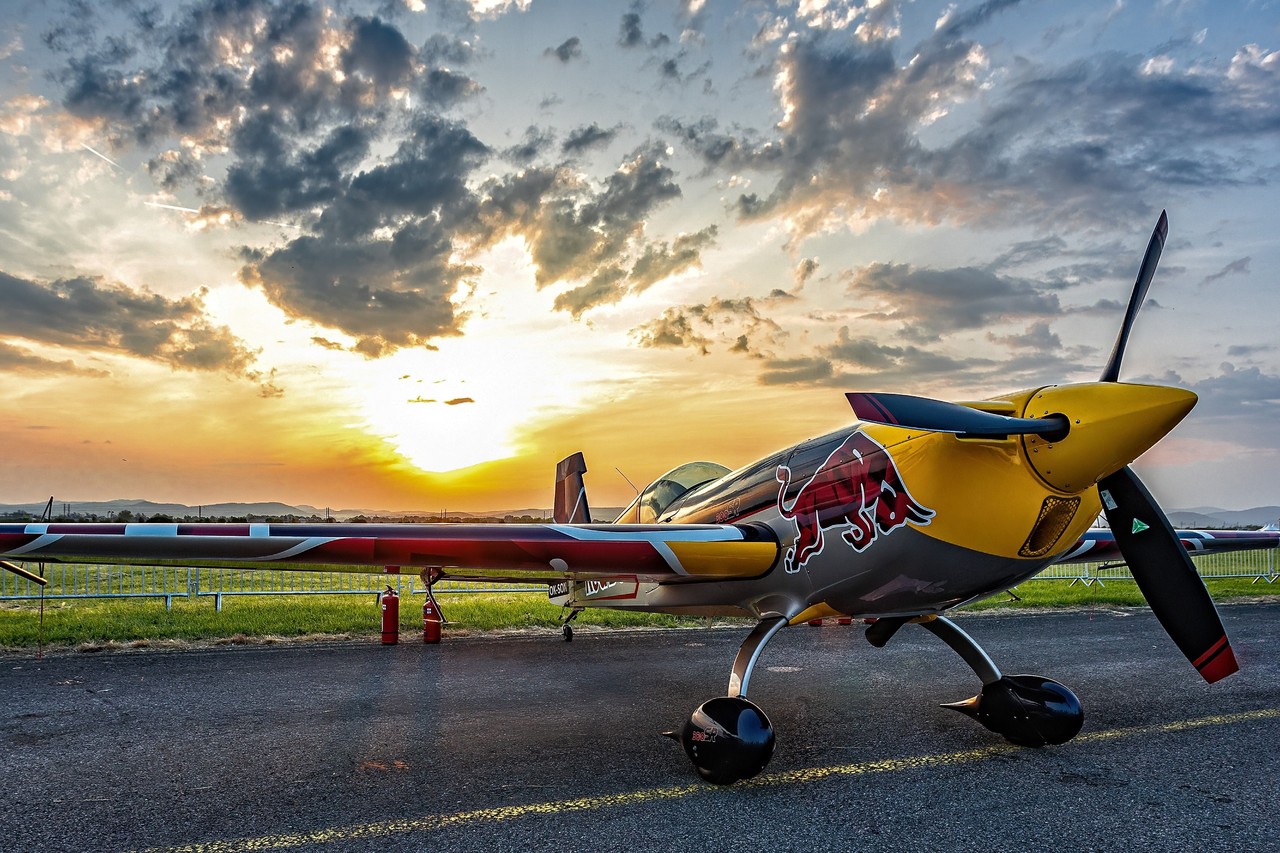
Dominating Aerobatic Competition
The EA-300 quickly established itself as the premier aircraft for unlimited aerobatic competition, the sport's highest category. By 2003, Extra had delivered 264 aircraft across all EA-300 variants, with the vast majority exported to American customers who dominated international aerobatic competitions. The aircraft's innovative symmetrical airfoil mounted at zero angle of incidence provided equal performance in both upright and inverted flight, a critical advantage that made it the weapon of choice for serious competitors.
Notable operators included Brian Lecomber's Firebird Aerobatics team in the United Kingdom, which operated two EA-300Ls for demonstration flying. The aircraft's reputation spread globally, with deliveries to Israel, Romania, South Africa, and numerous locations across the United States, establishing Extra as a major force in the specialized aerobatic aircraft market.
The Designer and His Vision
Walter Extra, a trained mechanical engineer and accomplished aerobatic pilot, began designing the EA-300 in January 1987 with clear objectives: create a production aircraft capable of unlimited aerobatic competition that improved upon his earlier EA-230 design. Extra's dual expertise as both pilot and engineer proved crucial, as he understood the demanding requirements of competitive aerobatics from personal experience while possessing the technical knowledge to implement radical design solutions.
The design incorporated lessons learned from the wooden-winged Extra 230, but represented a quantum leap forward in materials and construction techniques. Extra's engineering team completed the design phase rapidly, moving from initial concept to first flight in just 16 months.
Extra Flugzeugbau: German Engineering Excellence
Extra Flugzeugbau launched production in October 1988, quickly establishing manufacturing capabilities that would eventually reach 48 aircraft annually by 2005. The German manufacturer obtained type certification from the Luftfahrt-Bundesamt (LBA) on May 16, 1990, followed by crucial FAA approval on February 26, 1993, opening the vital American market.
The company's focus on the specialized aerobatic market proved successful, with production ramping from eight aircraft in 2003 to 36 in 2004, demonstrating strong demand for high-performance aerobatic aircraft among civilian pilots and professional demonstration teams.
Revolutionary Construction and Materials
The EA-300's technical innovations centered on its hybrid construction combining traditional and advanced materials. The fuselage utilized a welded steel tube framework covered in aluminum sheeting and fabric, providing exceptional strength while maintaining reasonable weight. The wings represented the most significant advancement: carbon fiber composite spars and skins that dramatically reduced weight compared to conventional aluminum or wooden construction.
The aircraft's fixed taildragger landing gear featured composite main legs with fiberglass wheel pants, emphasizing durability and maintenance simplicity over the complexity of retractable gear. This configuration proved ideal for the frequent high-stress landings associated with aerobatic training and competition flying.
Powerplant Performance
Extra selected the fuel-injected Lycoming AEIO-540 engine, a six-cylinder horizontally opposed powerplant producing 300 horsepower. This American-built engine provided the reliable power necessary for sustained inverted flight and high-G maneuvers, while its fuel injection system ensured consistent operation regardless of aircraft attitude.
The engine installation incorporated specialized systems required for aerobatic flight, including inverted oil and fuel systems that maintained power delivery during extended inverted flight sequences demanded by unlimited competition routines.
Evolution Through Variants
The original two-seat EA-300 spawned multiple variants addressing specific market needs. The EA-300S, first flown on March 4, 1992, offered single-seat configuration with reduced wingspan of 24 feet and more powerful aileron authority for enhanced roll performance. Only 31 EA-300S aircraft were completed by 2002, reflecting the specialized nature of single-seat aerobatic flying.
The EA-300L, introduced in November 1994, relocated the wing to a low-wing configuration that enhanced pilot visibility during aerobatic sequences. This variant proved most popular, with 326 EA-300Ls manufactured between 1993 and 2015, representing the majority of total production. The EA-330LX pushed performance further with a 330-horsepower Textron Lycoming AEIO-580 engine and carbon fiber reinforced plastic fuselage panels.
Performance Specifications
The EA-300L achieved remarkable performance figures that established new benchmarks for production aerobatic aircraft. Its roll rate of approximately 400 degrees per second exceeded many purpose-built competition aircraft, while G-force limits of +10/-10 with single occupancy provided generous margins for unlimited category maneuvers. With two occupants, limits reduced to ±8 G, still exceeding requirements for advanced aerobatic training.
The aircraft's symmetrical airfoil design eliminated performance differences between upright and inverted flight, crucial for complex aerobatic sequences requiring precise control regardless of aircraft orientation.
Legacy and Continuing Impact
The EA-300 achieved legendary status in aerobatic aviation, establishing Extra Flugzeugbau as the premier manufacturer of unlimited-class competition aircraft. Its introduction marked the transition from custom-built aerobatic aircraft to sophisticated production machines that democratized access to world-class aerobatic performance.
Today, EA-300 variants continue flying in private hands and aerobatic schools worldwide, with many examples still competing successfully in national and international competitions decades after their manufacture. The aircraft's robust construction and proven reliability ensure its continued presence in competitive aerobatics for years to come.