
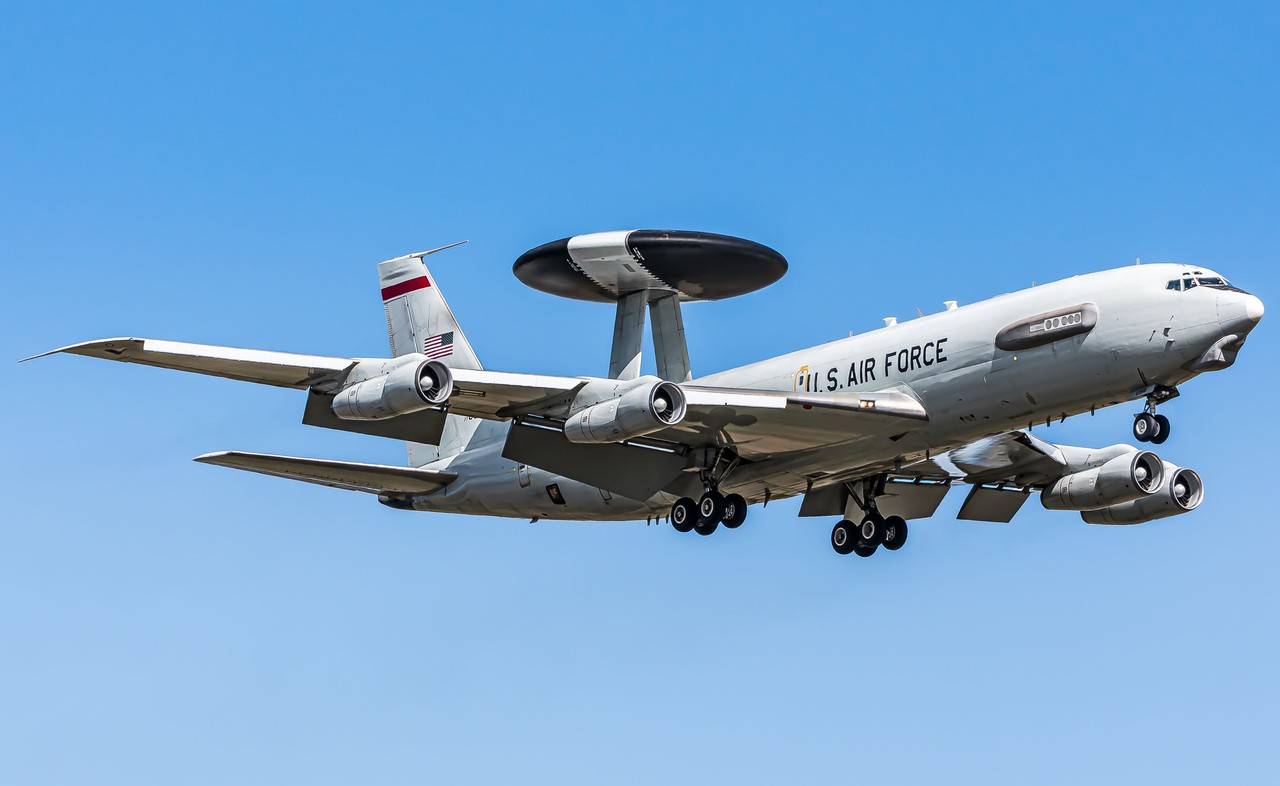
Revolutionary Surveillance Platform
The E-3A Sentry transformed modern air warfare by providing commanders with unprecedented aerial surveillance capabilities. Its distinctive rotodome, rotating six times per minute and positioned 11 feet above the fuselage, housed sophisticated radar equipment that could simultaneously track hundreds of targets across a 250-mile radius. This technological advancement allowed military forces to coordinate complex air operations with a level of precision previously impossible, establishing air superiority through information dominance rather than firepower alone.
Combat Proven Excellence
The E-3A demonstrated its strategic value during Operation Desert Storm in 1991, where AWACS aircraft flew more than 400 missions and logged over 5,000 combat hours. These missions directly supported more than 120,000 coalition sorties, with AWACS crews providing critical targeting data that contributed to all but two of the coalition's 40 air-to-air victories. The aircraft's ability to coordinate simultaneous operations across vast airspace proved indispensable in achieving the swift coalition victory.
Subsequent deployments from Grenada to Afghanistan consistently validated the E-3A's operational importance. During Operations Odyssey Dawn and Unified Protector over Libya, NATO E-3A aircraft orchestrated complex multinational air campaigns, demonstrating the platform's evolution into the world's premier Command, Control, and Battle Management aircraft.
Boeing's Military Adaptation
Boeing Aircraft Company, building on their success with the 707 commercial airliner, undertook the challenging task of adapting their proven airframe for military requirements. The company began engineering and test evaluation in October 1975, fundamentally redesigning the aircraft's structure to accommodate the massive radar installation and specialized mission equipment. This adaptation required strengthening the fuselage, modifying the electrical systems, and creating interior spaces for up to 19 mission specialists who would operate the sophisticated surveillance equipment.
The transformation from civilian transport to military command platform represented one of Boeing's most complex aircraft modifications. Today, The Boeing Company continues as one of the world's largest aerospace manufacturers, with the E-3A program demonstrating their capability to successfully adapt commercial designs for specialized military applications.
Pratt & Whitney Powerplant Reliability
The four Pratt & Whitney TF33-PW-100A turbofan engines provided the E-3A with exceptional operational reliability throughout its service life. Each engine delivered between 20,500 and 21,500 pounds of thrust, enabling the heavily laden aircraft to maintain eight hours of continuous patrol without aerial refueling. The TF33, manufactured by Pratt & Whitney (which remains a leading aerospace propulsion company), proved remarkably durable, with many engines accumulating thousands of flight hours across the platform's 47-year operational history.
This engine selection proved prescient, as the powerplants consistently performed in demanding environments from the Arctic to desert conditions. The high-bypass turbofan design provided fuel efficiency crucial for extended surveillance missions, while maintaining the thrust necessary to operate from shorter airfields when required.
Operational Excellence and Global Service
The E-3A's flight characteristics earned respect from military aviators worldwide. With a four-person flight crew managing the aircraft while up to 19 mission specialists operated surveillance equipment, the Sentry required exceptional coordination between aviation and mission personnel. The aircraft cruised at 360 miles per hour at altitudes exceeding 29,000 feet, positioning it above most air traffic while maintaining optimal radar coverage.
Pilots appreciated the aircraft's stability during extended missions, essential when maintaining precise flight patterns for surveillance operations. The 707-derived flight deck provided familiar handling characteristics for crews transitioning from other Boeing aircraft, while the robust landing gear accommodated the aircraft's maximum takeoff weight of 325,000 pounds.
Production Legacy and Modern Operations
Boeing completed production of 34 E-3A aircraft for the U.S. Air Force between March 1977 and June 1984, with total E-3 variant production reaching 68 aircraft by 1992. This relatively small production run reflected the specialized nature and substantial cost of each aircraft, with each unit representing a significant strategic asset.
Currently, 61 E-3 Sentry aircraft remain operational worldwide across seven nations and NATO. The United States Air Force operates 31 aircraft from Tinker Air Force Base in Oklahoma, with additional units stationed at Kadena Air Base, Japan, and Elmendorf Air Force Base, Alaska. International operators include NATO with 17 aircraft, the United Kingdom with seven, France with four, Saudi Arabia with five, and Japan with four aircraft.
The Air Force expects to operate the E-3A until 2035, when the Boeing E-7A Wedgetail will assume the AWACS mission. This exceptional 47-year service life, maintained through continuous modernization including the Block 40/45 upgrade program, demonstrates the fundamental soundness of the original Boeing design and the enduring strategic value of airborne surveillance platforms.