
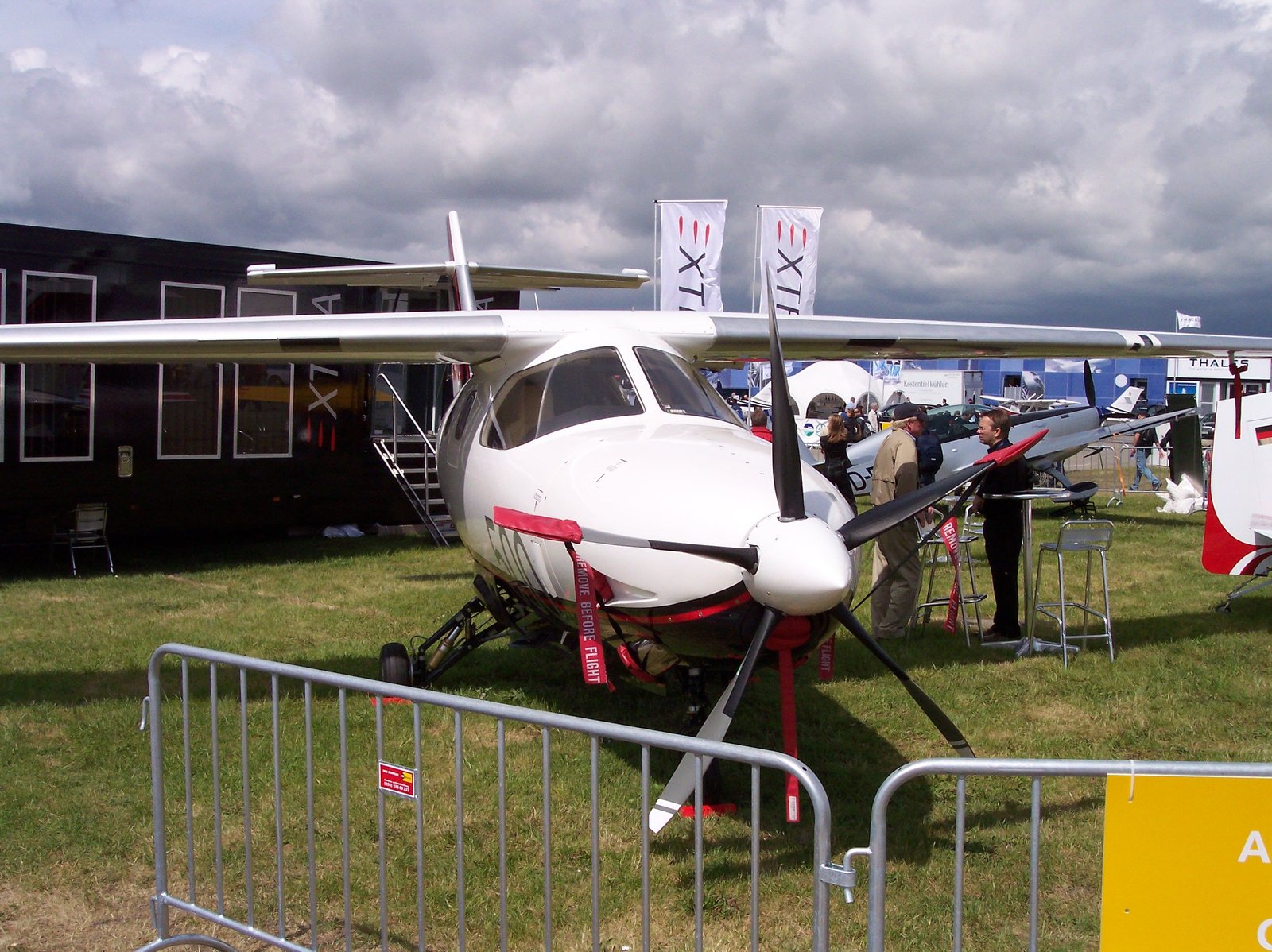
Development and Early Challenges
The EA-500 program began in 2002 under the leadership of Walter Extra, who sought to leverage his company's expertise in composite construction and precision manufacturing to create a turboprop variant of the successful EA-400. The development faced immediate tragedy when the prototype crashed on April 30, 2002, merely four days after its maiden flight, forcing Extra to postpone the aircraft's planned debut at the ILA 2002 Berlin Air Show.
Despite this setback, Walter Extra demonstrated the aircraft's capabilities by making a trans-Atlantic crossing to unveil the EA-500 at the National Business Aviation Association convention in October 2003. This dramatic introduction helped secure initial orders for 18 aircraft with deposits, priced at $1.65 million for the standard configuration with dual instruments and air conditioning.
The Extra Legacy
Extra Flugzeugbau emerged from Walter Extra's experimental one-man operation in the 1980s to become a internationally recognized manufacturer of precision aircraft. Operating from a 64,500-square-foot facility at Dinslaken Airport near Düsseldorf, the company built its reputation on the Extra 200, 230, 260, and 300 series aerobatic aircraft that dominated world championship competitions. The EA-400 and EA-500 business aircraft represented Extra's strategic expansion beyond the specialized aerobatic market into mainstream business aviation.
The company's expertise in carbon-fiber composite construction, developed through decades of building high-stress aerobatic aircraft, provided the foundation for the EA-500's advanced structural design. This experience enabled Extra to create a fuselage entirely from composite materials while maintaining the structural integrity required for pressurized flight operations.
Advanced Powerplant Integration
The EA-500's Rolls-Royce Model 250-B17F/2 turboprop engine represents a sophisticated powerplant choice, featuring a combination of four-to-six-stage axial and single-stage centrifugal compressors driving dual-stage low and high-pressure turbines. Weighing just 96 kilograms, the engine delivers 450 horsepower while maintaining fuel efficiency of 21.38 nautical miles per gallon. The powerplant operates on military-grade JP-4, JP-5, and JP-8 fuels and offers a 3,500-hour time between overhaul interval.
The engine drives a five-blade constant speed reversible MT composite propeller, providing exceptional ground handling capabilities and operational flexibility. Integration with a Honeywell hydromechanical fuel controller ensures precise power management across all flight phases.
Technical Innovation and Certification
The EA-500 incorporates numerous advanced features reflecting Extra's commitment to operational capability and safety. The aircraft features pneumatic Teflon de-icing boots for certified flight into known icing conditions, a heated pilot-side windscreen, and comprehensive LED lighting systems including wing-mounted recognition lights and ice detection illumination.
The pressurized cabin maintains sea-level comfort up to the aircraft's 7,620-meter service ceiling, while three convex windows on each side provide exceptional visibility for passengers. Electric fuel pumps with low-fuel sensors and electric elevator trim reduce pilot workload during extended flights.
European Aviation Safety Agency certification was achieved in July 2004, followed by a lengthy refinement period before production commenced in 2009. The introduction of the Entegra Release 9 avionics suite in April 2010 brought modern glass cockpit technology to the design, with final EASA certification completed in June 2011.
Performance and Market Position
With a maximum takeoff weight of 4,696 kilograms and payload capacity of 730 kilograms, the EA-500 delivers impressive performance metrics including a 7.4-meter-per-second rate of climb and 418-kilometer-per-hour cruise speed. The aircraft requires just 381 meters for takeoff and 280 meters for landing, enabling operations from shorter airfields typically inaccessible to larger business aircraft.
The EA-500's 4.2-hour maximum endurance and 2,963-kilometer range position it competitively against other single-engine turboprops while offering the refined handling characteristics inherited from Extra's aerobatic aircraft heritage. The first delivery was scheduled for the Aero Friedrichshafen exposition in April 2012, marking Extra's entry into series production of business aircraft.
Current Status and Legacy
The EA-500 remains in limited production as a specialized business aircraft, representing Extra's successful transition from pure aerobatic aircraft manufacturing to the broader general aviation market. While production numbers remain modest compared to mainstream manufacturers, the aircraft demonstrates the viability of applying competition-aircraft engineering principles to business aviation, creating a unique niche product that combines exceptional build quality with distinctive performance characteristics.