
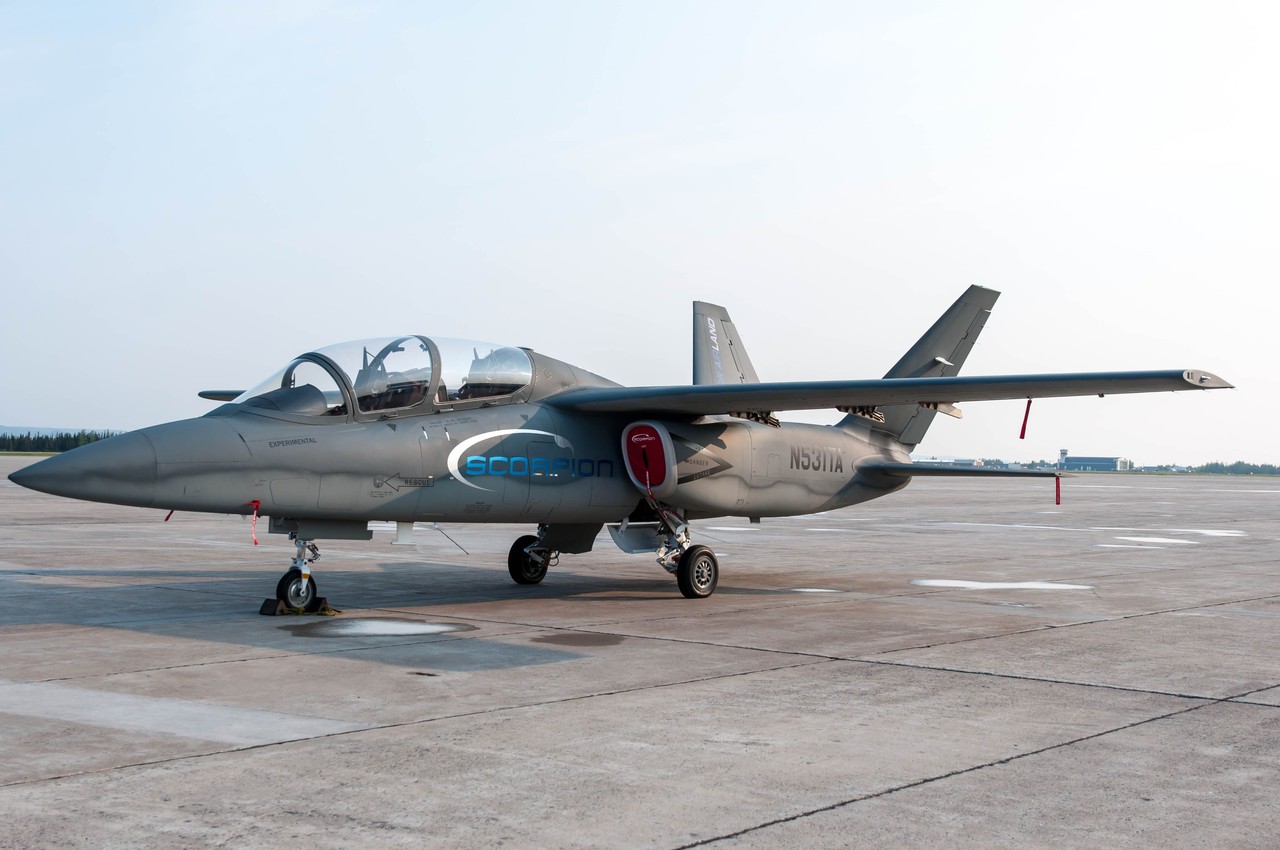
Development Philosophy
The Scorpion emerged from a radical departure from traditional military aircraft procurement. Instead of responding to detailed government specifications, Textron AirLand conducted independent market analysis to identify capability gaps in domestic and foreign air forces. This company-funded approach aimed to bridge the operational space between less capable turboprop aircraft and expensive dedicated attack jets, particularly appealing to smaller nations facing budget constraints.
Rapid Development Timeline
Development proceeded at unprecedented speed for modern aircraft programs. The outside contours were finalized in May 2012, with wing production beginning just three months later in August 2012. In an unusual sequence, wind tunnel testing occurred after wing manufacturing had already commenced. The prototype was constructed in secret between April 2012 and September 2013, with a development team that peaked at 200 personnel, including 120 engineers, before settling at 170 members.
The aircraft achieved first flight on December 12, 2013, merely 23 months after initial conception. Pre-flight taxi trials had been completed on November 25, 2013, leading to the maiden flight lasting 1.4 hours. This timeline represented remarkable efficiency in an industry where development cycles typically span decades.
Design Evolution and Configuration
Engineers evaluated 12 different configurations before settling on the final twin-engine design, despite initial concepts favoring a single-engine layout. The tandem-seat arrangement provides operational flexibility, allowing single-pilot operations when required. A retractable nose mount accommodates electro-optical systems for reconnaissance missions, reflecting the aircraft's dual attack and surveillance roles.
The twin-turbofan powerplant configuration proved robust during testing, with pilots reporting the aircraft remained "agile, nimble, and powerful" even when operating on a single engine. Performance parameters include a stall speed below 100 miles per hour and capability to withstand g-forces ranging from 3.7 to -0.5 g.
Flight Testing and Demonstrations
By April 9, 2014, the Scorpion had accumulated 50 flight hours across 26 flights. This expanded to 76.4 hours over 41 test flights by May 19, 2014, with zero cancellations due to mechanical or maintenance issues—an exceptional reliability record for a prototype aircraft.
Preparations for the 2014 Farnborough Airshow required significant modifications, including installation of an engine inlet ice protection system, replacement of composite inlet leading edges with metal alternatives, addition of a cockpit ladder, and integration of an onboard oxygen-generating system. Flight testing resumed on June 1, 2014, culminating in the aircraft's public debut at Farnborough in July 2014.
Operational demonstrations showcased the aircraft's versatility. In August 2014, the Scorpion participated in a mock chemical spill scenario involving search-and-rescue operations for U.S. Air National Guard personnel. The aircraft achieved 100 percent mission availability while successfully transmitting full-motion video, validating its ISR capabilities. By 2015, total flight testing exceeded 400 hours with exceptionally high mission availability ratings.
Manufacturing and Production Plans
Construction occurred at Cessna's Wichita, Kansas facility, with only two aircraft manufactured to date. The second aircraft, built to production standards, completed its maiden flight on December 22, 2016. Had customer orders materialized, production was scheduled to begin in 2015, with delivery timelines of 15 to 18 months after order placement.
Textron AirLand identified a potential market for up to 2,000 Scorpion aircraft globally. However, manufacturing arrangements remained fluid, with Textron spokesman David Sylvestre noting in November 2013 that while Cessna built the prototype, final production decisions remained undetermined, with possibilities including manufacturing "at Cessna, but by the joint venture called Textron AirLand."
The Manufacturer Legacy
Textron AirLand represented a partnership between Textron, the aerospace giant that owns Cessna, and AirLand Enterprises. This collaboration leveraged Cessna's manufacturing expertise while pursuing innovative market approaches. Textron continues as a major aerospace and defense corporation, maintaining its position in both civilian and military aircraft markets.
The joint venture structure reflected changing dynamics in military procurement, where traditional defense contractors increasingly pursue independent research and development to present solutions before formal requirements emerge.
Current Status and Market Reality
Despite achieving technical success and demonstrating operational capabilities, the Scorpion failed to secure production orders. The aircraft remains a technology demonstrator, representing both the potential and challenges of privately-funded military aircraft development. The program's emphasis on rapid development and cost-effectiveness addressed real market needs, but insufficient customer commitment ultimately limited commercial success.
The two existing aircraft serve as testaments to innovative engineering and unconventional development approaches, even as the broader program illustrates the complexities of introducing new platforms into conservative military procurement environments.