
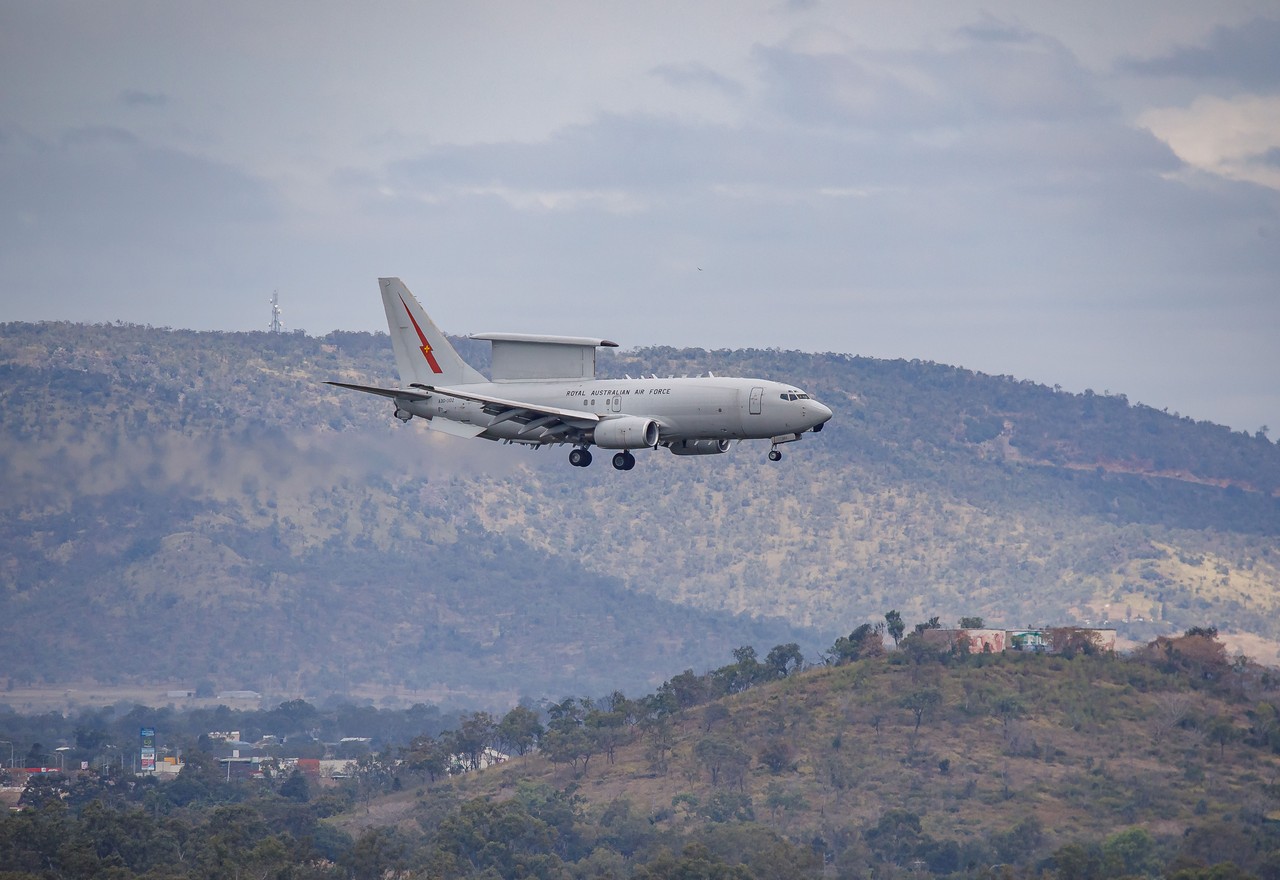
Service History
The E-7A Wedgetail has established itself as the premier airborne early warning and control platform through its operational success across multiple air forces. Australia pioneered the program, selecting the E-7 in July 1999 and placing orders for six systems with four 737-700 airframes in December 2000. The Royal Australian Air Force achieved Initial Operational Capability in November 2012, with all six aircraft operated by No. 2 Squadron RAAF from RAAF Base Williamtown.
By 2024, the platform had proven so successful that the United States Air Force selected it to replace their aging E-3 Sentry AWACS fleet. Boeing received a massive $2.56 billion contract on August 9, 2024, for E-7A production, with the first fuselage delivered to Boeing's Renton factory on January 22, 2025. The USAF plans to procure 26 aircraft total, with the first entering service in 2027 and 24 additional aircraft following by fiscal 2032.
International Operations
South Korea operates four modified 737 AEW&C aircraft, with deliveries completed between December 2011 and October 2012 at Gimhae Air Base. Israel received Peace Eagle variants, completing their first test flight in September 2007. The United Kingdom committed to five aircraft for the RAF, beginning conversions in 2021 with each modification requiring approximately 24 months. Initial operating capability for the RAF has been delayed multiple times, finally scheduled for 2026.
The Manufacturer
The Boeing Company traces its 737 program back to preliminary design work beginning May 11, 1964, when engineers sought to supplement the 727 on shorter, thinner routes. The 737-700, launched in November 1993 as the first Next-Generation variant, was designed specifically to replace the earlier 737-300. Southwest Airlines received the first 737-700 delivery in December 1997.
Boeing manufactures the aircraft at their Renton, Washington factory, while Spirit AeroSystems (a Boeing spin-off) produces fuselages in Wichita, Kansas, before rail transport to the final assembly line. The 737 Next Generation series achieved remarkable commercial success with 7,097 total orders and 7,031 deliveries as of May 2019.
Engine & Technical Specifications
The 737-700 Wedgetail utilizes twin CFM56 turbofan engines, representing a collaboration between Boeing engineer Mark Gregoire's design team and CFM International. These high-bypass turbofan engines delivered significant improvements in fuel economy and noise reduction compared to earlier Pratt & Whitney powerplants used on original 737 variants.
The military conversion transforms the commercial airliner's passenger cabin into a sophisticated command and control center capable of simultaneous tracking of airborne and maritime targets. The distinctive dorsal radome houses advanced radar systems that provide 360-degree surveillance coverage, making it the most operationally-proven airborne early warning platform currently in service.
Strategic Impact
The Wedgetail program gained particular prominence when General Kenneth S. Wilsbach, Commander of US Pacific Air Forces, publicly advocated for American procurement in February 2021. His endorsement led to the April 2022 Air Force announcement that the E-7 would replace the E-3, as it represented "the only platform capable of meeting the requirements for the Defense Department's tactical battle management, command and control and moving target indication capabilities within the timeframe needed."
This selection validated years of Australian operational experience and international confidence in the platform. The 2023 award of an initial $1.2 billion contract to develop two US-specific variants demonstrated the aircraft's adaptability to different operational requirements.
Production Legacy
The Wedgetail conversion represents a unique success story in military aviation, taking a proven commercial design and adapting it for specialized military missions. Australia's first two aircraft were assembled and modified in Seattle, Washington, with deliveries beginning in November 2009, though formal RAAF acceptance occurred in May 2010. The final Australian aircraft was accepted in June 2012.
The program's expansion from Australia's initial six aircraft to international adoption by South Korea, Israel, the United Kingdom, and ultimately the United States demonstrates the platform's exceptional capabilities. With American production now underway and a final production decision for 26 USAF aircraft planned for 2025, the Wedgetail has evolved from an Australian specialty program into a global standard for airborne early warning missions.
Today, the E-7A Wedgetail stands as testimony to the successful marriage of commercial aviation reliability with cutting-edge military technology, providing air forces worldwide with unmatched situational awareness and command capabilities in an increasingly complex battlespace environment.