
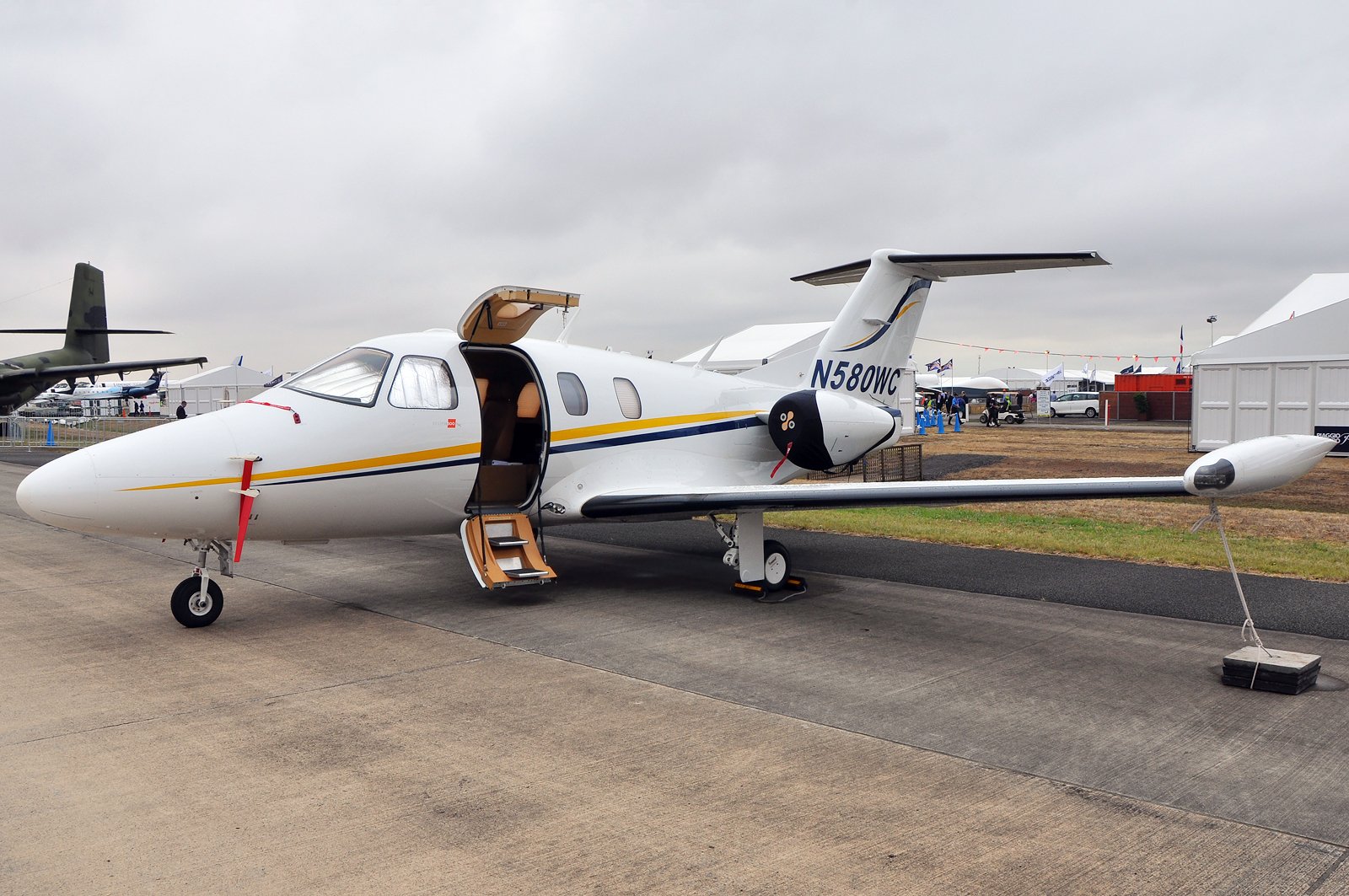
Development and Design Legacy
The Eclipse 550 emerged from the ambitious vision of Eclipse Aviation, which had revolutionized the very light jet market with its predecessor, the Eclipse 500. Building upon the proven airframe of the 500, which completed its preliminary design in 2000 and first flew on 26 August 2002, the EA550 incorporated significant technological advances that pushed the boundaries of single-pilot jet operations.
Engineering teams focused on enhancing the proven platform with cutting-edge avionics and safety systems. The aircraft retained the twin Williams International PW610F augmented turbofan engines from its predecessor while integrating a sophisticated dual Avio IFMS avionics suite. Notable innovations included synthetic vision technology, enhanced vision systems, autothrottles for single-pilot operations, and advanced anti-skid braking systems that could bring the aircraft to a complete stop in 700 feet from normal landing speeds.
Manufacturing Renaissance
The EA550's production story reflects one of aviation's most dramatic corporate resurrections. Eclipse Aviation, founded in 1998, had initially produced 260 Eclipse 500s between 2006 and 2008 before financial difficulties forced production to halt at serial number 267 in October 2008. The company's bankruptcy left hundreds of customers with unfulfilled orders and sparked numerous lawsuits over deposits.
Eclipse Aerospace emerged from these ashes on 1 September 2009, opening operations in Albuquerque, New Mexico with just 15 employees. This lean organization successfully obtained an FAA production certificate in April 2012, marking a crucial milestone in the aircraft's revival. The company established an innovative international manufacturing arrangement with PZL Mielec in Poland, which began producing fuselages, empennages, and wings in May 2012, while final assembly remained in Albuquerque.
The first production EA550 powered up in March 2013, with the initial rollout occurring that same month. Customer deliveries began on 22 October 2013, though some sources cite 12 March 2014 as the first fully certificated delivery. Eclipse Aerospace later merged with Kestrel Aircraft in April 2015 to form One Aviation, which continued production until March 2017.
Technical Excellence and Certification
The EA550 achieved several significant certification milestones that demonstrated its advanced engineering. The aircraft received an impressive 20,000-hour and 20,000-cycle fatigue limit with unlimited calendar life in June 2013, reflecting exceptional structural integrity. The FAA approved the aircraft's autothrottles and anti-skid braking systems in February 2014, making it one of the most technologically advanced aircraft in the very light jet category.
European Aviation Safety Agency certification followed on 18 November 2015, opening European markets and enabling air-taxi operations across the continent. This certification attracted deposits from six European customers, with deliveries beginning in January 2016 following minor switch modifications for European operations.
The aircraft's twin PW610F engines provided best-in-class efficiency for the very light jet category, enabling the EA550 to compete directly with aircraft like the HondaJet and Embraer Phenom 100. The powerplants had proven their reliability through extensive service on the Eclipse 500, avoiding the thrust issues that had plagued the earlier EJ22 engines during initial development phases.
Production Challenges and Revival
Despite technological excellence, the EA550 faced significant market challenges. Production proceeded slowly, with approximately 10 aircraft delivered by August 2014, falling short of the planned 1.5 to 2 aircraft per month production rate. One Aviation delivered 33 EA550s between 2014 and 2017 before announcing a production pause in March 2017 to complete four additional aircraft and shift focus to the larger Eclipse 700 project.
The company's financial struggles culminated in Chapter 7 bankruptcy liquidation in February 2021, once again leaving Eclipse aircraft owners without factory support. However, the Eclipse story experienced another resurrection in 2023 when a new company purchased the assets and resumed operations as Eclipse Aerospace, Inc. under AML Global Eclipse. This new entity delivered two EA550s in 2023, demonstrating renewed commitment to the platform.
Legacy and Current Status
The Eclipse 550 represents a significant achievement in very light jet development, proving that sophisticated avionics and single-pilot operations could be successfully integrated in an affordable business aircraft package. With an initial price of $2.695 million, the EA550 made turbine-powered business aviation accessible to a broader market segment.
Today, Eclipse Aerospace, Inc. continues operations, providing support for all Eclipse aircraft while maintaining production capabilities for the EA550. The company operates service centers at key locations including Albuquerque, Gainesville Regional Airport in Florida, and Albany International Airport in New York, ensuring comprehensive support for the existing fleet.
While exact numbers of currently flying EA550s remain undisclosed, the aircraft's robust structural design and unlimited calendar life suggest that most delivered examples remain in active service. The successful restart of production in 2023 indicates continued market demand for this innovative very light jet, cementing its position as a pioneering aircraft in modern business aviation.