
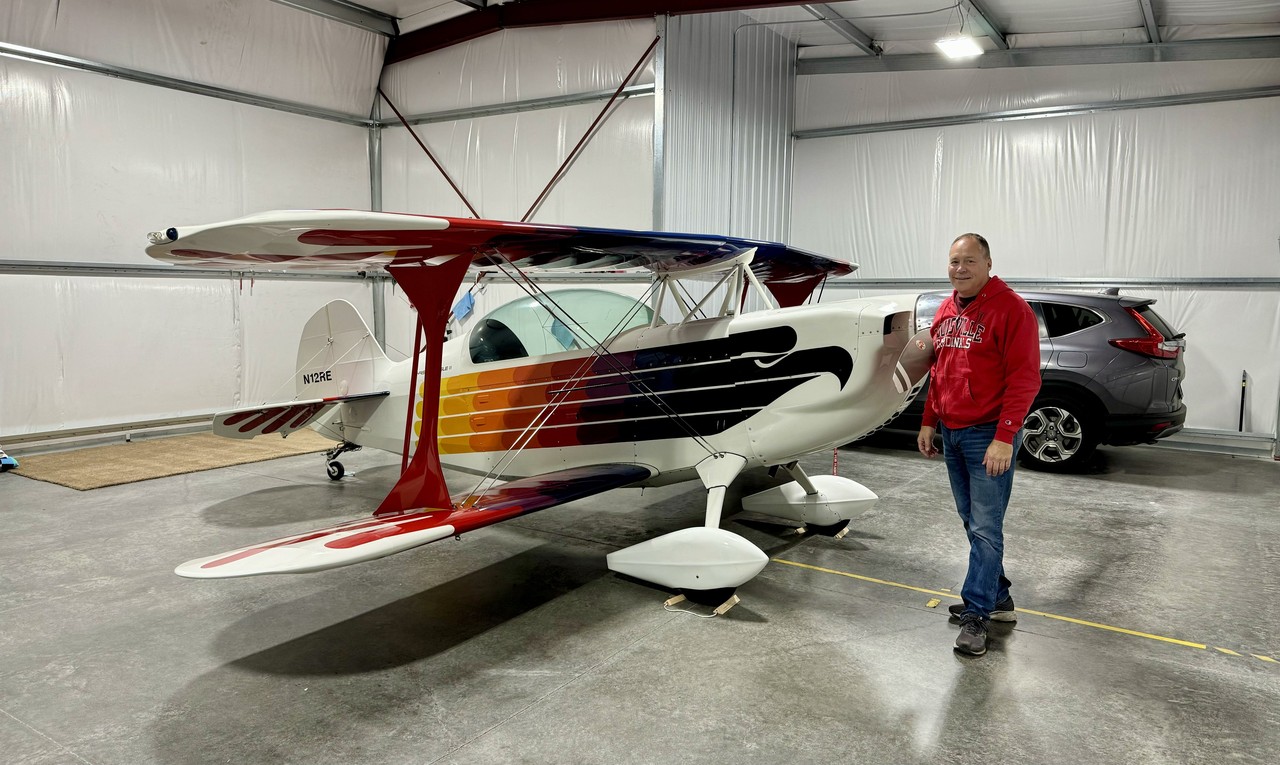
Revolutionary Kit Design
Frank Christensen's vision for the Christen Eagle emerged from frustration in 1976 when his attempt to purchase Pappy Pitts' aircraft operation fell through. A wealthy semiconductor equipment manufacturer and competitive aerobatic pilot, Christensen decided to create his own improved version of the legendary Pitts Special. His design philosophy centered on superior styling, enhanced performance, and most importantly, a completely documented kit that would transform homebuilding from a project requiring extensive fabrication skills to one accessible to dedicated enthusiasts.
The first Eagle II kits, priced at $40,000 in 1977, included factory-welded assemblies, finished components, specialized tools, and construction jigs—a revolutionary approach that set the standard for modern homebuilt aircraft. By 1982, Christensen had sold nearly 500 kits, proving the market demand for high-quality aerobatic aircraft that builders could complete in their own hangars.
The Eagles Aerobatic Team Legacy
The aircraft's reputation soared when the legendary Eagles Aerobatic Team selected three Christen Eagle I aircraft in 1979. Charlie Hillard, Tom Poberezny, and Gene Soucy had previously performed as "The Red Devils" flying Pitts Specials for 25 years, making them the longest-running aerobatic team in aviation history. Their transition to the Christen Eagle validated the design's capabilities at the highest levels of aerobatic performance.
From 1979 to 1995, the Eagles Aerobatic Team performed at airshows across America, with their final farewell performance at EAA AirVenture Oshkosh 1995 marking the end of an era. Today, all three team aircraft hang prominently in the EAA AirVenture Museum lobby in Oshkosh, Wisconsin, serving as testament to both the aircraft's performance and its cultural impact on aerobatic aviation.
Manufacturing Evolution and Success
Christen Industries initially operated from California before making a strategic acquisition in 1983 that would reshape the aerobatic aircraft market. The company purchased the assets of Pitts Aerobatics and consolidated all operations in Afton in 1984, dramatically increasing efficiency and achieving peak production rates of 100 aircraft per year across both Eagle and Pitts product lines.
The company's commitment to excellence extended beyond kit aircraft when they pursued FAA certification under Part 23 regulations. Remarkably, Christen achieved certification in just 18 months after beginning development in 1985—an FAA record for an all-new aircraft design that stood as testimony to the thoroughness of the original engineering.
Technical Excellence and Variants
The Christen Eagle's construction combined traditional techniques with modern materials for optimal performance. The fuselage employed chromoly steel welded tube construction with aluminum forward skinning and fabric covering aft. Wings featured Sitka spruce wood structure with fabric covering, while the engine cowling utilized lightweight fiberglass. This hybrid approach balanced strength, weight, and maintainability.
Four distinct variants emerged during production. The original Eagle I, powered by a 260-horsepower Lycoming AEIO-540 engine, remained extremely rare with only four airframes built—three residing in the EAA Museum and one in Dallas. The Eagle II became the standard production aircraft, featuring a 200-horsepower Lycoming AEIO-360 engine in a two-seat tandem configuration under a large bubble canopy.
Two Super Eagle variants pushed performance boundaries further. The Super Eagle I 540, equipped with a 300-horsepower Lycoming AEIO-540, powered the Iron Eagles Aerobatic Team from 1992 to 2014. The Super Eagle II offered similar performance in two-seat configuration, though limited fuel capacity restricted its operational envelope.
Pilot Perspective and Performance
Pilots consistently praised the Eagle's superior handling characteristics compared to its Pitts Special inspiration. The aircraft delivered crisp control response essential for precision aerobatics while maintaining predictable behavior throughout the flight envelope. With a cruise speed of 162 miles per hour in the Eagle I configuration, the aircraft provided respectable cross-country capability between aerobatic competitions.
The tandem seating arrangement with excellent visibility through the bubble canopy made the Eagle II particularly valuable for aerobatic instruction. Student pilots could experience unlimited aerobatic maneuvers under instructor guidance, while the aircraft's forgiving characteristics built confidence during the learning process.
Continuing Legacy
When Aviat Aircraft acquired Christen Industries in the mid-1990s, production continued under the Aviat Eagle designation, ensuring the design's survival into the 21st century. By 2011, more than 350 Eagles flew worldwide, representing one of the most successful homebuilt aircraft programs in aviation history.
The Christen Eagle's influence extends far beyond its production numbers. The comprehensive kit concept pioneered by Frank Christensen became the industry standard, enabling countless homebuilders to complete aircraft projects that would have been impossible under previous kit philosophies. Today's thriving homebuilt aircraft community owes much to the revolutionary approach first demonstrated by the Christen Eagle in 1977.