
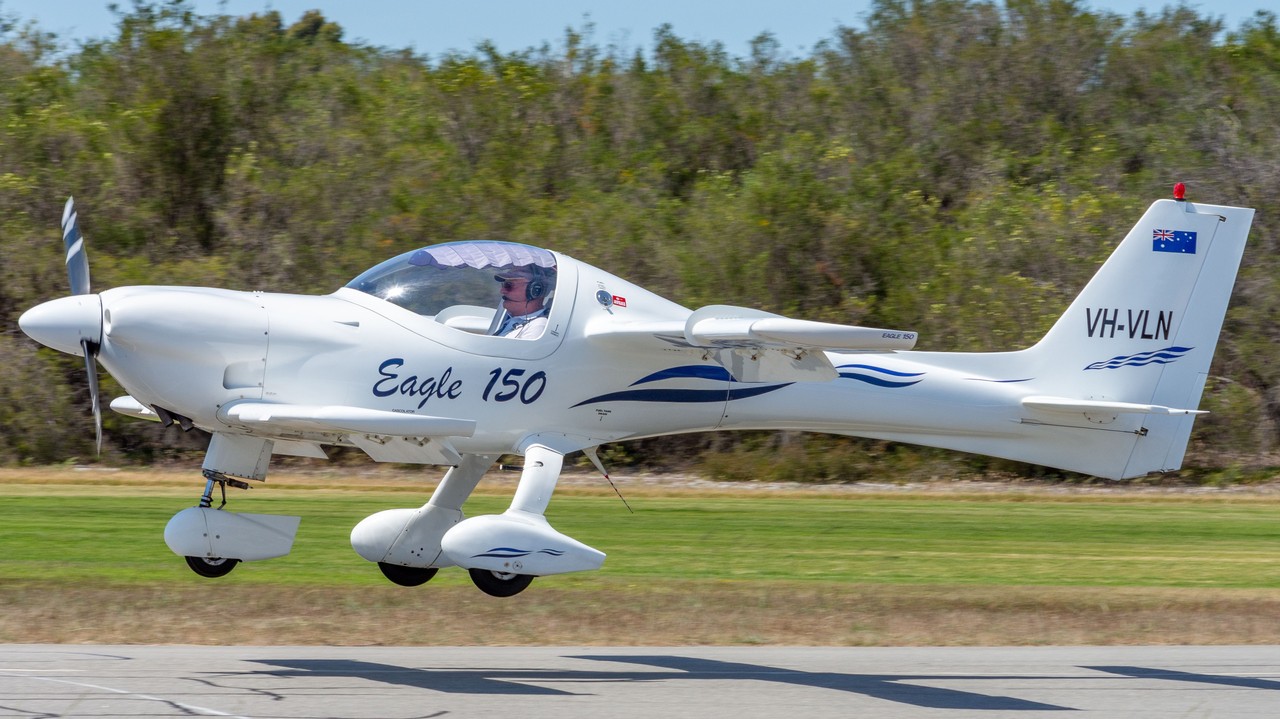
Development and Innovation
The Eagle 150 program originated in 1981 when Composite Industries Ltd of Western Australia conceived an ambitious project to create the world's first mass-produced all-composite aircraft. The original concept came from Western Australian inventors Neil Graham and his father Deryck Graham, who envisioned a light airplane with excellent visibility for Australian ranchers to use in mustering sheep. The aircraft's unconventional design would prove both its greatest asset and most significant challenge.
Development faced early setbacks when Eagle Aircraft entered liquidation in 1989, stalling progress on the promising design. Malaysian investors rescued the program that same year, funding crucial redesign work by American aerodynamicist John Roncz. This international collaboration proved essential, as Roncz's expertise helped transform the concept into a certifiable aircraft that would eventually earn him the Prince's Australian Medal from Prince Philip in 2000.
Technical Achievement
The Eagle 150's most distinctive feature was its tandem-wing configuration with a forward canard, a layout that distinguished it from conventional light aircraft. Production aircraft utilized advanced composite construction incorporating Kevlar, carbon fiber, and Nomex honeycomb rather than traditional fiberglass materials. This construction method provided structural advantages while demonstrating the viability of composite manufacturing techniques for production aircraft.
The aircraft was powered by a Continental IO-240 engine producing 125 horsepower, replacing earlier prototype engines that included a 78-horsepower Aeropower unit and 100-horsepower Continental O-200. The final engine selection proved crucial for certification compliance, as the aircraft needed to meet JAR-VLA standards for international marketability.
Production History
Eagle Aircraft commenced production in August 1993, delivering the first customer aircraft VH-FPO to Western Australia's Department of Conservation and Land Management in December 1993. The company operated as a subsidiary of the original Composite Industries group, with Malaysian component support provided through Eagle Aircraft (Malaysia), a wholly owned subsidiary established after the 1989 investment.
Three variants targeted different market segments: the pastoral version featured robust interior appointments, basic instrumentation, and large tires for rough field operations; the trainer variant was optimized for aeroclub use; and the sport/executive model catered to recreational and business operators. By 2000, pricing ranged from $119,000 for the basic Eagle 150B to $129,500 for the executive variant.
Certification Challenges
The Eagle 150's certification journey proved complex, requiring multiple regulatory approvals across several countries. Australian FAR33 certification was achieved on September 21, 1993, though initially with weight restrictions. The improved Eagle 150B received full CASA certification on November 13, 1997, meeting JAR-VLA standards at a maximum takeoff weight of 1,411 pounds.
International certification followed with FAA approval on February 11, 1999, and New Zealand approval by mid-1999. Thailand also granted approval, though European JAA certification remained pending when production concluded. These certification efforts demonstrated the aircraft's fundamental airworthiness while highlighting the complexities of international light aircraft marketing.
Operational Service
In service, the Eagle 150 demonstrated the performance characteristics its designers intended. The aircraft achieved a 125-knot cruise speed at 75 percent power while exhibiting docile stall characteristics and crisp handling qualities. Maintenance costs were calculated at $9.98 per hour over 2,000 hours of utilization as of 2003, indicating reasonable operating economics for its class.
Two aircraft were delivered to the United States in 2002, representing the type's limited international success. The first night VFR instrumented aircraft received certification and delivery in December 2000, expanding the type's operational capabilities beyond basic day VFR operations.
Production Transfer and Conclusion
In December 2001, Eagle Aircraft announced production would transfer to Malaysia, with Australian operations concluding by late February 2002. Composites Technology Research Malaysia (CTRM) assumed manufacturing rights, redesignating the aircraft as the EAM Eagle 150. Malaysian production added three additional aircraft by January 2003, bringing total production to 49 examples including two Australian-built prototypes.
Legacy and Preservation
The Eagle 150's legacy extends beyond its modest production numbers. As one of the first successful applications of advanced composite materials to production light aircraft, it demonstrated manufacturing techniques that would influence subsequent aircraft designs. The program's international development model, combining Australian innovation with Malaysian investment and American aerodynamic expertise, illustrated emerging patterns in global aerospace collaboration.
Today, no Eagle 150 aircraft remain on the Australian civil registry, though more than 20 examples appeared on Australian registers during the type's active period. Some aircraft have migrated to the Recreational Aviation Australia register, including construction numbers 2 and 14. The original single-seat proof-of-concept aircraft is preserved at Sydney's Power House Museum, while CTRM donated an Eagle 150B to Malaysia's Department of Museums in 2016, ensuring the type's historical significance remains documented for future generations.