
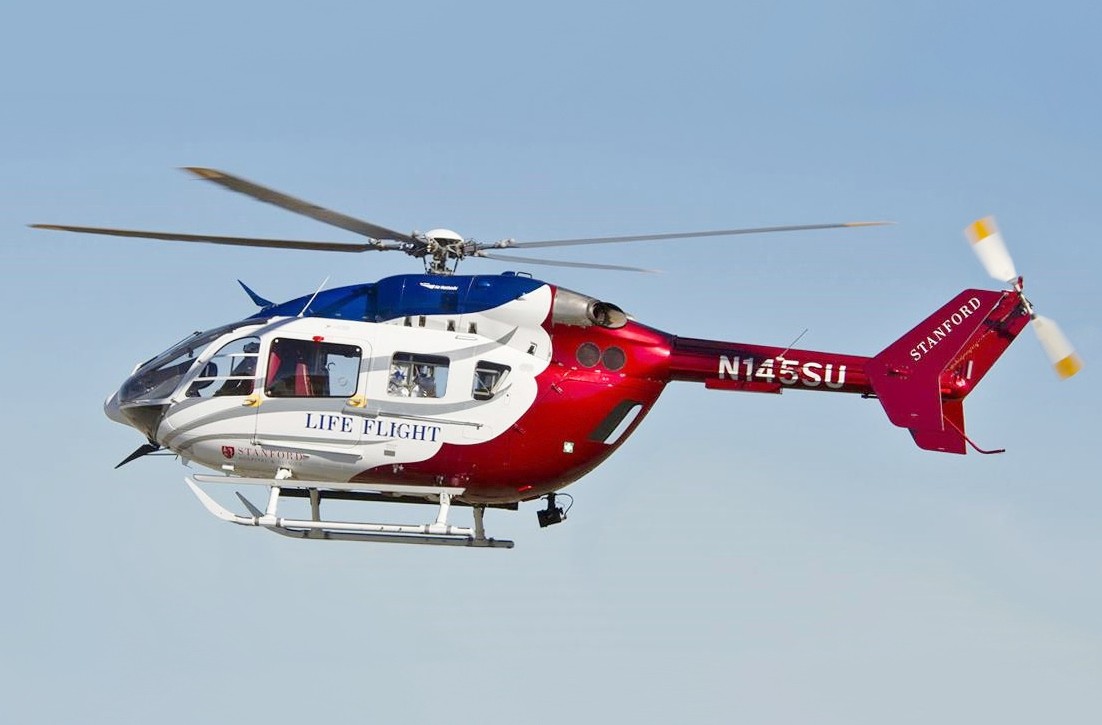
Service Dominance
The EC-145 achieved remarkable market penetration, with over 1,600 units in service by 2023 and production continuing today as the H145. Operating in more than 34 countries by 2012, the helicopter accumulated over 8 million flight hours, establishing itself as the backbone of emergency medical services worldwide. Swiss air rescue operator Rega received the 2,000th delivery of the H145 family in 2024, while Metro Aviation took delivery of the final EC-145e variant on March 18, 2024, marking the end of an era before full transition to the five-bladed H145 configuration.
Military Operations
Though designed primarily for civilian roles, the EC-145 serves military forces across 25 nations, including Albania, Brazil, France, Germany, Israel, Norway, Spain, Thailand, Ukraine, and the United Kingdom. The United States Army operates the type as the UH-72 Lakota, manufactured at Airbus Helicopters' Columbus, Mississippi facility for utility and training missions. While the EC-145 has not seen major combat operations, its military operators utilize the aircraft for reconnaissance, light transport, and law enforcement support roles.
The Manufacturer Partnership
The EC-145 represents the culmination of a unique international partnership between Eurocopter (now Airbus Helicopters) and Kawasaki Heavy Industries that began with the original BK 117 agreement in 1977. Eurocopter, formed in 1992 through the merger of Germany's Messerschmitt-Bölkow-Blohm helicopter division and France's Aérospatiale-Matra helicopter operations, brought decades of rotorcraft expertise from the pioneering German helicopter technology developed after World War II. Kawasaki, founded in 1896 and originally focused on shipbuilding and motorcycles before entering aviation, contributes 40 percent of production including the fuselage and main transmission systems. The partnership, extended until at least 2025 in a 2010 agreement, celebrated its 50th anniversary in 2024.
Technical Innovation
The EC-145 emerged from an ambitious design philosophy that combined 90 percent of existing proven technology from two successful predecessors: the BK 117 C1's rear section merged with the EC 135's forward cockpit and avionics systems. Engineers at both Eurocopter and Kawasaki focused on creating an enlarged cabin with higher speed, increased payload capacity, and reduced noise levels compared to earlier light twins. The aircraft incorporated the distinctive Fenestron shrouded tail rotor system and featured integration with the advanced Helionix avionics suite introduced in the 2014 H145 upgrade.
Engine Performance
Powered by twin Turboméca Arriel 2D turboshaft engines manufactured by Safran Helicopter Engines, the EC-145 benefits from decades of proven reliability in the Arriel engine family. The engines feature full authority digital engine control (FADEC) systems and provide exceptional hot-and-high performance capabilities, particularly when integrated with the Helionix avionics system. The 2020 introduction of the five-bladed Blue Edge main rotor system, retrofittable to existing aircraft, increased payload capacity by 150 kilograms while improving overall efficiency.
Production Legacy
Primary manufacturing occurs at Airbus Helicopters' Donauwörth facility in Germany, with Kawasaki's Japanese operations handling critical components and the Mississippi facility producing American military variants. Production began in 1999 and continues today, with the broader BK 117/H145 family reaching 2,000 deliveries by 2024. The five-bladed configuration became standard production in February 2021, representing the latest evolution in the continuous development program.
The EC-145 stands as a testament to successful international cooperation in aerospace manufacturing, transforming light twin helicopter operations through its combination of German engineering precision and Japanese manufacturing quality. Its legacy continues through ongoing production and worldwide operations, cementing its position as one of the most important helicopters of the early 21st century.