
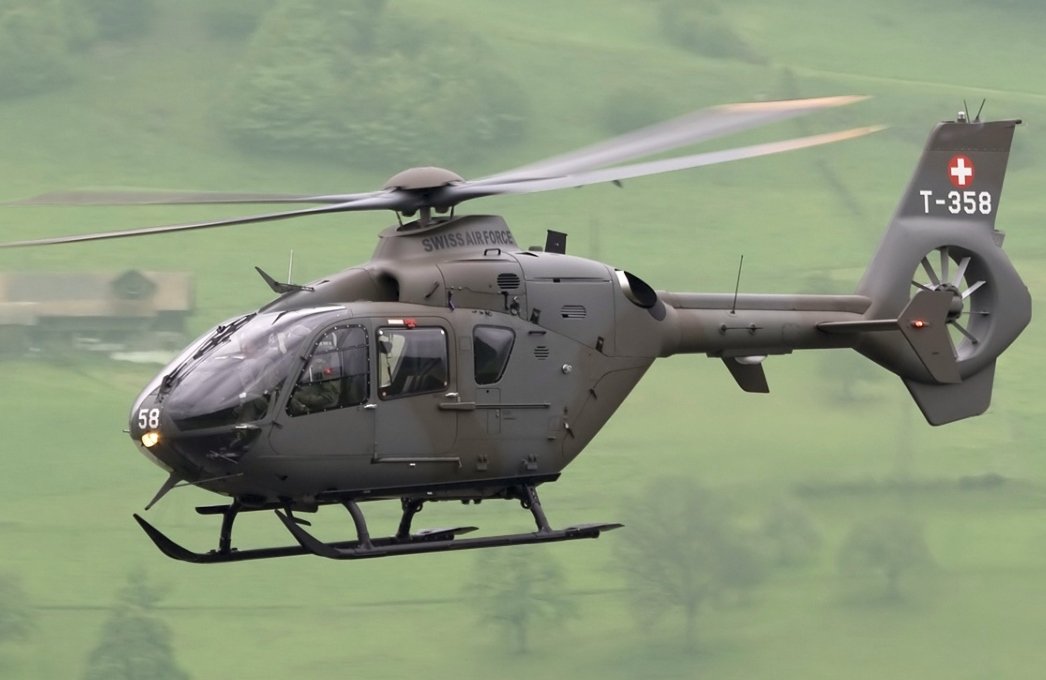
The Eurocopter EC635, currently designated as the Airbus Helicopters H135M, is a militarized version of the EC135 light twin helicopter. The aircraft was first publicly unveiled in May 1998 at the Aviation Africa trade show in South Africa. It was developed as a successor to the experimental BO 108, utilizing a modern composite airframe and digital avionics to provide a low-maintenance platform for military operators. While a specific chief designer is not credited, the aircraft was developed by the Eurocopter design teams in France and Germany.
Production of the EC635 began in the late 1990s, with deliveries starting in the early 2000s. The manufacturing process was primarily handled by Eurocopter (now Airbus Helicopters) in France and Germany. Notably, for a Swiss order of 20 aircraft, RUAG Aerospace in Switzerland license-built 16 of the airframes, completing deliveries by December 2009. Total production numbers for the military variant vary by source, with estimates ranging from 121 to 250 units, while the broader EC135 family has exceeded 1,400 units.
Technically, the EC635 is a twin-engine turboshaft helicopter featuring a four-bladed main rotor and a Fenestron tail rotor, which reduces noise and infrared signatures while increasing ground safety. Depending on the variant, it is powered by either two Turbomeca Arrius 2B2 engines (providing approximately 417 kW of continuous power each) or two Pratt & Whitney Canada PW206B2 engines. The aircraft is capable of reaching a maximum speed of 259 km/h and has a range of 620 km, which can be extended to 880 km with optional long-range tanks. Its maximum take-off weight is cited between 2,835 kg and 3,100 kg.
In military service, the EC635 has performed diverse roles including combat search and rescue (CSAR), medical evacuation (MEDEVAC), and armed scouting. The Royal Jordanian Air Force was an early adopter, receiving aircraft in 2003. The Iraqi Army acquired 24 EC635 T2+ units in 2009, which featured reinforced airframes and were utilized in combat operations against Islamic State insurgents. Other operators include the Swiss Air Force and more recent orders from the British Army Air Corps and the Spanish Ministry of Defence.