
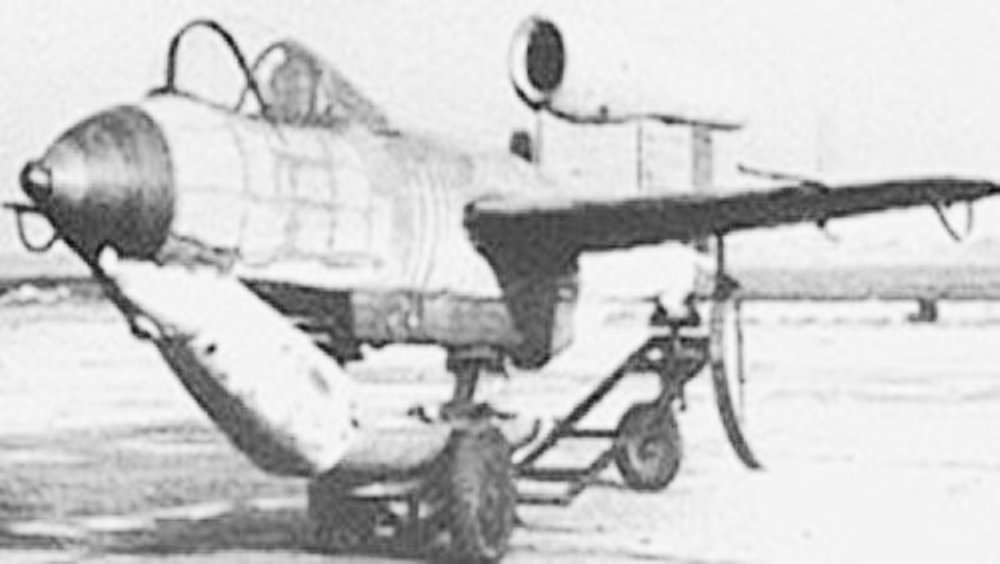
The Junkers EF 126, known as the "Elli," was a product of the German Air Ministry's (RLM) Miniaturjägerprogramm initiated in 1944. This program sought to develop the most inexpensive and simple fighter possible to counter Allied threats, utilizing pulse-jet propulsion similar to that used in the V-1 flying bomb. The EF 126 was intended to serve as a low-altitude interceptor and ground-attack aircraft, emphasizing ease of construction through the use of wooden wings and a metal fuselage. Its proposed armament included two 20 mm MG 151/20 cannons—though some sources suggest 30 mm MK 108 cannons—and the capability to carry up to 400 kg (880 lb) of bombs under the wings.
Designed by Junkers Flugzeug- und Motorenwerke AG, the aircraft was powered by a single Argus As 109-044 pulse jet, which produced approximately 500 kg of thrust (roughly 4.9 kilonewtons or 1,100 lbf). Due to the inherent characteristics of pulse-jet engines, which lose efficiency at higher altitudes, the EF 126 was specifically optimized for low-level operations. The design also incorporated a retractable nosewheel undercarriage.
No complete aircraft were built in Germany before the nation's surrender in May 1945. However, the project continued in the Soviet Union, where captured German materials and personnel were used to complete prototypes. An unpowered version of the EF 126 first flew under tow on May 21, 1946, though this specific prototype later crashed during testing. A second powered prototype featuring a running engine was completed in 1947, although detailed performance data from these tests remains undocumented.
Technically, the EF 126 measured 8.46 meters in length with a wingspan of 6.65 meters and a wing area of 8.9 square meters. While it never entered operational service with the Luftwaffe, it served as the conceptual basis for the EF 127 "Walli," a rocket-powered derivative. Today, the EF 126 is primarily remembered by aviation historians and scale modelers as a representative of the desperate "Luft '46" experimental era, illustrating the transition of German aeronautical technology to the Soviet Union after World War II.