
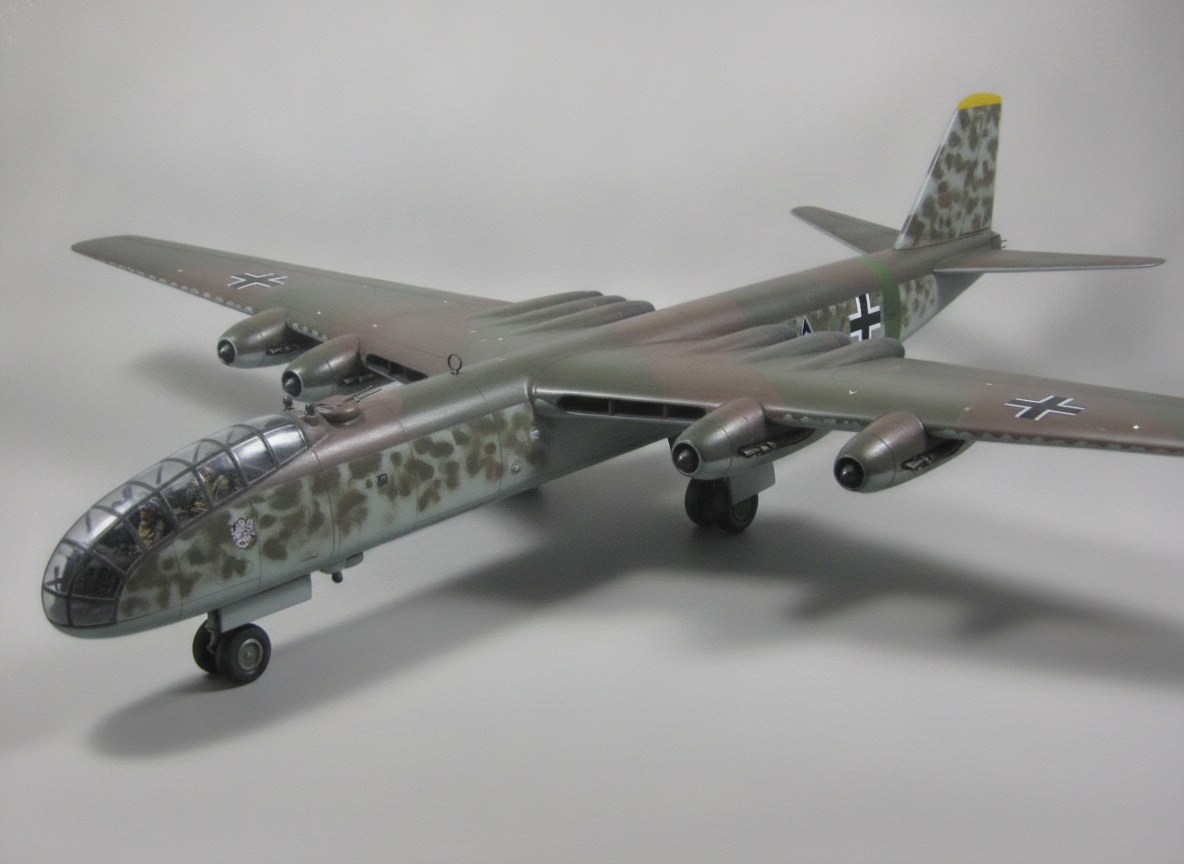
The Junkers EF 132 was a projected long-range heavy bomber developed during the final stages of World War II. Emerging from the research initiated by the Ju 287 program in 1942, the EF 132 was designed by the Junkers Dessau design office between 1944 and 1945. It was intended to serve as a high-speed, high-altitude strategic asset for the Luftwaffe, combining advanced aerodynamics with significant payload capabilities. Despite its advanced design, the aircraft never progressed beyond mock-ups and test articles; no complete, flyable aircraft were ever constructed.
Technically, the EF 132 was characterized by a swept-back wing mounted at shoulder height and a pressurized cabin designed to house a five-man crew. Its propulsion system consisted of six Junkers Jumo 012 axial-flow turbojet engines, each projected to produce 24.5 kN (5,500 lbf) of thrust. The aircraft was designed for a maximum takeoff weight of 65,000 kg and a maximum speed of 930 km/h. For defense, the design incorporated a sophisticated remote-control system, utilizing twin 20 mm cannon turrets located dorsally and ventrally, as well as a tail barbette. Its offensive capacity included an internal bomb bay capable of carrying between 4,000 and 5,000 kg of ordnance.
Following the defeat of Germany in 1945, surviving Junkers personnel and assets were relocated to the Soviet Union. Under the direction of German engineer Brunolf Baade at OKB-1 (attached to GOZ No. 1), work continued on the project. Although Council of Ministers directive No. 874-266 authorized the construction of an unpowered test example, the project failed to reach operational status. The EF 132 program was formally terminated on June 12, 1948, via Council of Ministers directive 2058-805.
While the EF 132 never saw combat or entered production, it remains historically significant as a bridge between German and Soviet jet bomber development. The project embodies the highly ambitious "Luft '46" era of aviation, where theoretical performance often exceeded the industrial capabilities of the time. Today, the aircraft exists only in historical records, design drawings, and scale models.