
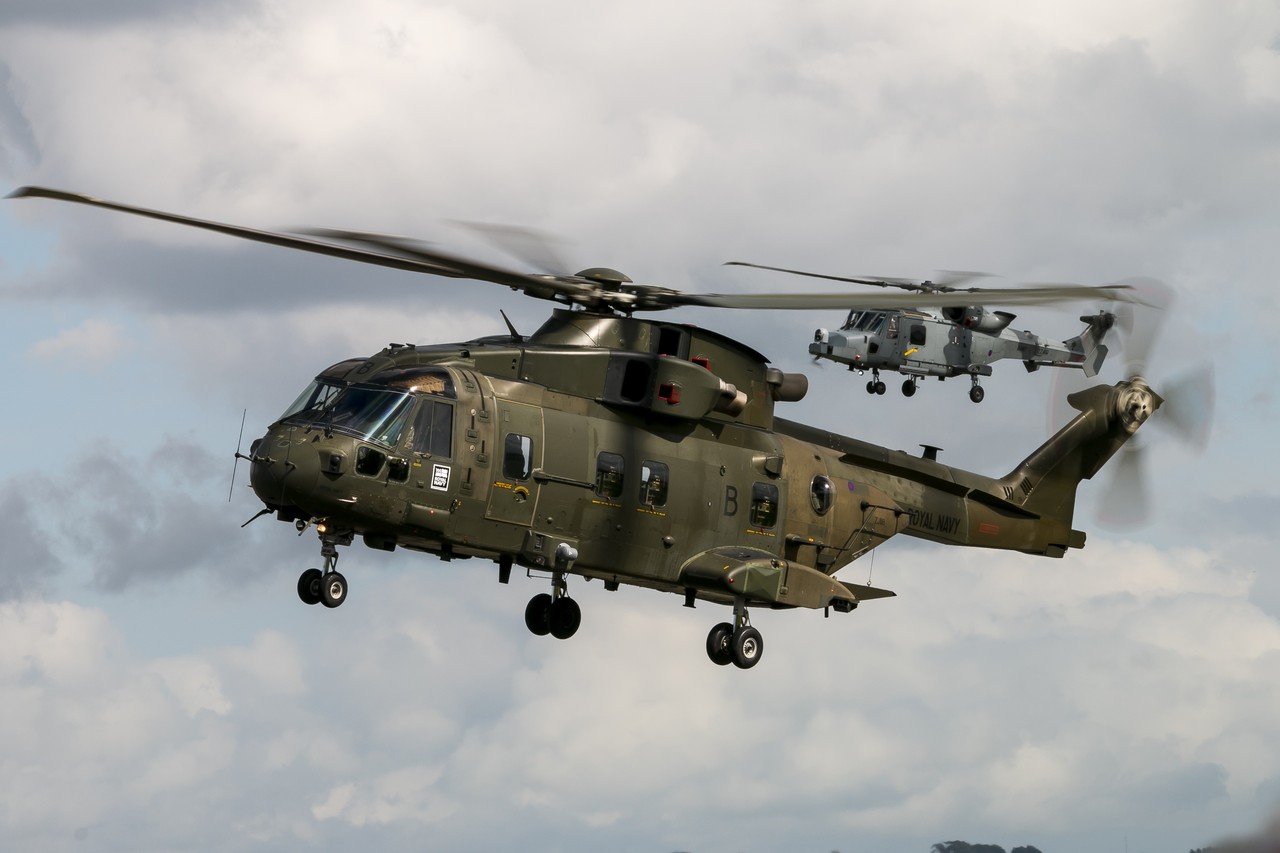
Revolutionary Three-Engine Design
The AW101's unprecedented three-engine configuration emerged from demanding naval requirements that twin-engine helicopters of the 1980s could not safely meet. When one of three engines fails, the aircraft maintains full operational capability—a critical advantage during over-water missions or when operating from aircraft carriers in harsh weather. This design philosophy proved prescient during a January 2025 mission to Jan Mayen Island, where an AW101 completed a 486-nautical-mile flight operating on just two engines.
Development and International Collaboration
The aircraft originated from a 1981 agreement between Westland Helicopters and Agusta, formalized when the UK government confirmed £20 million in initial funding on June 12, 1981, for nine pre-series aircraft. EH Industries Limited managed the program, with Westland leading UK variants and Agusta handling Italian versions. The first prototype, PP1, lifted off on October 9, 1987, from Yeovil, powered by General Electric CT7-2A engines. However, tragedy struck early development when prototype PP2 crashed on January 21, 1993, killing all four occupants.
The program switched to Rolls-Royce Turbomeca RTM322 engines for production aircraft, with the new powerplant first flying in an EH101 on June 6, 1993. This engine choice proved superior, offering exceptional hot-and-high performance and accumulating over 170,000 fleet hours by 2009 with outstanding reliability.
Military Service and Global Operations
Production deliveries began in 1995, with the Royal Navy receiving 22 Merlin HM.1 aircraft in February 1995, followed by Italy's order for 16 helicopters in October 1995. The first Italian production aircraft, MM81480, flew on October 4, 1999, beginning deliveries that continued through 2004.
The Royal Navy's Merlin HM.1 variants revolutionized anti-submarine warfare, replacing aging Sea Kings with advanced sonar systems and modern avionics. Royal Air Force Merlin HC.3 and HC.4 variants proved invaluable during operations in Afghanistan, providing medium-lift transport capability in demanding conditions. However, combat operations extracted a toll—aircraft ZJ138 was written off at Camp Bastion on June 23, 2010.
International Military Adoption
The Royal Canadian Air Force operates 15 CH-149 Cormorant aircraft primarily for search-and-rescue missions across Canada's vast territory. These aircraft regularly perform life-saving missions in extreme weather conditions, though the program faced tragedy when aircraft 149914 crashed on July 13, 2006, killing three crew members.
Norway's acquisition of 14 AW101 Mk612 aircraft, delivered between 2004-2006 and 2017-2020, replaced their Sea King fleet in December 2023. The Japanese Maritime Self-Defense Force operates CH-101 and MCH-101 variants, though suffered losses including aircraft 8193, which crashed on August 17, 2017.
Manufacturing and Production Legacy
Exactly 304 airframes have rolled off production lines at two primary facilities: Yeovil, England, and Vergiate, Italy. Kawasaki assembled additional aircraft under license for Japan, while Boeing received manufacturing rights for US production in 2010, though these were never exercised.
The aircraft underwent significant corporate transitions during its production life. AgustaWestland rebranded the EH101 as AW101 in 2007 after dissolving EH Industries. The company became part of Leonardo S.p.A. in 2016, which continues production and support today.
Technical Innovation
The AW101's 61-foot main rotor incorporates advanced composite blades with RAE 9651 airfoils at the root transitioning to RAE 9645-9634 sections at the tips, providing exceptional lift efficiency across its 2,922.5-square-foot rotor disc. The rotor system folds for shipboard operations, essential for naval variants operating from frigates and aircraft carriers.
Later variants incorporated fly-by-wire flight controls, enhancing safety and reducing pilot workload during demanding missions. The spacious cabin accommodates diverse mission requirements, from 30 combat-equipped troops to sophisticated anti-submarine warfare equipment.
Current Operations and Legacy
More than 200 AW101s remain operational as of 2025, continuing to serve with military forces worldwide. Recent incidents, including aircraft ZJ135 on September 4, 2024, and ZJ128 suffering minor damage on September 10, 2025, demonstrate the type's continued active service.
The AW101 established the template for modern tri-engine helicopters, influencing subsequent designs and proving that the three-engine configuration offers genuine operational advantages. With over 180 aircraft delivered to more than 10 nations by 2009, the type succeeded in its original goal of replacing aging Sea Kings while establishing new standards for naval helicopter capability. Museum examples, including airframes at the Fleet Air Arm Museum in Yeovilton, preserve this significant chapter in rotorcraft history.