
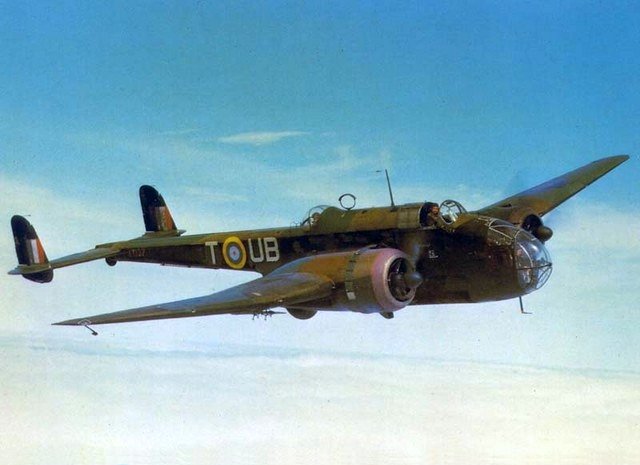
Design and Development
Designed to meet a 1932 Air Ministry requirement for a high-performance twin-engine day bomber, the Handley Page HP.52 Hampden was developed under the direction of Sir Frederick Handley Page. The aircraft featured a modern all-metal, stressed-skin structure with a mid-mounted wing, representing a significant technological leap over previous fabric-covered bombers. To maximize speed and agility, the designers implemented a remarkably narrow and deep fuselage, which earned the aircraft the nickname "Flying Suitcase," though this resulted in cramped conditions for the four-man crew. The prototype first flew on 21 June 1936, achieving a top speed of up to 265 mph and a low landing speed of 73 mph.
Production and Manufacturing
Production spanned from 1936 to 1941, with a total of 1,430 aircraft built. Handley Page Ltd handled initial production at their Radlett and Cricklewood works, contributing 500 airframes. English Electric joined production in February 1940 at its Preston works, ultimately becoming the largest contractor with 770 aircraft delivered, the last of which arrived on 15 March 1942. Additional airframes were produced in Canada by the Canadian Associated Aircraft (CAA) consortium, which consisted of six companies divided into Ontario and Quebec groups.
Technical Specifications
The standard Hampden B.Mk I was powered by two Bristol Pegasus XVIII 9-cylinder, air-cooled radial piston engines, producing between 980 hp and 1,000 hp each. A variant known as the Handley Page Hereford utilized 24-cylinder Napier Dagger H-type engines, though it saw limited service. The aircraft's armament typically consisted of four to six .303 in Vickers K machine guns positioned in the nose, dorsal, ventral, and tail-boom areas. It could carry up to 4,000 lb of bombs or mines internally and under the wings.
Military Service and Legacy
No. 49 Squadron RAF received the first Hampdens in September 1938. By the start of World War II, 226 aircraft were in service across eight squadrons. Initially utilized for daylight reconnaissance and bombing, the Hampden proved vulnerable to German fighters, leading the RAF to transition the type to night operations. Notable achievements include participation in the first night raid on Berlin and the first "1,000-bomber" raid on Cologne in May 1942.
As it was superseded by four-engine heavies in late 1942, many Hampdens were transferred to RAF Coastal Command. Approximately 144 aircraft were converted to the TB Mk I torpedo bomber configuration, equipped with a Mk XII torpedo. The type was operated by the RAF, RCAF, RNZAF, and the Soviet Air Force. The cost of these operations was high; 714 aircraft were lost during the war, resulting in 1,077 crew killed and 739 missing. The Hampden was retired from service by 1945. Today, the aircraft is extremely rare, with surviving examples such as AE436—a former No. 144 Squadron RCAF torpedo bomber—undergoing restoration for museum display.