
Post-War German Aviation Revival
The Elster emerged from Germany's careful rebuilding of its aviation industry following the Allied occupation restrictions. Alfons Pützer KG Flugzeugbau developed the aircraft from their experimental Motorraab, itself a motorized version of the Schempp-Hirth Doppelraab glider. This evolutionary approach allowed the company to leverage proven aerodynamics while adapting to the demanding requirements of post-war aviation training and touring.
Design Evolution and Variants
Three distinct variants emerged during the decade-long production run. The prototype Elster A, registered D-EJOB with construction number 001, flew with a 52-horsepower Porsche 678/3 inline engine. The Elster B became the primary production model, equipped with the Continental C-90-12F or C-90-14F engine producing 95 horsepower. The most powerful variant, the Elster C, utilized a 148-horsepower Lycoming O-320-A2B engine specifically for glider towing operations.
The aircraft's all-wood construction kept manufacturing costs manageable while the strut-braced high-wing configuration provided excellent stability for training operations. At 23 feet 4 inches long with a wing area of 188 square feet, the Elster achieved a maximum speed of 112 mph and could operate to a service ceiling of 13,123 feet.
Military Service with the Luftwaffe
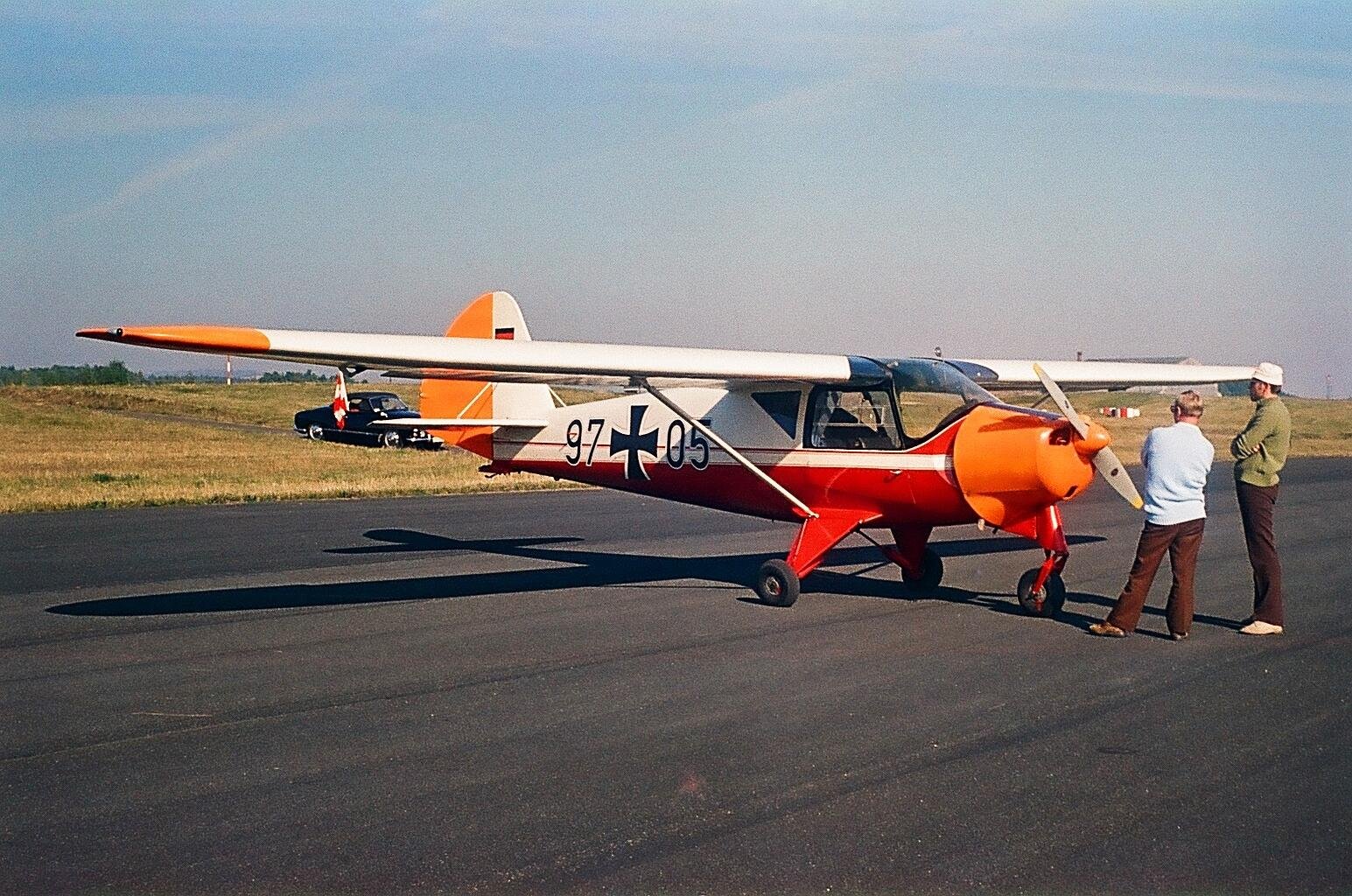
The West German Luftwaffe and Marineflieger acquired 25 Elster B aircraft for their sport flying groups, representing a significant portion of total production. Initially operated under civilian registrations such as D-EGWD (ex-military serial 97+18) and D-EGFH (construction number 044), these aircraft received proper military serials in 1971. The military contract included comprehensive maintenance support until 1978.
Military operations focused on pilot training and recreational flying rather than tactical missions. The aircraft proved reliable in service, though accidents occurred including a fatal crash of aircraft 97+02 near Bornheim on June 12, 1976. When the Luftwaffe maintenance contract expired in 1978, surviving military aircraft entered the civilian market.
Civilian Operations and Roles
Flying clubs across Germany embraced the Elster for training and touring. Notable operators included Eschweger Luftsportverein e.V., Segelfluggemeinschaft Bohlhof e.V., and Luftfahrt-Verein Bottrop. Commercial operators like Binder Aviatik KG and Offenburger Flugdienst GmbH utilized the aircraft for flight training and charter work.
The Elster C variant found particular success as a glider tug, where its 148-horsepower Lycoming engine provided sufficient power for towing operations. With an empty weight of 1,014 pounds and maximum takeoff weight of 1,654 pounds, the aircraft offered a practical balance between performance and operating economics.
Manufacturing Legacy
Alfons Pützer KG Flugzeugbau completed production in 1967 after building 45 aircraft including prototypes and all variants. The company ceased aircraft manufacturing operations following the Elster program, marking the end of one of Germany's pioneering post-war aviation manufacturers. Production averaged approximately four aircraft annually, reflecting the specialized nature of the market and the company's limited manufacturing capacity.
Current Status and Preservation
Several Elster aircraft remain airworthy today, regularly appearing at European airshows including the Oldtimer-Fliegertreffen Hahnweide in 2013 and 2016. Notable survivors include D-EGWD (construction number 30), D-EFPR (construction number 042, formerly military 97+19), and D-EDIQ. However, the type has suffered significant attrition with at least 22 documented accidents since 1964, resulting in 10 fatalities across various incidents.
Major accidents included D-ELBO on May 23, 1964 (two fatalities) and D-EDIQ on June 26, 2010 (two fatalities). Despite these losses, surviving aircraft continue to represent an important chapter in German aviation history as tangible examples of the nation's post-war industrial recovery.
Historical Significance
The Pützer Elster occupies a unique position as Germany's bridge between wartime aviation restrictions and the eventual resumption of normal aircraft manufacturing. Its success enabled rapid development of sport and training aviation in West Germany, providing essential experience for pilots and mechanics during the crucial rebuilding period. While production numbers remained modest, the aircraft's symbolic importance far exceeded its numerical impact on aviation.