
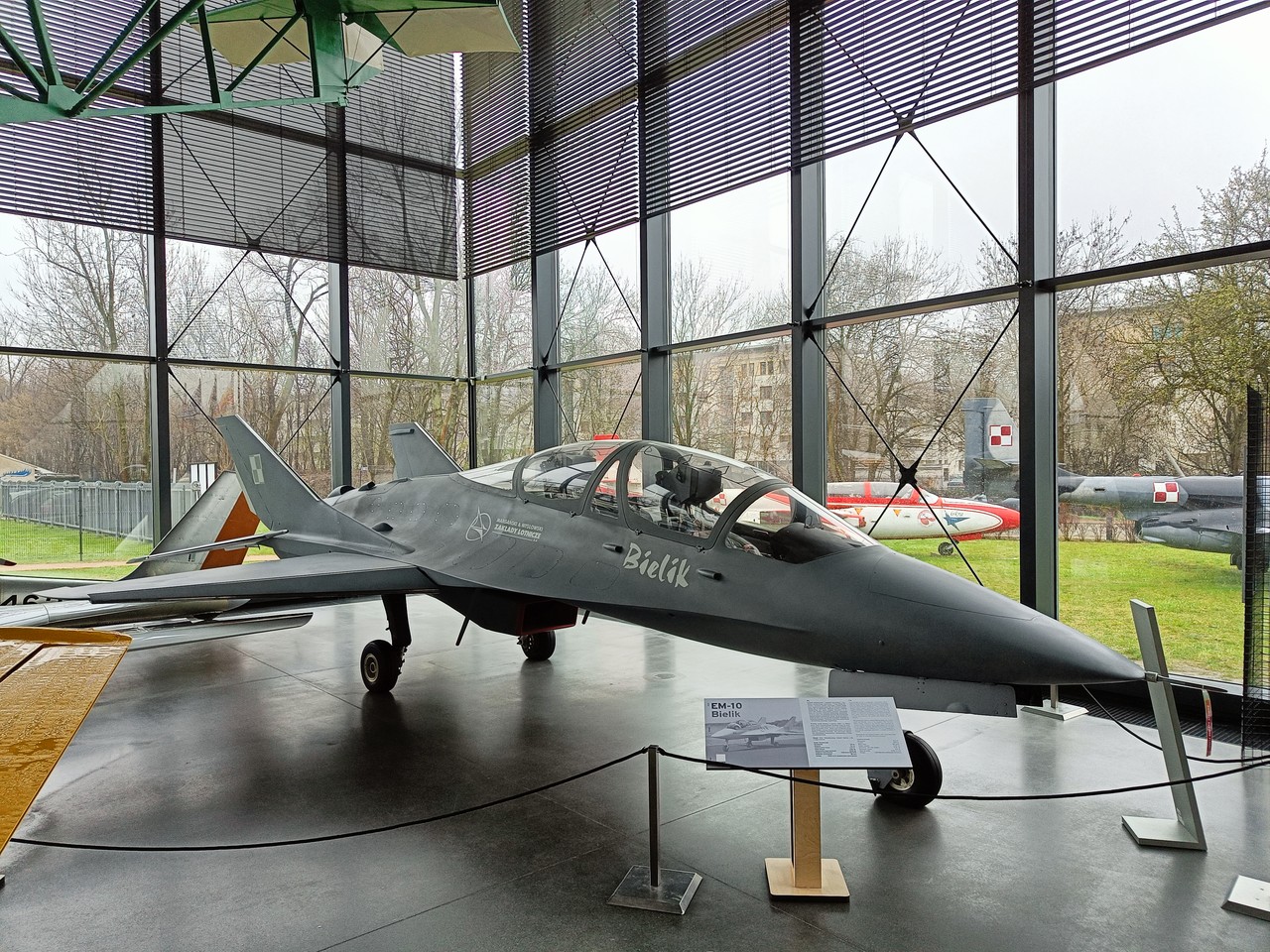
Development and Design Philosophy
The EM-10 Bielik emerged from the vision of Edward Margański in 1997, who sought to leverage his company's expertise in composite glider construction to create Poland's entry into the military trainer market. Margański built upon research conducted by PZL Mielec on the supersonic M-16 project, spending two years developing the concept before presenting a full-scale mockup to Poland's Aviation Council in May 1999. Originally designated "Iskra II" after Poland's existing TS-11 trainer, the name evolved to "Bielik" - meaning white-tailed eagle - during the development process.
The aircraft incorporated several innovative features for its era, including a composite fuselage constructed primarily of carbon fiber with a light-alloy aft section. The pressurized cockpit accommodated two crew members in ejection seats, reflecting its intended role as both a basic and advanced military trainer. The design objectives encompassed aerobatics, navigation training, and low-altitude flight operations, with plans for a military version equipped with virtual combat simulation systems and a civilian variant optimized for aerobatic competition.
The Manufacturer's Ambitious Leap
Margański & Mysłowski Zakłady Lotnicze represented an unlikely candidate for jet aircraft development, having built its reputation manufacturing single-seat gliders and ultralight aircraft. Edward Margański, the company's founder and chief designer, had previously created the amateur-built DK-3 "Kasia," the tourist aircraft EM-11 Orka, and world-leading aerobatic gliders including the MDM-1 Fox and Swift S-1. The EM-10 project marked a dramatic departure from the company's traditional focus, demonstrating the ambitious spirit of Polish aviation entrepreneurs following the nation's transition from communist rule.
The company remains operational today, having returned to its core competencies in glider and light aircraft production after the EM-10's commercial failure. This pattern reflected the broader challenges facing small aviation companies attempting to break into the military aircraft market without substantial government backing or international partnerships.
Technical Specifications and Performance
Powered by a General Electric CJ610-6 turbojet - a 1960s-era design producing 3,000 pounds of thrust - the EM-10 achieved impressive performance figures on paper. The aircraft demonstrated a maximum speed of 1,100 km/h (Mach 0.9) with a service ceiling of 12,000 meters and an exceptional rate of climb of 45 meters per second. With auxiliary fuel tanks, the ferry range extended to 2,500 kilometers, providing the endurance necessary for international ferry flights and extended training missions.
The relatively high wing loading of 210.1 kg/m² indicated a design optimized for speed rather than low-speed handling, though the stall speed of 165 km/h remained manageable for training operations. Production aircraft were planned to incorporate engines producing between 12.75 and 17.65 kN of thrust, potentially improving performance beyond the prototype's capabilities. The fuel capacity of 850 kilograms provided substantial endurance for training missions while maintaining the aircraft's 2,500-kilogram maximum takeoff weight.
Brief Flight History and Commercial Failure
Test pilot Wiesław Cena lifted the EM-10 prototype into the air for its maiden flight on June 4, 2003, marking a significant milestone for Polish private aviation. However, the aircraft completed only two flights before development work ceased, highlighting the substantial challenges facing the project. Between 2003 and 2005, Margański attempted to attract investors and potential military customers, showcasing the aircraft's capabilities to various international delegations.
Despite representing a potentially cost-effective alternative to expensive Western trainers, the EM-10 failed to secure any production contracts. The project officially ended in 2006 when funding dried up and no military customers committed to purchases. This outcome reflected the broader difficulties facing new entrants in the military aviation market, where established manufacturers with proven track records typically dominated procurement decisions.
Legacy and Preservation
The sole EM-10 prototype has found new life as a symbol of Polish aviation ambition and innovation. Initially displayed at the Polish Aviation Museum in Kraków starting in 2002, the aircraft later underwent extensive restoration by aviation enthusiasts at Nowy Targ Airport. On August 19, 2022, the fully restored Bielik was officially unveiled as a monument at Nowy Targ Airport, where it serves as an inspiration to future generations of Polish aviation engineers.
The aircraft represents a significant chapter in post-Cold War Polish aviation development, demonstrating the nation's technical capabilities while illustrating the commercial realities of military aircraft development. Although the EM-10 never achieved its intended role as a successor to the TS-11 Iskra, it stands as testament to the innovative spirit that drove Polish aviation entrepreneurs to attempt ambitious projects in the rapidly changing European defense market of the early 2000s.